For any use of my photos, please contact me at monika.wieland (at) gmail (dot) com
Showing posts with label l12. Show all posts

Sunday, November 4, 2012

Day of the Dead ~ 3rd Annual Tribute

This is my third year writing a Day of the Dead blog post to honor the Southern Resident Killer Whales that we've lost during the preceding year. Unfortunately in the last 12 months, we've lost an astounding seven whales.

J48 was the fifth offspring born to J16 Slick. The calf was first seen in December 2011 and was missing the next month. I didn't get to meet this little whale, who in addition to mom left behind three surviving siblings: J26 Mike, J36 Alki, and J42 Echo.

L112 Sooke, born 2009, seen here with L47 Marina, L86 Surprise, and L91Muncher
The death of L112 Sooke remains particularly sad and mysterious. I documented her story in detail in a separate blog post. She washed up on a beach in Long Beach, Washington in February 2012 with blunt force trauma. The exact cause of her death has not been determined, but a necropsy showed that her wounds were not consistent with a ship strike or predation event. Following her death, activities of both the US and Canadian Navy received a lot of scrutiny, from underwater sonar testing to the bomb range that exists off the Washington coast. Hopefully, the result of all this is that additional precautions be put in place to protect this endangered population of whales from underwater noise and explosions that could lead to permanent injury and death. In the near future her skeleton will be on display at The Whale Museum in Friday Harbor. It is always sad to lose a whale, particularly a young whale, but even more so a young female. L-Pod does not have many juvenile females, without which this population has no chance of recovery. Sooke was one of the few.

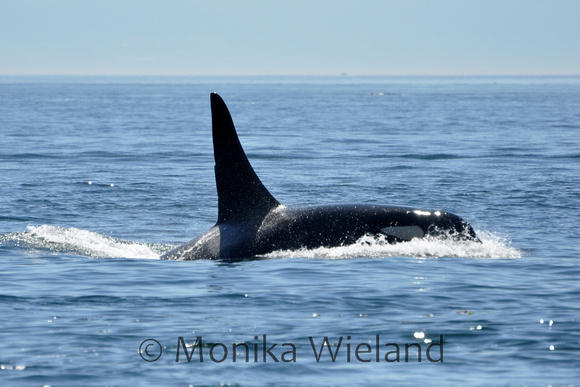
J30 Riptide, born 1995, seen here with L53 Lulu and J1 Ruffles
I was shocked when I heard that J30 Riptide had not been seen this spring. J-Pod has always seemed like the most resilient of the three pods, but Riptide is the second young adult male in the pod to die prematurely in recent years (the other was J33 Keet in 2010). Riptide was the second known offspring of J14 Samish and despite being just 16 years old already had a huge dorsal fin that was nearly fully grown. One of the very first pictures I took of Riptide shows him with J1 Ruffles, and the two proved to be regular companions over the years until the death of Ruffles. That's why I chose to honor him with the above picture, showing the two males together in Boundary Pass several years ago. I imagine Riptide must have been learning a lot from the oldest male among the Southern Residents, and it's a shame he won't be able to put the knowledge to use as a breeding adult male. Riptide is the probable great grandson of J2 Granny and also leaves behind three younger siblings.

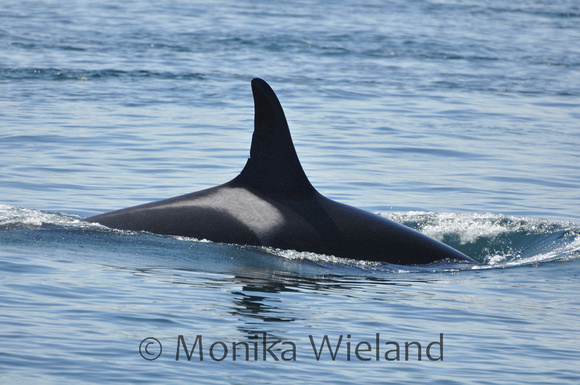
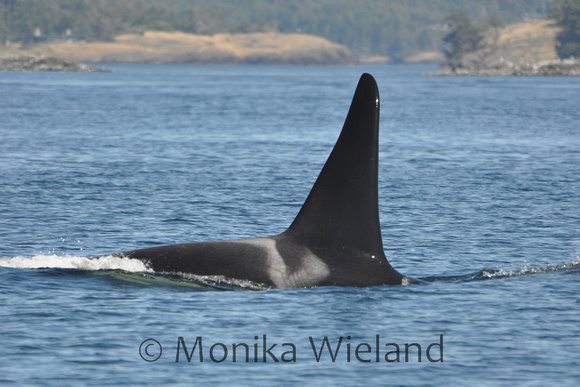
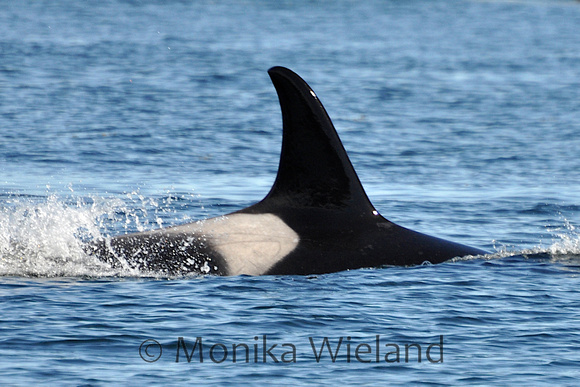
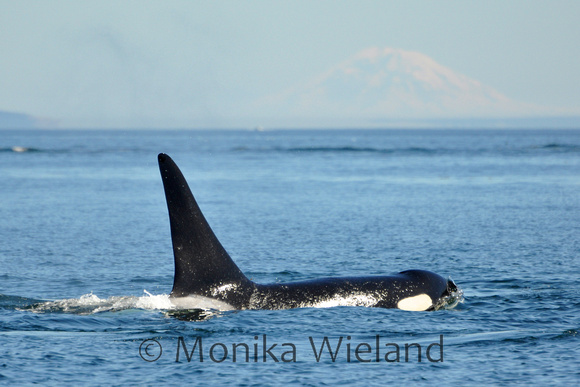
L12 Alexis, estimated birth year 1933
At an estimated age of 79, Alexis lived the long, fruitful life of a matriarch resident whale. She's the namesake for the L12 subgroup, a well-known portion of L-Pod that tends to spend a lot more time in inland waters than the rest of the Ls. Her strong ties throughout her life with the L28 and L32 matrilines seems to be a key reason these three families travel together so much of the time. She was often associated with both of these mothers as well as with their offspring, and late in her life seemed to have become the adopted mom of L85 Mystery, the son of L28 Misky. The probable grandmother of the iconic male L41 Mega, Alexis, like Mega, also had two notches on her dorsal fin that made her distinct. Earlier this year I wrote a creative piece imagining a day in the life of Alexis where she was surrounded by her extended family. A mainstay throughout my whale watching years and well before that, I had no idea I would never see her again.

L5 Tanya, estimated birth year 1964, seen here with her son L73 Flash diving beside her
Unlike Alexis, L5 Tanya was part of a group of L-Pod whales that does not spend a lot of time in inland waters. As such, I never got to see too much of her, and was always excited when I did as she remained a more unknown whale to me. She only had two known offspring, both sons, and both very distinct males. L58 Sparky was one of the first few whales I learned to identify around the year 2000. He was easy to pick out because this was a time when there were only 3 or 4 fully adult males in the whole population. Her other son, L73 Flash, was a bit of a Ruffles lookalike. Unfortunately both sons preceded Tanya in death. Tanya had a bit of a unique dorsal fin, at least to my now more highly trained eye. The middle of the back trailing edge seemed to bulge out, easily seen in the above photograph where she is silhouetted. She also had a distinct line across one of her saddle patches, and a testament to how rarely I saw her is the fact that I never got a great picture showing this unique marking very well. With her passing, Tanya leaves behind young male L84 Nyssa, her sister's grandson, as the only surviving member of the L9 matriline.

K40 Raggedy, estimated birth year 1963
Raggedy! I still can't believe you are really gone. Talk about a whale with a unique history, of which we only know a very small piece. One of the unknown parts is how she got all those notches that made up the tattered trailing edge of her dorsal fin. I first learned about Raggedy's interesting family when I wondered how she was already numbered the 40th whale in K-Pod when at the time there was no K39, K38, K37, and so on. It turns out this is because she, along with the rest of her family group, were originally designated as L-Pod whales. Before 1977 they were always seen with L-Pod. Then, between 1977 and 1981 they started being seen with Ks, and after 1981 were almost always seen with Ks. Michael Bigg suspected they might be Ks due to their acoustic call types, and in 1986, coinciding with the birth of K21 Cappuccino into this family group, the switch from L to K was officially announced, the only time any whales have had their pod designation changed.

Raggedy's family was our first clue that matrilines are probably more stable than pods, as we've seen other whales and groups of whales seemingly shift pod associations for both short and long lengths of time. While there is a genealogy written out for this group of whales (the K18 and K30 matrilines), it seems the mother-offspring relationships have never really been clear as the family associations were reorganized several times. What is known is that Raggedy was never seen with a calf, leading to speculation that she was probably infertile. 

One of my first-ever whale encounters was with Raggedy and her suspected mom, K18 Kiska, and probable brother K21 Cappuccino. I was aboard the Bon Accord in Haro Strait. The boat was parked as we watched a social multi-pod gathering milling about when we were surprised by three whales that popped up closer to us than all the rest: Kiska, Raggedy, and Cappuccino. This was the first time I had ever been this close to a wild whale, and the video camera I had rolling at the time recorded my frantic, excited comments as Raggedy surfaced right beneath me. "I got wet from the spray!" I called out in a shaky voice. "Oh my God!" There was no going back for me from that moment.

Raggedy leaves behind her stalwart companion Cappuccino. In recent years these two whales have often traveled between pods with K16 Opus and K35 Sonata, continuing the rogue ways of the family group. Early sightings indicate Cappuccino, Opus, and Sonata will carry on the unpredictable tradition in Raggedy's absence.

L78 Gaia, born 1989
L78 Gaia is another whale from a very independent family group: the L2 matriline. At just 23 years old, it also feels like we lost Gaia way too early, but unfortunately he follows a trend of other L-Pod whales that we have recently lost in their 20s. Since 2008, the family group has just been made up of L78 Gaia, mom L2 Grace, and Gaia's younger brother L88 Wavewalker. The three whales were sometimes seen with no other Southern Residents. On one memorable day they were spotted near Lopez Island and initially identified as transients since there were only three of them, though this is a bit hard to believe since all three have distinct open saddle patches that transients never sport.

Gaia was the uncle of L98 Luna, the young whale who somehow got separated from his mom and spent years alone in Nootka Sound off the west side of Vancouver Island. In 2009 Gaia showed up with a wicked scrape on his dorsal fin, a wound so gruesome observers worried it could become infected. He seemed to heal up from this just fine, and it wasn't too long before he had just a faint scar on the front of his dorsal fin. I always thought of Gaia as having a very broad dorsal fin, one that will truly be missed by me among the other L-Pod whales.

So those are the whales we have lost this year - unnamed J48, Sooke, Riptide, Alexis, Tanya, Raggedy, and Gaia. We have had just two new arrivals in that time. L119, a girl, was born to L77 Matia, a calf I was very happy to hear about. Both Matia and her sister L94 Calypso had calves in 2010, but Matia lost hers, and I could only imagine what it was like for her as a bereaved mom to watch her younger sister with a healthy baby. It must have been very bittersweet. Now she has another little youngster of her own, which amazingly I never got to meet this summer. Perhaps an indicator of the shifting patterns as a result of Alexis' death (Matia and Calypso, along with Mega, are also her probable grandchildren), the L12s did not spend nearly as much time doing their regular westside shuffle off of San Juan Island this summer. I saw very little of this family group this year and look forward to seeing both sisters with their healthy calves next year.

The other birth was J49, a boy, born to J37 Hy'shqa. In a rare case of a Southern Resident being born in inland waters, we actually know the birthday of J49 is August 6th, and he was born somewhere around Turn Point on Stuart Island. With his birth, Hy'shqa became the youngest mother on record at just over 11 years old. I was worried about these two whales, since the other young mom I witness (K28 Raven was just 12 when she gave birth to K39 in 2006 ) both perished shortly thereafter. But so far, both mom and calf seem to be doing just fine, and Hy'shqa has lots of help from her extended family. J49 is the first grandchild to productive mother J14 Samish and is also the first great-great grandchild to J2 Granny.
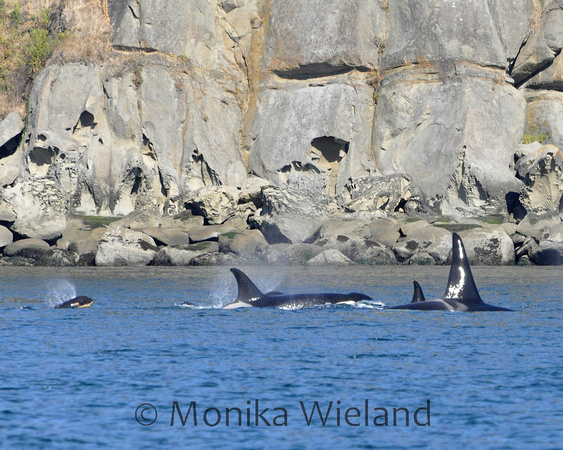
J49, left, seen here at about six weeks old following behind grandmother J14 Samish and uncle J26 Mike

This years births and deaths leave us at 84 whales in the Southern Resident Community. To the ones you have lost, you will be dearly missed, and to those that have arrived, we welcome you and hope you live to see the recovery of this endangered population.

Saturday, July 23, 2011

That Was Awesome

Today was one of those days - the kind of day that made me want to live on San Juan Island in the first place. The title of this blog post is rather unoriginal, but it's probably the phrase I most uttered today, so I thought it was appropriate.

We went out to the westside around noon today with word that some whales were heading down from the north. Just as soon as the boats and some distant blows were coming into view to the north of Lime Kiln Lighthouse, we heard some people screaming to the south of us. I turned around and saw a big disturbance in the water just offshore of the rock to the south of me. A few seconds later, just long enough for me to grab my camera but not to adjust any of the settings, this big male orca surfaced just north of me, cruising north towards the other whales heading our direction. Surprise!
L85 Mystery heads north to meet up with J and K Pod whales
It was L85 Mystery, and right behind him were the rest of the L12 sub-group. This family group of whales likes to spend a lot of time off the southwest end of San Juan Island, going up and down, up and down, but rarely really committing to going north. They're well known among shore-based whale watchers as the group that just comes into view at Lime Kiln before nearly always turning south again. This afternoon, however, they were interested in going just a little bit further north to meet up with some of their J and K Pod friends. Best of all, as they sped north, they did so very close to shore.

L12 Alexis - the best photo I've ever gotten of this female estimated to be 78 years old. Prints of this photo available here
L41 Mega - prints of this photo available here

The whales all met up just north of the lighthouse, and spent a bit of time milling around before slowly making their way back south. While we were waiting for them to come back, we noticed a very unafraid little bird making its way through all the whale watchers on the rock. It was an immature brown-headed cowbird, and it was totally unfazed by all the human activity. It hopped right between my feet, and perched on my radio sitting with my stuff right next to me:


I've never seen anything quite like it! He even seemed to perk up and get interested as the whales started coming by, but then I must admit I lost track of him as my focus returned to the orcas.


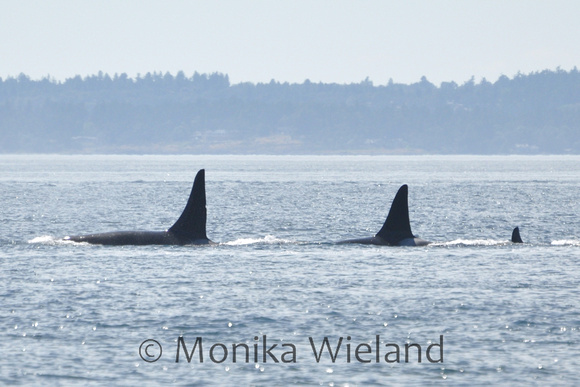
All the male orcas seemed to be grouped up, which was an impressive sight with all those tall dorsal fins. Here's L41 Mega and K25 Scoter, and at least J27 Blackberry and J34 Doublestuf were in there with them, so I suspect the other L12 subgroup males were as well.


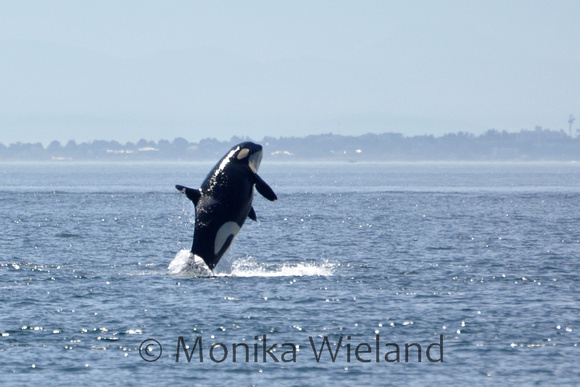
This large group of whales, including more than just the males, was a little ways offshore, but they were playful. They were just slowly making their way south, doing some tail-slapping, cartwheeling, upside-down swimming at the surface, logging on the surface, and they threw in a couple of breaches for good measure:

Prints of this photo available here

Then I noticed two whales that were much closer to shore, and heading right for us. Let me tell you, my favorite feeling in the world is sitting on a rock on the west side of San Juan Island and seeing this - a wild killer whale heading right for you:

Prints of this photo available here
It turned out to be J31 Tsuchi and L77 Matia, two female whales ages 16 and 24. I always think it's especially cool to see whales from different pods hanging out together. It's a glimpse into the social lives of these animals outside of their matrilines, with whom they travel with 24/7.

J31 Tsuchi - prints of this photo available here
A note on this next photo, to give you an idea of just how close these whales come to the shore - this image is not cropped, and my lens was only zoomed in to 180mm to take it:

L77 Matia - prints of this photo available here
So after the L12s had gone north, the L12s, K13s, and half of J-Pod (the J11s, J22s, and J17s) came back south. Where was the rest of J-Pod? They were coming down San Juan Channel past Friday Harbor, which gave us enough time to drive down to Cattle Point to see them down there. We got there a little ahead of the whales, and while waiting for them we saw lots of other wildlife, including a single male Steller sea lion over on Whale Rocks.

I was also watching a single rhinoceros auklet diving on a school of small fish. Every time it dove, bait fish would start jumping at the surface, and a single glaucous-winged gull was sitting on the water nearby and taking advantage of this feeding opportunity. As we watched, more gulls came in, and then more auklets, and then some pelagic cormorants, and some Heermann's gulls, and before we knew it a nice bait ball had formed.


Then the whales came into view passing Cape San Juan close to shore, heading south towards where we were on the rocks in Cattle Pass. I was excited they were on "our" side of the channel, but I know they usually veer out and go around Goose Island. In fact, I heard some people commenting on the radio that they had never seen them go inside of Goose Island. Well, if you keep watching these whales, every so often you are going to see them do something you've never seen them do before, and today was one of those days! They swam through the San Juan Island side of Goose Island!


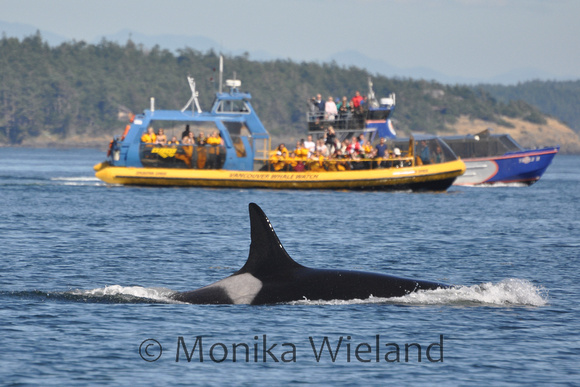
They continued swimming close to shore as they passed us at Cattle Point, and since they were active and surfacing a lot I was able to find each and every whale from the J2, J14, and J16 family groups in my photos. The lighting was also perfect, much better than the harsh lighting off the lighthouse earlier in the afternoon. Here's J2 Granny with a Vancouver Whale Watch boat in the background:

Prints of this photo available here

J26 Mike was looking good - I remember seeing him before he was even a sprouter male, and now he's so huge!

J26 Mike - prints of this photo available here
He must have been feeling good, too - look at that tail slap!

Tail slap by J26 Mike - prints of this photo available here
The whales don't travel through San Juan Channel very often, but when they do I've never seen them kelping at Cattle Pass. That's what some of them were doing today, though! Here's J16 Slick, Mike's mom, with kelp draped on her dorsal fin:

J16 Slick kelping - prints of this photo available here

Not to be outdone by her mother, J37 Hy'shqa surfaced with kelp, too - a lot more of it!

J37 Hy'shqa kelping - prints of this photo available here

Behind the J16s were the J14s. J14 Samish was surrounded by all of her offspring. Here's a close-up look at Samish, who was what looks like black scribbles going through her saddle patch. I always think of Samish as having the most perfectly shaped dorsal fin. She always stands out to me:

J14 Samish - prints of this photo available here
Samish's oldest son, J30 Riptide, is another big male in J-Pod. He surfaced here with Mt. Rainier visible in the distant background:

J30 Riptide with Mt. Rainier in the background - prints of this photo available here

If you want to take another look at all the above whale photos from today, you can look at the gallery here or see a slideshow of them here. I'm sure you can see how after this epic whale-of-a-day, the only words I could come up with to summarize it were: That was awesome.

Friday, September 11, 2009

Superpod in Swanson Channel

After some cooler weather and rain throughout the first week of September we've returned to what feels like summer with clear skies, calm seas, and temperatures in the 70s on the island today. It was a beautiful day to get out on the water, and on the Western Prince we had a great encounter with all three pods up in Swanson Channel in the Canadian Gulf Islands.

The whales were in travel mode when we met up with them, and they were cruising north in several large, tight groups. I think we had nearly all the Southern Residents there (minus the L2s and L5s who were seen down south) so we potentially had as many as 75 whales there! Swanson Channel is a scenic place to watch whales with the cliffs of the Pender Islands in the background, and today the blue waters made for gorgeous photographic opportunities:

With all the confusion lately on who's been traveling with whom, I was extra careful with the IDs I made today, but with views like this one I was certain this time we had J1 Ruffles and J2 Granny there, the oldest male and oldest female. They are pictured here in the center of the photograph surrounded by the other whales they were traveling with. Notice the head of the whale in the foreground that hasn't yet broken the surface:

I wasn't sure who all they were traveling with until I got home, but it looks like they were with L7 Canuck and L53 Lulu (the honorary J-Pod members), the whole J14 family group, and the K12 family group. It's not often you can get a single picture with whales from all three pods...in fact I think today is the first time I've ever gotten a shot like that! From left to right we have L53 Lulu, L7 Canuck, J1 Ruffles, and K12 Sequim:

I love seeing the whales swim in such tight groups, when they are so close they may be touching one another. They were all surfacing in synchrony, so their striking black dorsal fins are partially obscured by the spray from their blows. It was a beautiful sight!


We didn't get any close looks at any of this year's calves, but they were in there! This shot was from far away, but clearly shows how a youngster briefly peaks over the surface right next to mom:


Finally, there had been some confusion about whether or not the L12s (a subgroup of L-Pod that often travels separately) were present, as they were originally the whales reported down south. I thought I saw them today, and this photo confirms it, showing L12 Alexis herself. She has two notches, one in the middle and one at the bottom of the trailing edge of her dorsal fin, which separates her from any other whale in J-, K-, or L-Pods. Click on the photo to see a larger version and see if you can spot her notches:

Saturday, August 1, 2009

Superpod Split - L-Pod in San Juan Channel!

What an interesting day! Last night a superpod (all members of all three pods) headed north towards the Fraser River, and this morning they were found coming back south down Boundary Pass, a pretty typical route for them. But then a very strange thing happened - most of L-Pod broke off from everybody else and came down some of the inland channels, first through President's Channel and then south through San Juan Channel. It is only about once or twice a season we get resident whales traveling through San Juan Channel, and today was one of those days!

Here's a map to show you what the whales did today. J-Pod, K-Pod, and two small L-Pod family groups took the "normal" route south to the west side of San Juan Island. The rest of L-Pod took the bizarre route:

I was out on the Western Explorer this afternoon and literally all we had to do was pull out of the marina and we could see whales in front of us. The whales were in two groups, and we met up with the lead group, which seemed to be all of the L12 subpod, a group of ten whales, including L12 Alexis and male L85 Mystery:


While it was sunny and clear in Friday Harbor, as we headed south through San Juan Channel we encountered first low-lying clouds and then fog. Check out this Washington State Ferry emerging of the mist with a hazy Mt. Baker in the background:


We continued following the L12s into the fog, and L41 Mega was, as expected, with his sisters and older female L25 Ocean Sun. Here is Mega and one of his sisters, L77 Matia:


After a time we broke off to check out some other wildlife, including harbor seals, a couple of sea bird nesting colonies, a bald eagle nest, and three bald eagles. Then on our way back to Friday Harbor we encountered L-Pod again down at Griffin Bay, and by this time the fog had mostly burned off. After the L12s went by we were able to confirm that most of the rest of L-Pod was present. "The big part of L-Pod", as I call them, spends a lot of time out in the open ocean so we don't see them as much as the other Southern Residents. For this reason, it's always fun to see them.

The L5 and L54 matrilines were there, and several of their members are pictured in the photo below. From left to right we have L100 Indigo (an 8 year-old male), L5 Tanya (a 45 year-old female), an unidentified whale, and L73 Flash (a 23 year-old male). Flash has a wavy dorsal fin and is often confused for J1 Ruffles, but if you look closely he has a notch near the base of his fin that is the sure-fire way to tell them apart:


There are so many big male dorsal fins in L-Pod, which is great to see! I remember not too long ago when we had only 3 breeding age males in the entire population, and its neat to have watched so many young males grow up. Here is L92 Crewser (15 year-old male) surfacing with L84 Nyssa (19 year-old male). You can see that males' dorsal fins don't grow at the same rate, as Crewser is younger but seems to have a taller fin. It's not often you get to make a direct comparison like this!


It wasn't all males, though. We had a small group fo whales come porposing by, including youngster L105 Fluke. It seems like every time I see Fluke he's flying out of the water in some fashion or another. Check out this sequence of him surfacing:


After getting back to port I headed out to the west side of San Juan Island to check on the progress of the southbound J and K Pods. Off Land Bank I got a nice pass by the "real" J1 Ruffles - no notch on this one! He was the closest whale there was to shore - the others were spread out up to several miles offshore.


I heard that L-Pod came out of Cattle Pass and porpoised north to meet up with Js, Ks, and the rest of Ls. The three pods were only separated for a couple of hours but I guess they couldn't wait to meet up again! We've had a superpod going on for days now, and it seems like there are whales everywhere. I know, I know....it's a rough life.

Did you join us on this or another trip with Western Prince? We always appreciate your reviews on Trip Advisor.

Tuesday, July 28, 2009

Magnificent Minkes and Outstanding Orcas

A real summer heat wave has hit us here in the islands. While we've "only" reached temperatures in the 90s compared to the mainland that is topping out at over 105 degrees, its certainly hot enough that it was a real pleasure to get out on the water and cool down! I never thought I would wear just a T-shirt and not the anti-exposure suit on one of our zodiac trips, but today was one of those days.

This morning on the Western Explorer trip we saw no fewer than three different cetacean species: harbor porpoise, minke whales, and orcas. For whatever reason there seems to be more minkes around this season, and Captain Ivan has a spot marked on his GPS where he's been reliably seeing them just about every day a little ways south of Salmon Bank. Today we saw three minkes out there, and got good looks at two of them. Here's the first one:


Minkes are among the smallest baleen whales at about 30 feet long. They are common worldwide but are often overlooked by whale watchers in favor of larger, more charismatic species. It does take patience to watch them - they are affectionately known as slinky minkes by the locals since they are hard to track and can go down for long dives - but they are really cool animals if you take the time to observe them. The second minke we saw was a bit smaller, probably no more than about 18 feet long indicating it was probably a young animal:


After surfacing a little ways off our starboard side it showed definite curiosity about us, as it swam along the length of the boat before surfacing right off the bow. Its not often you get to see the entire body of a whale and observe it as it swims. This little whale showed us how beautiful minkes are, with some swirled white marks on their sides and white chevrons on their pectoral fins. I just held up my camera and clicked with no idea what I would get, but in the shot below you can see one of our young passengers looking at the minke underwater. The head of the whale is to the left, and the brightest white marking you see is the chevron on the pec fin:


As we left the minkes the orcas weren't far away. All three pods were in the area this afternoon and we met up with a very spread out L-Pod. The whales were foraging in ones and twos and we got the chance to check out several different groups. The L12 subgroup spends a decent amount of time around the San Juan Islands in the summer, but the "big part" of L-Pod doesn't come in nearly as often so its always exciting to see them since we don't see the whales nearly as often.

L92 Crewser, a 14 year-old male, with his mother L26 Baba


L12 Alexis


L72 Racer, who had five year-old calf L105 Fluke close in tow

Just as I was getting home at the end of the day, I noticed a pair of hairy woodpeckers flying around the buildings above the marina. I only see this species a couple times a year around here, and had never seen one this close to home, so it was a cool sighting! They were down in the shade and a little ways off so it the photos didn't turn out great, but here's proof anyway that they were here: