For any use of my photos, please contact me at monika.wieland (at) gmail (dot) com
Showing posts with label bait ball. Show all posts

Sunday, August 17, 2014

August 13th ~ A Magical Evening at Lime Kiln

After a very sunny, dry summer we finally got a couple days of much-needed rain. The temperatures were still warm, but with it being so gray out, it was easy to hole up, and I was already in my pajamas at home after work when I heard that whales were heading towards the west side. I debated staying comfy, but only for a moment - soon I was out the door with camera bag in hand. Good decision!

It was one of those nights where most of the people on the rocks are your friends. That's one of the things I love about Lime Kiln - moments like that. The lighting was ethereal as the fog banks came and went. It had the essence of winter about it - except it was warm, and still light after 6 PM!

The mood - foggy some directions....

....clear in others
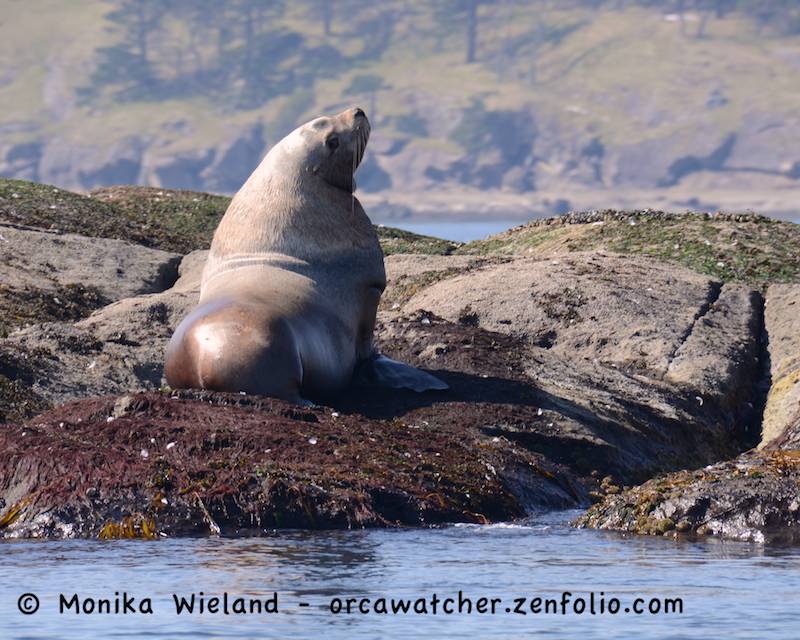
We couldn't see that far too the north, so weren't sure how close the whales were. We did have a bit of a wait, but there was plenty of stuff to look at, including a Steller sea lion and a couple of bait balls:

See the two with mouths full of fish?

Who says glaucous-winged gulls aren't diving birds?

Finally it cleared enough that we could see a line of whales coming - but then the fog came back in as they passed us. It was pretty neat, though hard to focus the camera!


There was a gap between this first group of whales and the next one, and during this time a minke whale went by way off shore!


There was also a great blue heron drifting towards us on some kelp. First it caught a gunnel:

That's a fish hanging out of the heron's beak

Then the heron took flight, and landed on another raft of kelp right in front of us! With the lighting, it was perfect:


Next up were J42 Echo, who paused to presumably pursue a fish:

J42 Echo

And not far away was big brother J26 Mike, with an amazing blue-gray backdrop:

J26 Mike
Pretty much the only people at the lighthouse other than whale-watching friends of mine were this couple getting married! Perhaps not the weather they were hoping for, but still not bad timing!

Exchanging vows, then watching whales - all from the top of the lighthouse!
Then the fog REALLY moved in. As J2 Granny came by, we could hear her before we could see her, and then glimpse her only barely. The next couple of whales we couldn't see at all!

Shore-based whale-watching in the fog
Boat-based whale-watching in the fog
Finally, just as I was going up the hill to leave, the fog lifted again just enough to see L87 Onyx rocketing by the lighthouse, a bit behind the others.


Just another one-of-a-kind night at Lime Kiln! :)

Saturday, March 30, 2013

Spring at East Point

As the month has gone on, the long awaited spring migrants have started to arrive and as the weather has improved I've been out more and adding to the year list. On the 9th I saw some greater yellowlegs (120) at Jackson's Beach. On the 15th I added black-bellied plover (121) and purple finch (122) at Fourth of July Beach along with dunlin and sanderling. Two days later I saw my first turkey vulture (123) of the year at Mt. Young. False Bay Creek turned up a nice mixed flock of violet-green (124) and tree swallows, along with a savannah sparrow, Wilson's snipe, and several singing marsh wrens.

Yesterday at lunch I saw an album posted by my friend Traci (of Traci Walter Photography) of an amazing boat trip she took up near East Point on Saturna Island in the Canadian Gulf Islands. She saw thousands of gulls and sea birds. I sent a message to my friend Phil, another bird-watcher who like me doesn't work on a whale-watching boat and doesn't get the chance to visit some of these places all that often. He got his own boat a little over a year ago and we had talked about the potential of splitting costs to go check out some of these great sightings when they pop up. "When we going, Phil?" I asked. He responded two minutes later - "How about right now?" With the afternoon off of work that sounded perfect to me. Half an hour later we were on our way up San Juan Channel, navigating through some of the unseasonable spring fog that still remained and hoping for clear weather at East Point.

Luckily, despite even denser fog in President's Channel where we were still able to spot a few harbor porpoise, the fog did clear as we headed into the glassy calm waters of Boundary Pass. We had to get into Canadian waters before we could see the gulls, but soon they were evidence both on the water and in flight - thousands and thousands of Bonaparte's (125) and mew gulls:


Most of the birds seemed to be northeast of the point, so before we headed up there we cruised by the Boiling Reef rocks to see the harbor seals and Steller sea lions hauled out there.


It was pretty awesome to see (and hear and smell) so many sea lions:


Right before we were ready to move on I spotted a small flock of birds along the shoreline right among the sea lions. They turned out to be half a dozen surfbirds (126). Check out this shot of them just to the left of this huge sea lion!


Lucky for us, by this time the birds had moved a bit closer. I've been lucky enough one other time to see such huge congregations of birds at East Point, but at that time the thousands of Bonaparte's gulls were actively feeding and flying all over the place. Most of them were sitting on the water today, meaning every direction you looked it looked kind of like this:


It was interesting to me that the Bonaparte's and mew gulls seemed to segregate into different flocks that didn't intermix much. We'd find ourselves among one species, then the other, then the first again. Most of the Bonaparte's gulls were in transitional plumage, with some still in winter and some in full, black-hooded summer plumage. Still learning the new camera and getting the action settings right, I struggled a little bit with the in-flight shots, but got these couple of take-off shots I like:


At first it seemed like mostly just these two gull species, but if you looked closer there were other seabirds in there as well. We didn't see the thousands (!) of long-tailed ducks Traci reported, but we did see several hundred - far more than I've ever seen in one place. They seemed to be really skittish, though, and mostly we saw several dozen at a time flying in the distance. There were a few exceptions:


We came across one active bait ball that was made up mostly of glaucous-winged gulls. Unlike the long-tailed ducks, they didn't seem to mind our presence whatsoever. They had more important things to tend to. Notice the gull on the right in the first shot with some bait fish in its beak:


The bait ball was surrounded with rhinoceros auklets who we assumed were herding the fish underwater, but oddly enough we didn't see any rhinos with fish in their beaks. We ended up seeing hundreds of auklets, too, all decked out in their breeding plumage now too. Many of them were striking kind of an awkward posture with their head's raised high, maybe some kind of courting behavior?


In much smaller numbers we saw several other species, too: red-breasted mergansers, harlequin ducks, black oystercatchers, common murres, and one bald eagle.

On our way back to Friday Harbor, Phil had to make a stop at Yellow Island where he is the steward, and I was more than happy to take a quick walk around the island to check out the early spring wildflowers. Yellow Island is always several weeks ahead of San Juan Island in terms of blooms - fawn lilies were out in abundance, and I also saw some harsh paintbrush and shooting stars. Here's a pair of fawn lilies in the sunlight:


As an added bonus, I also saw my first of the year rufous hummingbird (127) while we were there!

It was a spur of the moment trip, but often those end up being the best kind. It was a beautiful afternoon on the water with some amazing wildlife. Just what I needed! Thanks Traci for the head's up, and thanks Phil for driving!

Saturday, July 23, 2011

That Was Awesome

Today was one of those days - the kind of day that made me want to live on San Juan Island in the first place. The title of this blog post is rather unoriginal, but it's probably the phrase I most uttered today, so I thought it was appropriate.

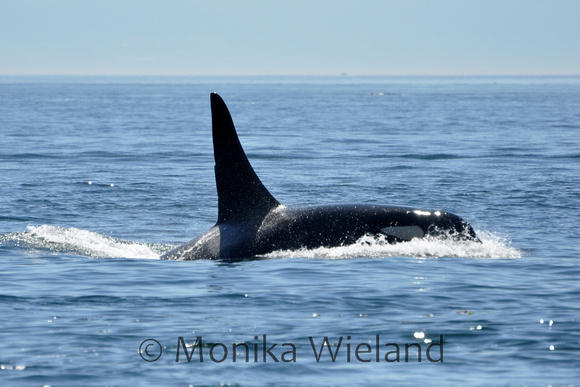
We went out to the westside around noon today with word that some whales were heading down from the north. Just as soon as the boats and some distant blows were coming into view to the north of Lime Kiln Lighthouse, we heard some people screaming to the south of us. I turned around and saw a big disturbance in the water just offshore of the rock to the south of me. A few seconds later, just long enough for me to grab my camera but not to adjust any of the settings, this big male orca surfaced just north of me, cruising north towards the other whales heading our direction. Surprise!
L85 Mystery heads north to meet up with J and K Pod whales
It was L85 Mystery, and right behind him were the rest of the L12 sub-group. This family group of whales likes to spend a lot of time off the southwest end of San Juan Island, going up and down, up and down, but rarely really committing to going north. They're well known among shore-based whale watchers as the group that just comes into view at Lime Kiln before nearly always turning south again. This afternoon, however, they were interested in going just a little bit further north to meet up with some of their J and K Pod friends. Best of all, as they sped north, they did so very close to shore.
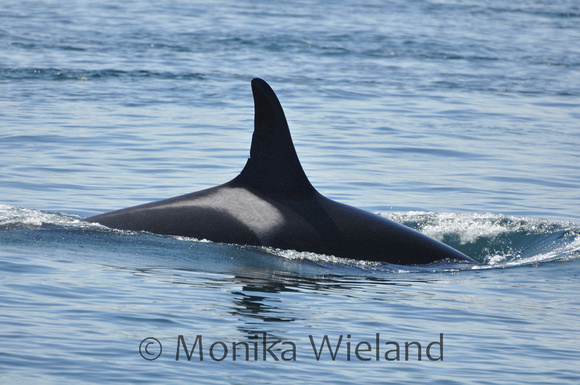
L12 Alexis - the best photo I've ever gotten of this female estimated to be 78 years old. Prints of this photo available here
L41 Mega - prints of this photo available here

The whales all met up just north of the lighthouse, and spent a bit of time milling around before slowly making their way back south. While we were waiting for them to come back, we noticed a very unafraid little bird making its way through all the whale watchers on the rock. It was an immature brown-headed cowbird, and it was totally unfazed by all the human activity. It hopped right between my feet, and perched on my radio sitting with my stuff right next to me:


I've never seen anything quite like it! He even seemed to perk up and get interested as the whales started coming by, but then I must admit I lost track of him as my focus returned to the orcas.


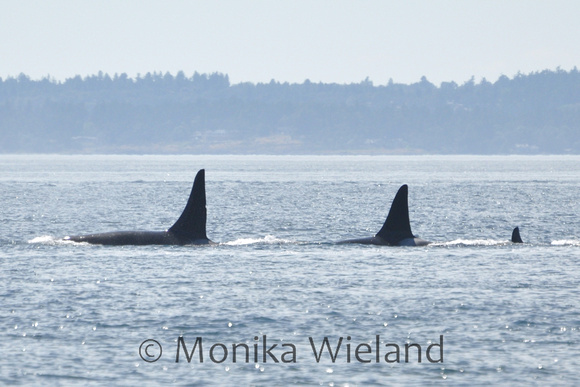
All the male orcas seemed to be grouped up, which was an impressive sight with all those tall dorsal fins. Here's L41 Mega and K25 Scoter, and at least J27 Blackberry and J34 Doublestuf were in there with them, so I suspect the other L12 subgroup males were as well.


This large group of whales, including more than just the males, was a little ways offshore, but they were playful. They were just slowly making their way south, doing some tail-slapping, cartwheeling, upside-down swimming at the surface, logging on the surface, and they threw in a couple of breaches for good measure:
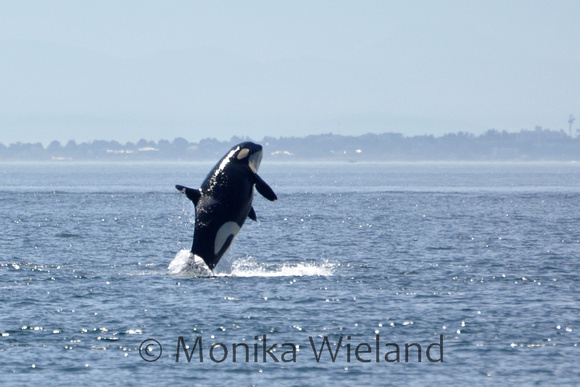
Prints of this photo available here

Then I noticed two whales that were much closer to shore, and heading right for us. Let me tell you, my favorite feeling in the world is sitting on a rock on the west side of San Juan Island and seeing this - a wild killer whale heading right for you:
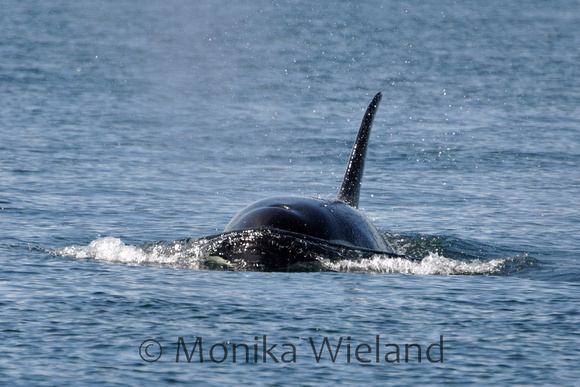
Prints of this photo available here
It turned out to be J31 Tsuchi and L77 Matia, two female whales ages 16 and 24. I always think it's especially cool to see whales from different pods hanging out together. It's a glimpse into the social lives of these animals outside of their matrilines, with whom they travel with 24/7.
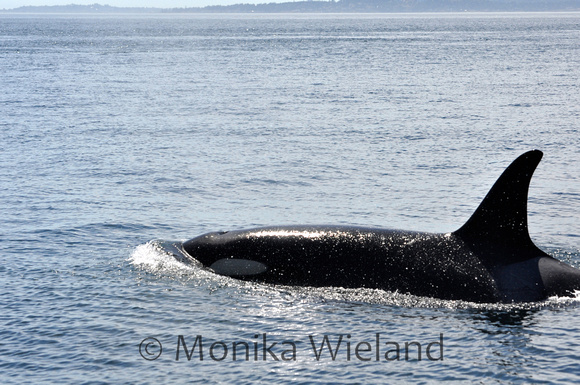
J31 Tsuchi - prints of this photo available here
A note on this next photo, to give you an idea of just how close these whales come to the shore - this image is not cropped, and my lens was only zoomed in to 180mm to take it:
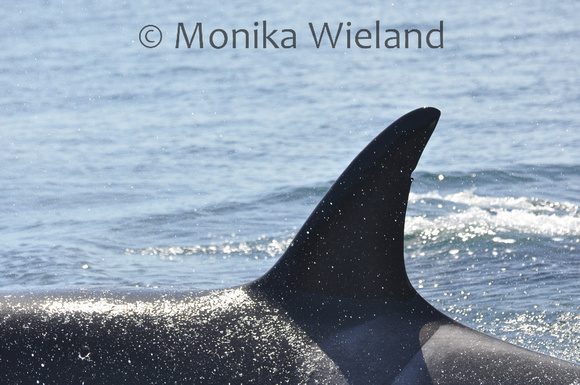
L77 Matia - prints of this photo available here
So after the L12s had gone north, the L12s, K13s, and half of J-Pod (the J11s, J22s, and J17s) came back south. Where was the rest of J-Pod? They were coming down San Juan Channel past Friday Harbor, which gave us enough time to drive down to Cattle Point to see them down there. We got there a little ahead of the whales, and while waiting for them we saw lots of other wildlife, including a single male Steller sea lion over on Whale Rocks.

I was also watching a single rhinoceros auklet diving on a school of small fish. Every time it dove, bait fish would start jumping at the surface, and a single glaucous-winged gull was sitting on the water nearby and taking advantage of this feeding opportunity. As we watched, more gulls came in, and then more auklets, and then some pelagic cormorants, and some Heermann's gulls, and before we knew it a nice bait ball had formed.


Then the whales came into view passing Cape San Juan close to shore, heading south towards where we were on the rocks in Cattle Pass. I was excited they were on "our" side of the channel, but I know they usually veer out and go around Goose Island. In fact, I heard some people commenting on the radio that they had never seen them go inside of Goose Island. Well, if you keep watching these whales, every so often you are going to see them do something you've never seen them do before, and today was one of those days! They swam through the San Juan Island side of Goose Island!


They continued swimming close to shore as they passed us at Cattle Point, and since they were active and surfacing a lot I was able to find each and every whale from the J2, J14, and J16 family groups in my photos. The lighting was also perfect, much better than the harsh lighting off the lighthouse earlier in the afternoon. Here's J2 Granny with a Vancouver Whale Watch boat in the background:
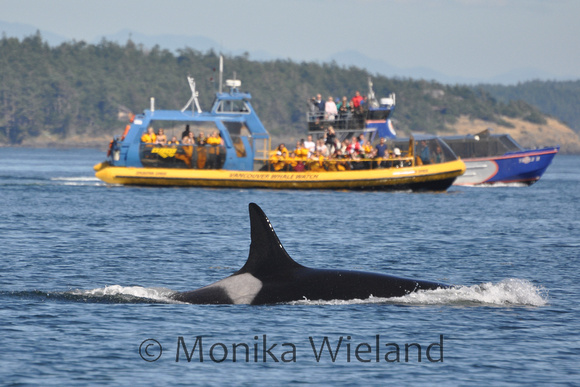
Prints of this photo available here

J26 Mike was looking good - I remember seeing him before he was even a sprouter male, and now he's so huge!
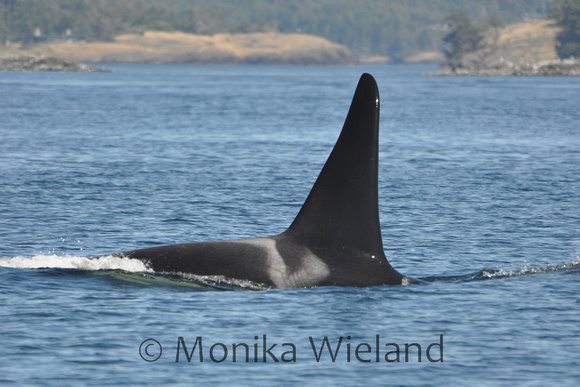
J26 Mike - prints of this photo available here
He must have been feeling good, too - look at that tail slap!
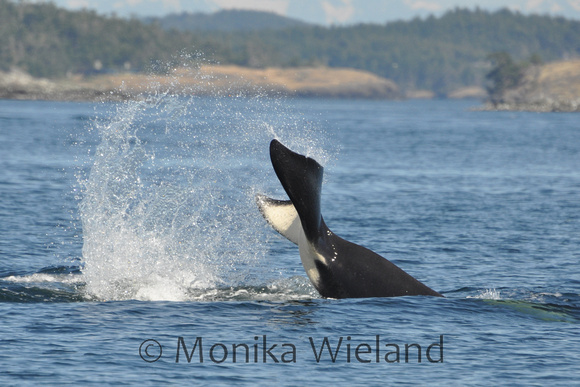
Tail slap by J26 Mike - prints of this photo available here
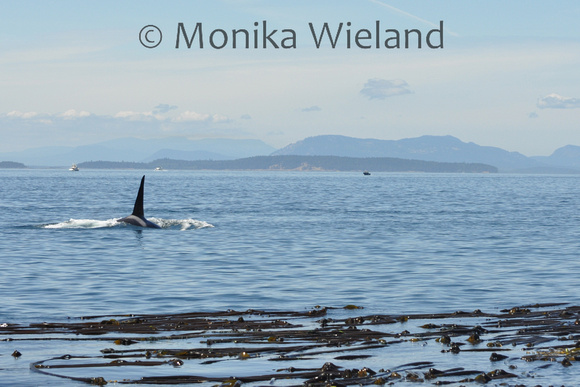
The whales don't travel through San Juan Channel very often, but when they do I've never seen them kelping at Cattle Pass. That's what some of them were doing today, though! Here's J16 Slick, Mike's mom, with kelp draped on her dorsal fin:
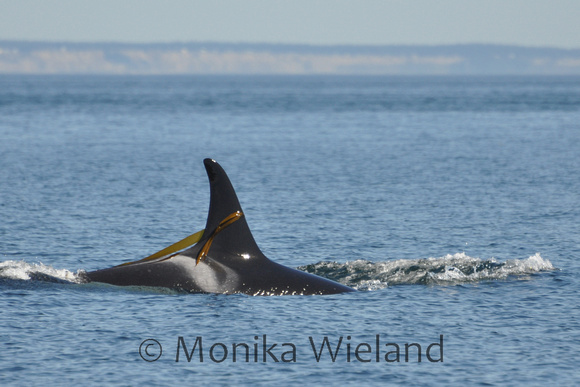
J16 Slick kelping - prints of this photo available here

Not to be outdone by her mother, J37 Hy'shqa surfaced with kelp, too - a lot more of it!
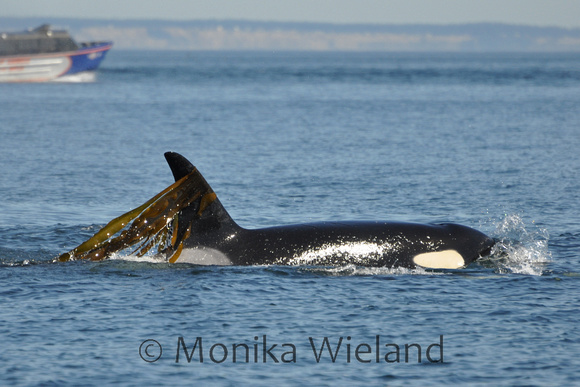
J37 Hy'shqa kelping - prints of this photo available here

Behind the J16s were the J14s. J14 Samish was surrounded by all of her offspring. Here's a close-up look at Samish, who was what looks like black scribbles going through her saddle patch. I always think of Samish as having the most perfectly shaped dorsal fin. She always stands out to me:
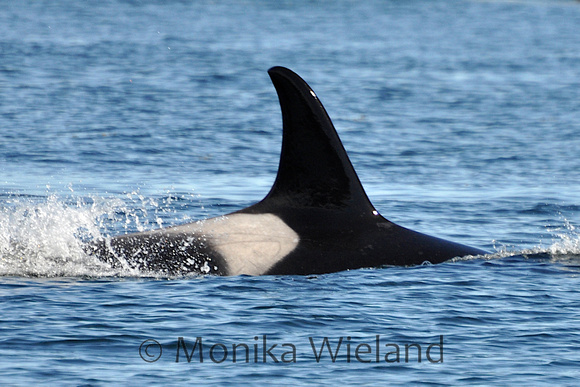
J14 Samish - prints of this photo available here
Samish's oldest son, J30 Riptide, is another big male in J-Pod. He surfaced here with Mt. Rainier visible in the distant background:
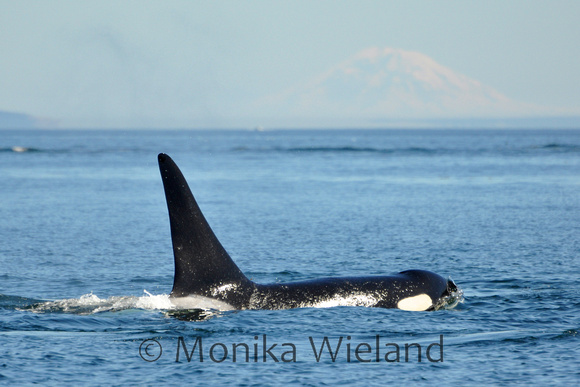
J30 Riptide with Mt. Rainier in the background - prints of this photo available here

If you want to take another look at all the above whale photos from today, you can look at the gallery here or see a slideshow of them here. I'm sure you can see how after this epic whale-of-a-day, the only words I could come up with to summarize it were: That was awesome.