For any use of my photos, please contact me at monika.wieland (at) gmail (dot) com
Showing posts with label l119. Show all posts

Saturday, July 23, 2016

July 20th and 21st: Summer Nights with the L12s and J-Pod

On July 14th, the L12 sub-group came in for the first time this summer, bringing with them the J11s who had been missing from the rest of J-Pod. In typical L12 fashion, they spent the next few days off the south end of San Juan Island, never making it up to Lime Kiln. On July 20th, I was more than ready to see them, so after work we went down to American Camp where I hoped to see them offshore. Sure enough, L22 Spirit and her son L89 Solstice were offshore of Eagle Point, apparently foraging and not really moving anywhere for the half hour we were watching them. While we watched the two of them, we could see the fleet of whale-watching boats moving north with the rest of the L12s. I figured they would probably turn around at False Bay as they had been doing, but given the really strong flood tide, when the boats disappeared from view, we decided to head north as well.

I was surprised when we got to Lime Kiln that the L12s were already there! They had finally decided to come up to the lighthouse, but were already past it. Luckily, this is why we have a boat! Team OBI hopped aboard Serenity and headed out to catch up with the L12s a few miles to the northwest of Lime Kiln.

By this point in time they had flipped back south again, but were fighting the strong flood tide and basically not going anywhere. The first whale we saw was L85 Mystery, who was swimming with L77 Matia. A few miles further offshore was L41 Mega.

L85 Mystery surfacing in synchrony with L41 Mega in the distance


About 10 years ago, the L12s were mainstays throughout much of the summer, so I spent a lot of time with them. That all changed a few years ago, and their visits are more infrequent these days. As such, it's been a while since I've gotten the chance to spend much time with them. It was nice to hang out with L85 Mystery, who I used to see all the time, but only got good looks at twice last year.


L85 Mystery with his distinct blunt, butter knife-like dorsal fin

L85 Mystery headed towards San Juan Island

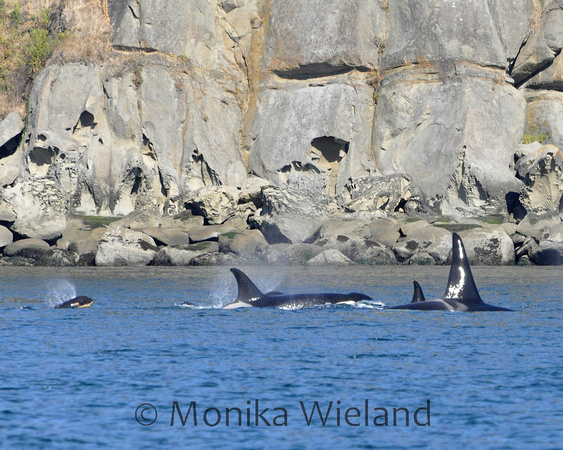
The whales all moved in towards shore before booking it back south, perhaps to catch a back eddy where the swimming against the tide would be easier? On their way towards shore, we got a nice look at L77 Matia and L119 Joy. About a week earlier, Joy was seen spyhopping with a neonate harbor porpoise in her mouth. The strange behavior of our fish-eating Southern Residents playing with and sometimes killing (but not eating) porpoises has been documented since studies on these whales began, but is little understood. It seems to come in fads, and porpoise playing is definitely "in" again this summer from the reports I've heard, though I haven't seen it yet myself this year!

L77 Matia and L119 Joy - probably one of my favorite shots so far this year

I figured that might be all I would see of the L12s for a while, but on July 21st J-Pod and the L12s spend the entire day on the west side of San Juan Island. I believe there were whales within sight of Lime Kiln from 6:30 AM to 3:30 PM, though unfortunately I missed all of it while at work. With J-Pod north of San Juan Island heading north and the L12s back in their spot off the south end of the island, I figured I was out of luck seeing whales for the rest of the day, but luckily, I was wrong! I caught the three hour evening extravaganza on the west side, starting at Land Bank where I saw the L12s come up and meet with some of the southbound members of J-Pod (the J11s, J17s, and J22s came back south while the rest of Js continued north) right in front of me.

I love looking at who associates with who among the Southern Residents, and indeed association patterns is one of the main things we're studying at the Orca Behavior Institute. For instance, why do the J11s seem to have a stronger affinity for the L12 sub-group? They were traveling with the L12s rather than J-Pod earlier this month, and when the two groups met up on the evening of July 21st the J11s and L12s seemed to seek each other out. The whales we saw meet up right in front of us, leading their respective groups, were L94 Calypso and J31 Tsuchi. And not long after, L85 Mystery booked it north through all the milling whales until he met up with J27 Blackberry and J39 Mako.

L85 Mystery cruising north past Land Bank, apparently in search of his pals from the J11s, Blackberry and Mako
The whales looked like they were all going to come back south, but again the strong flood tide was inhibiting their progress, so when it looked like they were going to hang off Lime Kiln for a while, we moved there. Right decision! It was a beautiful evening watching the whales pass, and the sunset lighting just kept getting better and better.

Nothing like sunset whales!

One year-old L121 Windsong

J35 Tahlequah and her son J47 Notch have often performed surface behaviors in syncrhony - I remember Tahlequah teaching Notch to spyhop way back in 2010, and seeing them do this again and again together! This time they were so close to doing a double breach, but Notch was just a second too late! Still an impressive sight!

Breach from J35 Tahlequah
J47 Notch coming up for a breach as his mom J35 Tahlequah splashes down
What was I saying about that sunset light? It just kept getting better. Here's what the sky looked like as J34 Doublestuf and his mom J22 Oreo approached:


And here's J22 Oreo surfacing right in the sun track:

J22 Oreo

Here's another look at Oreo as she continued south; the light was better here, so you can see the beauty marks on her left eyepatch (click to see a larger version).


The final whales to pass were the J28s - J28 Polaris with her daughter J46 Star and son J54. As they approached, they veered in from offshore right towards the rock where we were sitting.

J28 Polaris and J54 approaching

They surfaced at just the right moment, all together, to get a stunning silhouette shot. This photo is totally uncropped and unedited - just posted here exactly how it came off the camera.

From left to right, J46 Star, J54, and J28 Polaris.

The surfaced again just past us, allowing me to set up a shot with Jason in the foreground, to give a sense of how close to shore they were:


Our friend Steph was on the rocks down the shoreline and above us, and she caught this view of us and the passing whales:


I really love the J28s!

J28 Polaris and her calf J54
With all the whales past us at this point, the light fading, and the thunderstorm brewing to the south coming closer, we figured this was our grand finale. But as we drove home, the light just kept getting more amazing, so we had to pull over again to watch the sunset light progress, lighting bolts periodically decorating the sky to the south, right over a double rainbow that just kept getting brighter.

Sunset lighting up puffy clouds to the south, creative driftwood structure, and double rainbow. Not pictured: the craziest lightning bolt I've ever seen, that struck in four segments across most of the sky.


The colors just kept getting better and better....


The only thing taking away from the magical moment was the cloud of mosquitoes feasting on my bare legs. At the time I said out loud that it was definitely worth the bug bites (something I've been reminding myself of regularly in the itchy days since). Finally, approaching 9:30 PM, the rainbow had faded and the golden clouds had dimmed, and it looked like the color show was over. Just as we turned to walk back to the car, however, an orca surfaced. Couldn't resist snapping a few more blurry shots in the oncoming darkness as the whales started breaching way offshore. This image is lightened and cropped a bit, but the colors are unaltered:


Special times in the Salish Sea! This morning I was thinking how, after a very dry May and June, we've had Southern Residents around every day since July 3rd. Of course, as of this morning all the Js and Ls who have been visiting all went west, so today breaks that trend. Fingers crossed they all come back very soon!

Thursday, August 14, 2014

August 11th: Half a Superpod

For a little over a week I only saw the whales very far (more than a mile) away, but the stars aligned for me again during my lunch break on August 11th. It started out with three humpback whales off the west side! They were also pretty far away, but always a treat to see from shore.

Then I saw some groups of orcas slowly, slowly heading north. At first I thought it was all of them, as everyone but the L54 sub-group of L-Pod had been around. I soon realized while there was a lot of whales (about 30), it wasn't enough to be everyone, though members of all three pods were present! They all split up into yet another new grouping, with about half of them in Haro Strait. I later heard the other half were partying up in Rosario on the other side of the San Juan Islands!

Adult male approaching!
The first group to approach was a large one, and they weren't in any hurry to go anywhere!


I was thrilled to pick L41 Mega out of the crowd. He's a member of the L12 sub-group of L-Pod, whales I used to see more than any others during the summer. Not so this year! The L12s have been scarce in inland waters - this was only the second time I've seen Mega this year!

L41 Mega and Soundwatch
Lots of dorsals!!


I thought it was really funny that while this big group was meandering along the shoreline, J2 Granny and L87 Onyx came rocketing up from the south and into the lead. She often leads the way north, and she had clearly decided it was time to go!

J2 Granny and L87 Onyx cruising up the west side

Luckily the whales were heading slow enough that I could beat them a little further north and see them again - this time even closer to shore! I actually had to wait a bit, because they were going so slowly - here's who kept me company in the meantime:

Black oystercatcher
But before too long - whales approaching! Simply the best feeling.


A huge cartwheel by L94 Calypso:

L94 Calypso
I got a better look at the whales this time, and realized Mega's family group was hanging tight with the J22s, also known as "The Cookies". J22 Oreo has one of the most unique eyepatches, with black "beauty marks" in it (click to see a larger view):

J22 Oreo
More dorsal! I think this is Mega.


Underwater whales! I love it when you can see the whales underwater, even if it's just an abstract patch of white. I believe this was J34 Doublestuf swimming upside down:


These moments always pass so fast! These are all uncropped photos now...


J32 Rhapsody


I almost got a fantastic shot of L119 Joy! I like it anyway, even if her nose is out of the frame. She was cruisin'!

L119 Joy
Not far from Joy, the youngest whale in L-Pod at two years-old, was the oldest whale in L-Pod: L25 Ocean Sun, estimated to be about 86 years old.

L25 Ocean Sun

L25 Ocean Sun

 It was cool to see the two males hanging out together. They both surfaced right in front of me!

J34 Doublestuf
L41 Mega

L41 Mega
J34 Doublestuf

This would prove to be the last party day - for now - as most of the whales would leave the next morning. Not all of them, however! I'd be in store for another magical encounter just a few days later....stay tuned!

Sunday, November 4, 2012

Day of the Dead ~ 3rd Annual Tribute

This is my third year writing a Day of the Dead blog post to honor the Southern Resident Killer Whales that we've lost during the preceding year. Unfortunately in the last 12 months, we've lost an astounding seven whales.

J48 was the fifth offspring born to J16 Slick. The calf was first seen in December 2011 and was missing the next month. I didn't get to meet this little whale, who in addition to mom left behind three surviving siblings: J26 Mike, J36 Alki, and J42 Echo.

L112 Sooke, born 2009, seen here with L47 Marina, L86 Surprise, and L91Muncher
The death of L112 Sooke remains particularly sad and mysterious. I documented her story in detail in a separate blog post. She washed up on a beach in Long Beach, Washington in February 2012 with blunt force trauma. The exact cause of her death has not been determined, but a necropsy showed that her wounds were not consistent with a ship strike or predation event. Following her death, activities of both the US and Canadian Navy received a lot of scrutiny, from underwater sonar testing to the bomb range that exists off the Washington coast. Hopefully, the result of all this is that additional precautions be put in place to protect this endangered population of whales from underwater noise and explosions that could lead to permanent injury and death. In the near future her skeleton will be on display at The Whale Museum in Friday Harbor. It is always sad to lose a whale, particularly a young whale, but even more so a young female. L-Pod does not have many juvenile females, without which this population has no chance of recovery. Sooke was one of the few.

J30 Riptide, born 1995, seen here with L53 Lulu and J1 Ruffles
I was shocked when I heard that J30 Riptide had not been seen this spring. J-Pod has always seemed like the most resilient of the three pods, but Riptide is the second young adult male in the pod to die prematurely in recent years (the other was J33 Keet in 2010). Riptide was the second known offspring of J14 Samish and despite being just 16 years old already had a huge dorsal fin that was nearly fully grown. One of the very first pictures I took of Riptide shows him with J1 Ruffles, and the two proved to be regular companions over the years until the death of Ruffles. That's why I chose to honor him with the above picture, showing the two males together in Boundary Pass several years ago. I imagine Riptide must have been learning a lot from the oldest male among the Southern Residents, and it's a shame he won't be able to put the knowledge to use as a breeding adult male. Riptide is the probable great grandson of J2 Granny and also leaves behind three younger siblings.

L12 Alexis, estimated birth year 1933
At an estimated age of 79, Alexis lived the long, fruitful life of a matriarch resident whale. She's the namesake for the L12 subgroup, a well-known portion of L-Pod that tends to spend a lot more time in inland waters than the rest of the Ls. Her strong ties throughout her life with the L28 and L32 matrilines seems to be a key reason these three families travel together so much of the time. She was often associated with both of these mothers as well as with their offspring, and late in her life seemed to have become the adopted mom of L85 Mystery, the son of L28 Misky. The probable grandmother of the iconic male L41 Mega, Alexis, like Mega, also had two notches on her dorsal fin that made her distinct. Earlier this year I wrote a creative piece imagining a day in the life of Alexis where she was surrounded by her extended family. A mainstay throughout my whale watching years and well before that, I had no idea I would never see her again.

L5 Tanya, estimated birth year 1964, seen here with her son L73 Flash diving beside her
Unlike Alexis, L5 Tanya was part of a group of L-Pod whales that does not spend a lot of time in inland waters. As such, I never got to see too much of her, and was always excited when I did as she remained a more unknown whale to me. She only had two known offspring, both sons, and both very distinct males. L58 Sparky was one of the first few whales I learned to identify around the year 2000. He was easy to pick out because this was a time when there were only 3 or 4 fully adult males in the whole population. Her other son, L73 Flash, was a bit of a Ruffles lookalike. Unfortunately both sons preceded Tanya in death. Tanya had a bit of a unique dorsal fin, at least to my now more highly trained eye. The middle of the back trailing edge seemed to bulge out, easily seen in the above photograph where she is silhouetted. She also had a distinct line across one of her saddle patches, and a testament to how rarely I saw her is the fact that I never got a great picture showing this unique marking very well. With her passing, Tanya leaves behind young male L84 Nyssa, her sister's grandson, as the only surviving member of the L9 matriline.

K40 Raggedy, estimated birth year 1963
Raggedy! I still can't believe you are really gone. Talk about a whale with a unique history, of which we only know a very small piece. One of the unknown parts is how she got all those notches that made up the tattered trailing edge of her dorsal fin. I first learned about Raggedy's interesting family when I wondered how she was already numbered the 40th whale in K-Pod when at the time there was no K39, K38, K37, and so on. It turns out this is because she, along with the rest of her family group, were originally designated as L-Pod whales. Before 1977 they were always seen with L-Pod. Then, between 1977 and 1981 they started being seen with Ks, and after 1981 were almost always seen with Ks. Michael Bigg suspected they might be Ks due to their acoustic call types, and in 1986, coinciding with the birth of K21 Cappuccino into this family group, the switch from L to K was officially announced, the only time any whales have had their pod designation changed.

Raggedy's family was our first clue that matrilines are probably more stable than pods, as we've seen other whales and groups of whales seemingly shift pod associations for both short and long lengths of time. While there is a genealogy written out for this group of whales (the K18 and K30 matrilines), it seems the mother-offspring relationships have never really been clear as the family associations were reorganized several times. What is known is that Raggedy was never seen with a calf, leading to speculation that she was probably infertile. 

One of my first-ever whale encounters was with Raggedy and her suspected mom, K18 Kiska, and probable brother K21 Cappuccino. I was aboard the Bon Accord in Haro Strait. The boat was parked as we watched a social multi-pod gathering milling about when we were surprised by three whales that popped up closer to us than all the rest: Kiska, Raggedy, and Cappuccino. This was the first time I had ever been this close to a wild whale, and the video camera I had rolling at the time recorded my frantic, excited comments as Raggedy surfaced right beneath me. "I got wet from the spray!" I called out in a shaky voice. "Oh my God!" There was no going back for me from that moment.

Raggedy leaves behind her stalwart companion Cappuccino. In recent years these two whales have often traveled between pods with K16 Opus and K35 Sonata, continuing the rogue ways of the family group. Early sightings indicate Cappuccino, Opus, and Sonata will carry on the unpredictable tradition in Raggedy's absence.

L78 Gaia, born 1989
L78 Gaia is another whale from a very independent family group: the L2 matriline. At just 23 years old, it also feels like we lost Gaia way too early, but unfortunately he follows a trend of other L-Pod whales that we have recently lost in their 20s. Since 2008, the family group has just been made up of L78 Gaia, mom L2 Grace, and Gaia's younger brother L88 Wavewalker. The three whales were sometimes seen with no other Southern Residents. On one memorable day they were spotted near Lopez Island and initially identified as transients since there were only three of them, though this is a bit hard to believe since all three have distinct open saddle patches that transients never sport.

Gaia was the uncle of L98 Luna, the young whale who somehow got separated from his mom and spent years alone in Nootka Sound off the west side of Vancouver Island. In 2009 Gaia showed up with a wicked scrape on his dorsal fin, a wound so gruesome observers worried it could become infected. He seemed to heal up from this just fine, and it wasn't too long before he had just a faint scar on the front of his dorsal fin. I always thought of Gaia as having a very broad dorsal fin, one that will truly be missed by me among the other L-Pod whales.

So those are the whales we have lost this year - unnamed J48, Sooke, Riptide, Alexis, Tanya, Raggedy, and Gaia. We have had just two new arrivals in that time. L119, a girl, was born to L77 Matia, a calf I was very happy to hear about. Both Matia and her sister L94 Calypso had calves in 2010, but Matia lost hers, and I could only imagine what it was like for her as a bereaved mom to watch her younger sister with a healthy baby. It must have been very bittersweet. Now she has another little youngster of her own, which amazingly I never got to meet this summer. Perhaps an indicator of the shifting patterns as a result of Alexis' death (Matia and Calypso, along with Mega, are also her probable grandchildren), the L12s did not spend nearly as much time doing their regular westside shuffle off of San Juan Island this summer. I saw very little of this family group this year and look forward to seeing both sisters with their healthy calves next year.

The other birth was J49, a boy, born to J37 Hy'shqa. In a rare case of a Southern Resident being born in inland waters, we actually know the birthday of J49 is August 6th, and he was born somewhere around Turn Point on Stuart Island. With his birth, Hy'shqa became the youngest mother on record at just over 11 years old. I was worried about these two whales, since the other young mom I witness (K28 Raven was just 12 when she gave birth to K39 in 2006 ) both perished shortly thereafter. But so far, both mom and calf seem to be doing just fine, and Hy'shqa has lots of help from her extended family. J49 is the first grandchild to productive mother J14 Samish and is also the first great-great grandchild to J2 Granny.

J49, left, seen here at about six weeks old following behind grandmother J14 Samish and uncle J26 Mike

This years births and deaths leave us at 84 whales in the Southern Resident Community. To the ones you have lost, you will be dearly missed, and to those that have arrived, we welcome you and hope you live to see the recovery of this endangered population.