For any use of my photos, please contact me at monika.wieland (at) gmail (dot) com
Showing posts with label ridgefield nwr. Show all posts

Thursday, December 29, 2016

End of 2016: One Year List Ends, Another Begins

On December 7th, I was grateful to have one final orca encounter for the year, and it was an extra special one because it was totally unexpected! We were out for a walk on Lime Kiln on a beautiful, crisp day when a friend messaged me telling me to look north. Sure enough, there were blows from J-Pod! The whales were very spread out, but one active group gave us an awesome pass close to shore.


J41 Eclipse and J51 Nova
J37 Hy'shqa

On the year list front, I was thrilled to add not only a year bird but a life bird to my list in late November when a friend found a burrowing owl (year bird 205) hanging out at South Beach. Amazingly, it has stayed for weeks within yards of the same spot! Can you see it? It's well camouflaged.


In December, I also added ancient murrelet (206) when I saw some from the ferry, the sharp-shinned hawk (207) when one visited the yard - I was surprised I hadn't seen one yet this year!

By the time we headed down to Oregon for the holidays I figured my year list was done, but that didn't keep us from checking out some of our favorite birding spots. It's amazing to me how many species we can see in the Portland area that we don't have on San Juan Island!

Great egrets at Scappoose Bottoms

Some of the best birding is at my parents' bird feeders, where they get an impressive array of species, all at close range. 10 minutes of watching birds can sometimes turn up a dozen species!

Red-breasted nuthatch

Female California quail
Male and female California quail
Another awesome phenomenon we got to witness was something called ice hair, where apparently a fungus interacts with soaked, barkless, broadleaf wood in sub-freezing temperatures to create these amazing ice formations. Water basically freezes and then squeezes out of the pores in wood to create these hair-like structures. My parents had seen it several times, and I felt lucky it occurred while we were here!


Finally, we also got to visit Ridgefield National Wildlife Refuge, one of my all-time favorite birding spots but a place I hadn't been able to visit in a couple years.

Close up of a hunting great egret

Red-tailed hawk takes flight
Female and male hooded merganser
Perched red-tailed hawk
We didn't see any uncommon species, though we did tally 28 species in just over an hour. But, it also turned out tundra swan (208) was a year bird. All my crazy travels and life changes this last year has led to me almost missing some "gimme" species! :) But, my goal was 200, and I made it! There are still a few days left, but my dad is sitting at 185, same as Dave in England! So the victory should be in the bag.

But next year will hold a different challenge! For several years my dad has talked about doing a photo year list, where we count not species identified but species photographed for the year. Both Dave and I signed up for this new twist for 2017, along with a few other friends, so it should be interesting! Each bird can only be "submitted" once and must be identifiable in the photo, which lead to some interesting new considerations. Should we use the first photo opportunity we get of each species, replace with better photos as the year goes on, or wait for what we think are better than average photos for common species? Also, what will a reasonable target be? My dad is hoping for 80% of his typical year list, which for this year would be equivalent to nearly 150 species. Out of the gate Dave is going to be targeting 100 species. I think somewhere between the two may be the result, but 150 would be awesome! We will be tracking our joint progress via Facebook photo albums, but also I'm sure on the blogs as usual. If anyone else wants to join in, let me know! I'm looking forward to it as I'm sure it will lead to me having my camera out more than usual.

Saturday, January 5, 2013

The Year List Ticks On

By late morning on the third I was ready to get out and do some more birding. Our first stop was an unusual one: one of my dad's bars in North Portland where an Anna's hummingbird (69) has been reliably spending her winter:


Being so close, we cruised by Vanport Wetlands, where the lighting was poor, but we were still able to turn up some ruddy ducks (70). At nearby Force Lake we weren't able to locate the recently reported palm warbler, but I did see a downy woodpecker (71). The great horned owl nest we've seen the last few years there appeared to be unused this year. The other notable sighting was four red tailed hawks soaring overhead.

From there it was onto Broughton Beach, where very cold and windy conditions kept us in the car. There were some California gulls (72) in the parking lot along with the glaucous-winged and ring-billed gulls, and we also found one common merganser (73) in the lee side of a houseboat taking shelter from the wind.

Our main destination for the day was Ridgefield National Wildlife Refuge, where we drove the S-River Unit. For the first half of the loop bird life was actually pretty sparse. Much of the refuge's water was still frozen over, meaning a lot of the waterfowl had moved elsewhere. One exception was the coot, who were mostly foraging in the marshy grasses, and would occasionally cross the ice to get from one foraging area to the next:


There were a lot of raptors around, too - we probably saw about 20 red-tailed hawks and half a dozen eagles, plus another half dozen or so northern harriers, like this one:


There were lots of nutria around, too. They would be more interesting to watch if they weren't so invasive:


On the far side of Rest Lake the bird life started picking up. We found a huge flock of song sparrows - probably 25 of them altogether. I don't think I've ever seen song sparrows flocking like that before. In among them was one savannah sparrow:


Behind the sparrows, hopping around on the grasses sticking up above the frozen waters, were about fifteen yellow-rumped warblers (74), the first year bird for the refuge coming about three-quarters of the way through the loop. While watching them a single tree swallow (75) also flew over. We started seeing more waterfowl over here, too, including huge flocks of cackling and Canada geese:


I was even able to snap this photo showing the two recently split species right beside each other:


I have actually never seen so many swans on the refuge. Some of them were congregating on the thawed middle part of the lake, and hundreds more were huddled together on the ice. We estimated they were probably about 1500 (!!) of them.


One of the red-tailed hawks we saw was a very pale Kreider's morph, and this one was unique too in that he seemed content to be sitting on the ground. He flew a couple of times and always landed on the ground again instead of one of the nearby trees or snags:


As we were trying to leave the refuge we got stuck behind a stopped train blocking the tracks we had to cross. The bright side of being stuck for a while meant we got to look closely at the river as we crossed the one-way bridge, having no where to go on the other side and no cross traffic to compete with. We added some double-crested cormorants and a belted kingfisher to our sightings list, as well as a pair of hooded mergansers (76).

Back at my parents' house on January 4th I finally saw a pine siskin (77) come to the feeder, and driving home from a dinner out with friends I got a huge surprise when I saw a tiny owl sitting in the road a few miles from my parents' house. Luckily it hadn't gone far when I turned around - it was sitting on the bank by the side of the road and let me shine my headlights on it. It looked right at me before taking flight a moment later, allowing me to identify it as a northern saw-whet owl (78)! This is a species I definitely did not expect to get on the year list. It's also the first time I've ever seen this bird; last year it was a life bird when I heard a couple of them calling while camping near Astoria.

Today, after an amazingly quick two weeks, it was time to start heading north back towards the San Juan Islands. On the way, I had to stop again at the Nisqually Reach Nature Center near Olympia where I had some good sightings on my way south. It was well worth the slight side trip as while standing in a single spot on the shoreline I quickly added five more year birds: a western gull (79), the same very distant snowy owl (80) across the river delta, one horned grebe (81), a flock of common goldeneye (82), and a couple of red-breasted mergansers (83).

Perhaps spoiled by last year's amazing snowy owl sightings at Boundary Bay, I wasn't quite content with the speck of a view of one through a scope at Nisqually. Being in no rush, we made another side trip near Ballard to look for the snowy owls that have somewhat oddly been hanging out right in an urban neighborhood not far from downtown Seattle. Luckily the neighbors and local dog walkers are very friendly to the "owl people" and they pointed us in the right direction. We spotted one of the two that have been hanging out in the same few block area since before Thanksgiving. I wonder what they're eating?


Tomorrow, it's time to head home and get ready to get back to work and the regular routine on the island. First, we've got one more overnight away and hopefully a little more birding to do tomorrow before catching our ferry....

Wednesday, May 30, 2012

Ridgefield NWR - May 2012

On Sunday afternoon my parents and I spent over four hours at Ridgefield National Wildlife Refuge, one of my all-time favorite places to bird watch and a site I try to visit whenever I'm in the area. My dad and I comment how when you make a repeat visit to a location where you saw an uncommon bird, you always find yourself looking for that same species in the exact same spot. That's why we stopped before the bridge into the auto-tour loop to look around the trees where several years ago we found an oriole nest. We found a nest in the same tree, though it looked like the tattered remains of an old one made up primarily of blue fishing line. While looking around, we heard a loud call and then spotted a Bullock's oriole (190). Nice! Sometimes it pays off to take a closer look in those locations.

Along the first part of the drive we saw all the expected species: lots of waterfowl, including another family of pied-billed grebes. While we didn't see the numbers of ducks we do in the winter, a huge variety of species was still present, with small numbers of eleven duck species seen, including about 20 cinnamon teal, a few redhead, and a single male blue-winged teal (191).

Male gadwall
 We also saw some yellow-headed blackbirds and heard the first of many, many common yellowthroat and marsh wrens for the day. The new purple martin boxes seemed to be fulfilling their purpose, too - we saw one purple martin there, a new species for me at the refuge.

At the bird blind I found a white-breasted nuthatch (192), but the best photo op was of this little Pacific tree frog:


In the middle of the auto tour route is the one mile Kiwa Trail loop, which we hiked. It takes you out through a marsh habitat where this time of year you can hear lots of American bitterns, soras, and Virginia rails. On our walk we also heard several winnowing Wilson's snipes. The other main bird species present here were yellow warblers, tree swallows, and lots and lots of cedar waxwings:


Back in the car, we were able to find an adult great horned owl but not any of the chicks that were supposedly out of the nest nearby. The next reason to come to a stop was for this yellow-headed blackbird perched close to the road. Turns out he was also perched close to a red-winged blackbird nest, and the pair tending the nest were not happy about that, with the male red-winged blackbird keeping a close eye on him and flying directly at him if he made too many moves.


That didn't seem to be enough to deter the yellow-headed blackbird, however. This, for some reason, was definitely the place he wanted to be singing, if that's what you can call the interesting noises they make:


This was a popular stretch for singing birds. Here's one marsh wren belting his little heart out nearby:


Down the final stretch of the auto-tour loop is another one of those places where we always talk about how we saw black terns there once. With the species having been sighted there the day before, we took extra care to look for them again. I spotted something that very well could have been terns extremely high in the air, but as we positioned ourselves to get a better look they seemingly disappeared and we could not relocate them. Two other flying birds did catch my eye, however - at first I thought they were hawks, but the flight didn't seem quite right. Turns out they were bitterns! I've seen bitterns fly occasionally, but never so high in the air! It was quite a way to see these usually secretive birds. The one on the left was calling, and his mouth is open in this picture:


We were just pulling out of the refuge when one last bird caught my eye - a woodpecker that landed on a telephone pole. I only got a quick look, but enough to see it was a red-breasted sapsucker (193), my fourth year bird of the day. In total, we saw and heard 54 species at Ridgefield - not bad at all!

Monday, January 2, 2012

The First 60

When I woke up on New Year's Day, I expected to come downstairs and see a chickadee or junco at the feeder to start out the year list, but I got species #1 without even getting out of bed when I heard a Steller's jay (1). Over breakfast, watching the feeders provided another nine species, including the varied thrush (9) and fox sparrow (10), species it took me quite a bit longer to get last year.

We spent the next hour driving through Columbia County and Scappoose Bottoms, enjoying the kind of year list pace that only comes once a year. There's something liberating about slowing down to look at every single bird - is that a robin? Yes! - after the end of last year and the inability to find even one additional species to add to the list. We added many of the expected ducks, raptors, and passerines, but a rough-legged hawk and Wilson's snipe were especially nice finds. Once we got on the highway and started heading towards Portland the list stood at 37.

Vanport Wetlands turned up a few of the missing waterfowl species and nearby we found the great horned owl sitting on it usual nest, looking at us nonchalantly from its swaying tree branch. The wind picked up considerable as we headed over to Broughton Beach, but we saw several other birders there. We couldn't find the snow bunting, so walked up on the levy where we were pleased by a couple of American pipits. The huge flock of both greater and lesser scaup was close for a change, but we still couldn't locate the tufted duck that was seen mixed in a few weeks ago (but thanks Dave for the tip of looking at the black back - I totally forgot about that field mark last time). Among the choppy waves of the Columbia River we also found a common goldeneye, a horned grebe, and, somewhat unusual for this location, three surf scoters. Then, walking back to the car, another birder pulled over and told us she had just found the snow bunting. Yay! It was right where she described, and was #50 on the list.


Next up was Ridgefield National Wildlife Refuge. Surprisingly this was the first place we saw a northern flicker all day. I was also thrilled to find a single greater white-fronted goose among a big flock of cackling geese. Here's one flock of cacklers coming in for a landing:


Right across from the field of geese were hundreds of tundra swans on the main lake:


On the mammal front, there were nutria all over the place, but it was cool to see a coyote looking around before disappearing into the grasses (click to see a larger view):


(As an aside, I forgot to mention it, but a week or so ago I saw a skunk near my parent's house! Only the second time I've ever seen one.)

It was busy at Ridgefield, but there were still lots of great photo opportunities, like of this great blue heron in a tree:


All to quickly, the sun was starting to lower in the sky - but we still wanted to bird Lower River Road in Vancouver so off we went.


We got to the end of the road with just enough light to set up the scope and look at the very bird-active lake across the way. In a flurry we added canvasback, hooded merganser, and redhead to reach 60 species for the day. As we wrote down our final additions, I was still disappointed not to have found any sandhill cranes, a species it would be extremely unlikely to see on San Juan Island but that we could have found at any of our stops throughout the day. I looked up then and spotted a line of birds in flight above the distant tree line. Up came the binoculars, and sure enough, there were my sandhill cranes (61).

On the dark drive back along the road, we went slowly hoping to find a barn owl, a species that eluded me throughout all of 2010 despite my best efforts. Surely it would be poetic justice to see it on January 1 of the new year? It didn't happen, but we did find a great horned owl sitting on a post. It's cat-like silhouette against the purple western horizon was an awesome end to a great day of birding.

Saturday, December 3, 2011

Ridgefield NWR

Okay, I'm back up and running with both computer and internet, so it's time to play some catch up....

On the Friday after Thanksgiving, after a week of wind and rain, the weather finally cleared and it was a perfect day to go bird-watching at Ridgefield National Wildlife Refuge. We ended up spending more than three hours there, finding more than 30 species. Among the highlights this time of year are the water birds. All the overwintering ducks can potentially be found at Ridgefield. The most numerous on this visit were the mallards and northern shoveler, though many other species were seen in smaller numbers.

The first photo op of the day came when these three pied-billed grebes swam down a flooded ditch:


In terms of raptors, we saw northern harriers, bald eagles, and a red-shouldered hawk, but most numerous were the red-tailed hawks, including this one that stopped to look right at me:


I couldn't believe how many spider webs were everywhere. You could see them flying through the air when looking through binoculars, and they coated most all of the plants and grasses. On the drive home we noticed some of the tiny spiders had found their way inside of the car, too. It seemed like some type of tiny spider hatching explosion. You can see the webs in this first landscape shot, followed by a close up:


One of the birds I was really hoping to see while at Ridgefield was the vermilion flycatcher that has been hanging out there. I had been reading reports about it on the Washington birding listserv, hoping it would stay around long enough for me to see it. It hadn't been reported for a week or two, but had been relocated earlier in the morning on the same day we were at the refuge. I thought we were in luck, but when we reached the site it had most recently been seen we couldn't turn it up. While stopped looking for it, we did find a flock of purple finches, a red-breasted sapsucker, a brown creeper, two white-breasted nuthatches, and a Bewick's wren, so it was still a very bird-active area.

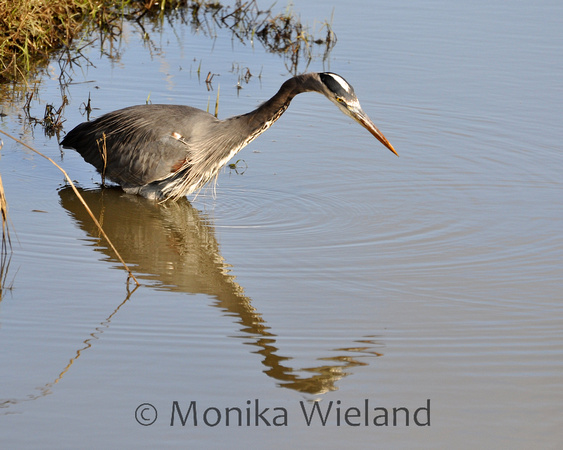
In the final stretch of the auto-tour route it was the herons that stole the show. First, we got a nice look at a great egret. Then, we paused to watch this great blue heron successfully catch several small fish:


Then, around the corner, I was amazed to see this American bittern right out in the open. These birds are often very tucked away in the grasses and hard to see, but this one was walking right along the edge of the marsh:


A couple of things really stood out while seeing this bird at close range. One was the beautiful, intricate patterning on the feathers. The other was the surprisingly large talons on the feet!

While we were watching, the bittern took a few steps back into the grass. It was amazing how, even while looking directly at it, the bird began to disappear into the grass just a few feet away.


When we got back to the start of the auto tour loop, we checked in with the park ranger who said no one else had seen the vermilion flycatcher after that one sighting early in the morning. Then, just as we were ready to leave, he came up to us on his cell phone and said he was talking to another birder who was looking right at it. Of course, being this close to not just a year bird but a life bird, I had to try again! We made another trip around the auto tour route, spending extra time in the area the flycatcher was seen, but despite having several other birders nearby looking for the same bird, we weren't able to relocate it.

There were several other year birds I was hoping to get while in Oregon, and a few other unexpected reports came in while I was there. Next up, I'll report on my successes and failures in the year bird hunt.

Tuesday, May 3, 2011

Spring at Ridgefield NWR

It was a beautiful spring day yesterday, and there was no better place to enjoy it than at Ridgefield National Wildlife Refuge, where my dad and I spent three hours birding along the River S Unit. We saw more than a dozen species of waterfowl, including one tundra swan that seemed reluctant to migrate. We also saw about ten ruddy ducks:

Male ruddy duck


We also saw about 15 pairs of cinnamon teal, which I thought was quite a lot!


Prints of this photo available here

It was the first day of the season that the Kiwa Trail was open, so we hiked that loop. The sounds of the marsh were impressive: marsh wrens and common yellowthroats were everywhere. Usually yellowthroats are very secretive, but we saw quite a few throughout the course of our visit, so I got a rare chance to photograph one.

Male common yellowthroat
Also along the Kiwa trail we heard several Virginia rails and soras (165), and even saw one sora fly a short distance. If I thought the yellowthroats were elusive birds, I don't know what word I would use to describe these rails! This was only my second time actually seeing a sora, and I've never seen a Virginia rail, only heard it.

In the forested part of the trail I also saw my first house wren (166) for the season. Other highlights of our walk included a white-breasted nuthatch, and all the swallows. Lots of pairs of tree swallows were flitting about their nesting holes in the trees, but we saw a single violet-green swallow perched right alongside the path. My dad pointed out that we could actually see both the violet and the green that led to the name of this bird - usually they just look dark greenish. 

Prints of this photo available here

We were also impressed by the number of Aubudon's (yellow-rumped) warblers. It seems people have been reporting impressive numbers of these guys all over the region. We probably saw at least a hundred of them. Here are a few photos:

Prints of this photo available here


Another species Ridgefield is known for is the yellow-headed blackbird, a species that tends to be seen more in eastern Washington rather than in the western part of the state. We saw at least three males throughout the day:


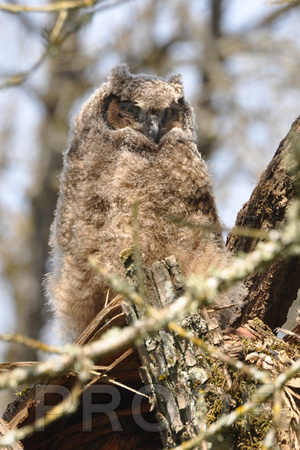
When we came across several cars pulled over and everyone out with cameras in hand, we knew there was something cool to be seen. It turned out to be the site of a great horned owl nest. One of the parents was perched across the creek in a tree, one of the chicks was hunkered down in the nest, but the second chick was right out in the open and didn't seem to have a care in the world. What a funny looking bird!

Prints of this photo available here

The final highlight of the day was one of the species we went to Ridgefield hoping to find: an American bittern (167). We saw one fly a short distance, and then heard it ca-chunck-a-chuncking after completely disappearing among the sedges. We ended the trip with 43 species on the day list, and we certainly enjoyed all the birds and all the sunshine!