For any use of my photos, please contact me at monika.wieland (at) gmail (dot) com
Showing posts with label blackbird. Show all posts

Tuesday, January 31, 2017

Birding the Fraser River Delta

With friends turning up some fantastic bird sightings just north of the border, it was time for another weekend trip to the mainland and into BC to see what could be seen. First up was a stop at Blackie Spit where ring-billed gulls were the first addition of the day.

Ring-billed gull (photo year list bird #82)
There were also a crazy number of Eurasian wigeon there in with the American wigeon!


Another highlight were the relatively tame black oystercatchers:


As well as the crows opening shells by dropping them on the rocks:

Crow diving to retrieve a shell it just dropped on the rocks

Next up was an afternoon at the Reifel Migratory Bird Sanctuary. I'm not entirely sure how I haven't visited this place before! It's a bit more park-like than many birding areas in that there are hours, admission fees, and many people feed the birds there, but there are also natural trails to walk and an astounding array of species. It got me a lot closer to some species than I've ever been before!

Northern pintail
Sandhill crane (86)
And while I have been close to wood ducks before, this was still one of my favorite shots of the day:

Wood duck (88)

 It was also clearly a very popular place, and it was cool to see so many people communing with birds, including people who otherwise might not.

Man befriends wood duck
Girl befriends red-winged blackbirds (I also overheard her declare this the best day of her life!)
I, too, had a special moment, with an immature bald eagle who didn't seem to mind at all that the path went right by his/her favorite perch!


It's not often you get the chance to take photos like this of a wild bald eagle...


We also got to see the great horned owl and two saw-whet owls that roost right near the trails at Reifel, and also within just a few yards of each other! Unfortunately none of them were very cooperative for photos - we counted this one for great horned owl:

Great horned owl (92)
But I couldn't quite convince myself that this northern saw-whet owl was identifiable from this photo:


And one more cool find:

One of four black-crowned night-herons (91)
There was still a little bit of daylight left, so we headed over to Boundary Bay, where I went to see snowy owls back during that great irruption year in 2012. After visiting many other likely habitats so far this year, I finally saw my first short-eared owl of 2017.

Short-eared owl (92)
While I added 12 species to the photo year list challenge on the day, just like when visiting Skagit county, it was the bald eagles who stole the show. We thought seeing over 100 eagles on the day in Skagit was impressive - try over 500 within a few miles of each other in Delta, BC! I've never seen anything like it. There could easily be 50 eagles in a single stand of trees, and in one location I counted over 250 eagles while standing in one spot. Apparently they've been congregating there in the winter months for the last 10 years or so, right around the landfill and the turf farm. At first they thought maybe it was indicating a problem at their normal winter food source, but I'm assuming by the fact there are more and more of them there each year including loads of immatures that they've just found something they like. I'm still not sure what exactly is supporting that many eagles in that narrow area, but it's an incredible sight!


I felt sorry for this fella trying to work on his nest in one of these trees...nothing like trying to defend your breeding territory from 500 rivals!


With that many predators/scavengers in one place, the skirmishes were frequent - not only among the eagles but between the eagles, gulls, hawks, owls, etc.


Harrier causes short-eared owl to drop large rodent - winner was an immature bald eagle who came in and grabbed the prey

The next day, before heading back to the ferry, we decided to try and twitch some of the many rare bird sightings in the area rather than go for other more common species we're likely to add at some point throughout the year. It was a mixed result, as it so often seems to be when looking for rare birds, but I did come up with a life bird! This very distant glaucous gull at the landfill site was not easy to find among the 10,000 gulls that kept reshuffling anytime one of the hundreds of eagles took flight. I was glad to find him; the black-headed gull that was also in there somewhere remained elusive.

Glaucous gull (93)

With the weather taking a turn we drove to Pitt Meadows, where again we went 1 for 2, finding the prairie falcon but not the gyrfalcon that have been there for the last several months. It's crazy to me that two such similar looking rare birds would hang out in the same block of each other! If it weren't for the photos proving otherwise I would suspect the same bird had just been ID'd as two different species!

Prairie falcon (94)
Back on the US side of the border, we had enough time to try for one more rare bird - the yellow-billed loon in Anacortes. I just don't know how some people have success in nearly all the rare birds they attempt - perhaps they just have much more time to wait! The loon was seen a few hours before we were there according to reports by others, but no such luck for us. The scenery was a good consolation prize, though.

No yellow-billed loon, but the view from Rosario Beach wasn't too shabby

Back home, I just added ruby-crowned kinglet as the 95th bird species photographed so far in 2017. I usually have a loft goal of 100 species on my traditional year list in January if I can - I had no idea I would get so close for photographed species in month number one as well! I'm closing out the month with 106 species on the year list and 95 species photographed, for a 90% photo rate that is far ahead of expectations!

Next up I'm hoping for a birding trip that will result in more owls and more life birds, but the tenuous weather forecast may postpone that - we shall see!

Wednesday, May 30, 2012

Ridgefield NWR - May 2012

On Sunday afternoon my parents and I spent over four hours at Ridgefield National Wildlife Refuge, one of my all-time favorite places to bird watch and a site I try to visit whenever I'm in the area. My dad and I comment how when you make a repeat visit to a location where you saw an uncommon bird, you always find yourself looking for that same species in the exact same spot. That's why we stopped before the bridge into the auto-tour loop to look around the trees where several years ago we found an oriole nest. We found a nest in the same tree, though it looked like the tattered remains of an old one made up primarily of blue fishing line. While looking around, we heard a loud call and then spotted a Bullock's oriole (190). Nice! Sometimes it pays off to take a closer look in those locations.

Along the first part of the drive we saw all the expected species: lots of waterfowl, including another family of pied-billed grebes. While we didn't see the numbers of ducks we do in the winter, a huge variety of species was still present, with small numbers of eleven duck species seen, including about 20 cinnamon teal, a few redhead, and a single male blue-winged teal (191).

Male gadwall
 We also saw some yellow-headed blackbirds and heard the first of many, many common yellowthroat and marsh wrens for the day. The new purple martin boxes seemed to be fulfilling their purpose, too - we saw one purple martin there, a new species for me at the refuge.

At the bird blind I found a white-breasted nuthatch (192), but the best photo op was of this little Pacific tree frog:


In the middle of the auto tour route is the one mile Kiwa Trail loop, which we hiked. It takes you out through a marsh habitat where this time of year you can hear lots of American bitterns, soras, and Virginia rails. On our walk we also heard several winnowing Wilson's snipes. The other main bird species present here were yellow warblers, tree swallows, and lots and lots of cedar waxwings:


Back in the car, we were able to find an adult great horned owl but not any of the chicks that were supposedly out of the nest nearby. The next reason to come to a stop was for this yellow-headed blackbird perched close to the road. Turns out he was also perched close to a red-winged blackbird nest, and the pair tending the nest were not happy about that, with the male red-winged blackbird keeping a close eye on him and flying directly at him if he made too many moves.


That didn't seem to be enough to deter the yellow-headed blackbird, however. This, for some reason, was definitely the place he wanted to be singing, if that's what you can call the interesting noises they make:


This was a popular stretch for singing birds. Here's one marsh wren belting his little heart out nearby:


Down the final stretch of the auto-tour loop is another one of those places where we always talk about how we saw black terns there once. With the species having been sighted there the day before, we took extra care to look for them again. I spotted something that very well could have been terns extremely high in the air, but as we positioned ourselves to get a better look they seemingly disappeared and we could not relocate them. Two other flying birds did catch my eye, however - at first I thought they were hawks, but the flight didn't seem quite right. Turns out they were bitterns! I've seen bitterns fly occasionally, but never so high in the air! It was quite a way to see these usually secretive birds. The one on the left was calling, and his mouth is open in this picture:


We were just pulling out of the refuge when one last bird caught my eye - a woodpecker that landed on a telephone pole. I only got a quick look, but enough to see it was a red-breasted sapsucker (193), my fourth year bird of the day. In total, we saw and heard 54 species at Ridgefield - not bad at all!

Tuesday, May 3, 2011

Spring at Ridgefield NWR

It was a beautiful spring day yesterday, and there was no better place to enjoy it than at Ridgefield National Wildlife Refuge, where my dad and I spent three hours birding along the River S Unit. We saw more than a dozen species of waterfowl, including one tundra swan that seemed reluctant to migrate. We also saw about ten ruddy ducks:

Male ruddy duck


We also saw about 15 pairs of cinnamon teal, which I thought was quite a lot!


Prints of this photo available here

It was the first day of the season that the Kiwa Trail was open, so we hiked that loop. The sounds of the marsh were impressive: marsh wrens and common yellowthroats were everywhere. Usually yellowthroats are very secretive, but we saw quite a few throughout the course of our visit, so I got a rare chance to photograph one.

Male common yellowthroat
Also along the Kiwa trail we heard several Virginia rails and soras (165), and even saw one sora fly a short distance. If I thought the yellowthroats were elusive birds, I don't know what word I would use to describe these rails! This was only my second time actually seeing a sora, and I've never seen a Virginia rail, only heard it.

In the forested part of the trail I also saw my first house wren (166) for the season. Other highlights of our walk included a white-breasted nuthatch, and all the swallows. Lots of pairs of tree swallows were flitting about their nesting holes in the trees, but we saw a single violet-green swallow perched right alongside the path. My dad pointed out that we could actually see both the violet and the green that led to the name of this bird - usually they just look dark greenish. 

Prints of this photo available here

We were also impressed by the number of Aubudon's (yellow-rumped) warblers. It seems people have been reporting impressive numbers of these guys all over the region. We probably saw at least a hundred of them. Here are a few photos:

Prints of this photo available here


Another species Ridgefield is known for is the yellow-headed blackbird, a species that tends to be seen more in eastern Washington rather than in the western part of the state. We saw at least three males throughout the day:


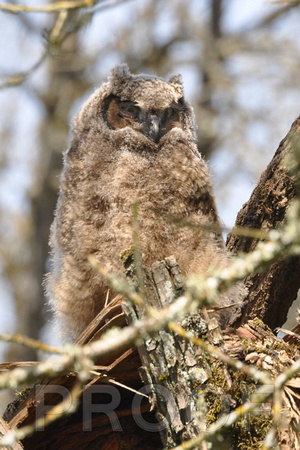
When we came across several cars pulled over and everyone out with cameras in hand, we knew there was something cool to be seen. It turned out to be the site of a great horned owl nest. One of the parents was perched across the creek in a tree, one of the chicks was hunkered down in the nest, but the second chick was right out in the open and didn't seem to have a care in the world. What a funny looking bird!

Prints of this photo available here

The final highlight of the day was one of the species we went to Ridgefield hoping to find: an American bittern (167). We saw one fly a short distance, and then heard it ca-chunck-a-chuncking after completely disappearing among the sedges. We ended the trip with 43 species on the day list, and we certainly enjoyed all the birds and all the sunshine!

Sunday, May 23, 2010

Fantastic Birding Along Highway 97

Location: Prince George, British Columbia
Population: 70,971

These first days are supposed to be filled with lots of driving, but so far they are ending up filled with lots of wildlife viewing as well. We're making a lot of short stops at viewpoints or points of interest, and today took two short hikes as well. With all the varying habitats we've traveled through, from semi-arid high plateau to farmland to pine forest, nearly every stop puts us in a different habitat which means there are different birds about. Today turned up an astounding 60+ species! A bucket load of them ended up being species for the year list as well, many of them birds I had down as potential but not guaranteed finds for the year, so it was an exciting day.

The day started out with a bang as from the breakfast table this morning we spotted a Lewis' woodpecker. I've only seen this species once before - I sought it out in January as a new life bird - so this was a spectacular find! Then, while loading the car, a western tanager (165) flew down out of the trees right into the grass in the parking lot - yet another good omen of things to come.


I hoping to maybe turn up some boreal chickadees on this trip as they would be a life bird for me, so when we stopped to look at an impressive geological formation showing various lava flows my years perked up when I heard an odd-sounded chickadee. It wasn't a boreal, but was a mountain chickadee (166)! Nearby I also saw mountain bluebirds and chipping sparrows.

Next we stopped at a series of lakes near 70 Mile House and 100 Mile House (towns named for their distance along the original gold rush trail which started in Lillooet). We saw a pair of barrow's goldeneyes, several spotted sandpipers (167), both red-winged and yellow-headed blackbirds (pictured below), and the normal array of ducks. In addition to the usuals like wigeon, shovelers, gadwall, and mallards there were also a couple of redhead (168) and blue-winged teal (169).


At one point we had to loop back to check out what looked like a sandpiper standing on top of a telephone pole - never seen anything like that before! It turned out to be a Wilson's snipe. It seemed like kind of an unusual perch for a bird that's usually camouflaged among the grasses, but there was another one a little further along doing the same thing. Maybe it was a male, who is described as calling from a perch during the breeding season?


William's Lake turned out to be a birding hot spot. As soon as we reached the lake we spotted some American white pelicans (170) and a leucistic red-tailed hawk - the first of it's kind I've ever seen. Several species of swallows were flying over the lake, and our picnic stop at Scout Island turned up some singing yellow warblers and an abundance of Wilson's warblers (171):


After lunch we hiked some of the boardwalk trails through the marsh at Scout Island were we saw a common loon on its nest, a couple of red-necked grebes, and a pair of evening grosbeaks (172). I also heard a couple of soras (173) calling - a great find as I knew the spring was my only chance to pick up this otherwise silent and always elusive bird! The other impressive sight were all of the Canada goose goslings. There were families with young of different ages all over the marsh. The most ridiculous spot was this little area on the bank where it looked like, as one person described it, "an anthill of goslings". There were only 2-4 sets of parents in the area, but these dozens of goslings from multiple families were all mixed together into one big flock:


A hike near Quesnel turned up both warbling and Hutton's vireos, and the last bird species added today was a long-billed curlew (174) just a few miles out of town from our stopping place for the night. As amazing as the birding was today - a whopping ten year birds were added, leaving me just one species shy of my original goal of 175 - it wasn't all about the birds.

The coolest insect sighting of the day was definitely not the mosquitos (which weren't that bad yet but are only going to get worse), but rather this butterfly which I was later able to identify as a common alpine (Erebia epipsodea):


There were also two mammal highlights today. The first was a colony of about 15 yellow-bellied marmots near Clinton. These animals are also known as the rock chuck or the whistle pig:


And, I could hardly believe it, just day two of the trip but I already had my first bear sighting! We spotted this black bear thinking about crossing the highway, but it thought better of it and headed back to the hills, stopping only to take a bite out of the nearby shrubbery and take one look back behind it before disappearing into the trees:


Our stopping place for the night is in Prince George, home of the Western Hockey League's Prince George Cougars. I'm a fan of the Portland Winterhawks, which are also in the same league, and I have seen them play in 13 of the league's 22 cities. Needless to say, Prince George is not one of those 13, and after arriving here myself I cannot believe they travel this far by bus from Portland to play hockey! Not only that, but they're not doing it in the spring like I am, but in the dead of winter....quite a trek! Now I fully understand why teams play two games back-to-back while they're here, so they don't have to travel here as often.

One of the Hawks' announcers once said that Prince George isn't the end of the Earth, but you can see it from here. Well, I hope not! Tomorrow we press on a few hundred miles further to the north and will see the official beginning of the Alaska Highway.