For any use of my photos, please contact me at monika.wieland (at) gmail (dot) com

Thursday, May 5, 2011

Spring at Nisqually NWR

Yesterday on my way back north to San Juan Island I made another stop at Nisqually National Wildlife Refuge near Olympia, Washington. Unlike on my drive south, the weather was beautiful, so it made this visit a little more pleasant. Somewhat surprisingly, there weren't nearly as many swallows around as in the pouring rain. I did see barn, tree, and violet-green swallows as well as a decent-sized flock of Vaux's swifts. The most abundant swallow yesterday was, however, the cliff swallow. The cliff swallows were hard at work collecting mud....


Building nests....


And then presumably incubating eggs as they peeked out from finished nests....


The marsh was pretty active, with gadwall, mallards, wigeon, a single coot, and lots of northern shoveler in addition to singing marsh wrens and common yellowthroats. On a mud spit there were several species of shorebirds, including about a dozen dowitchers, a few dunlin, and about 50 peeps that were too far away to be identified. I also heard a single sora calling. Northern shoveler were the most numerous of the lot and the only duck I got close enough to photograph:

Prints of this photo available here

Despite the "no jogging" signs, since it's a wildlife refuge, this child was running around chasing birds. I wasn't thrilled about that, but it result in kind of a neat looking photograph:


One of the marsh wrens was singing out in the open, too, allowing for a photo op:


Since the weather was nice I decided to walk further than last time, including out on the estuary boardwalk that extends will out into the tidelands. It's a neat walk:


There wasn't a whole lot of bird activity out there, however. On the way back to the car I did see a single lesser yellowlegs (168). The total for the afternoon was 37 species at the refuge.

At the Anacortes ferry landing I had a little bit of time to bird watch before getting on the ferry. The highlight there was two purple martins (169) checking out the nesting boxes on the old dock pilings. Usually this is a pretty active nesting colony so I hope some more birds show up there soon. Then, in Rosario Strait on the ferry, I saw a flock of approximately 750 Bonaparte's gulls - always a cool find!

Tuesday, May 3, 2011

Spring at Ridgefield NWR

It was a beautiful spring day yesterday, and there was no better place to enjoy it than at Ridgefield National Wildlife Refuge, where my dad and I spent three hours birding along the River S Unit. We saw more than a dozen species of waterfowl, including one tundra swan that seemed reluctant to migrate. We also saw about ten ruddy ducks:

Male ruddy duck


We also saw about 15 pairs of cinnamon teal, which I thought was quite a lot!


Prints of this photo available here

It was the first day of the season that the Kiwa Trail was open, so we hiked that loop. The sounds of the marsh were impressive: marsh wrens and common yellowthroats were everywhere. Usually yellowthroats are very secretive, but we saw quite a few throughout the course of our visit, so I got a rare chance to photograph one.

Male common yellowthroat
Also along the Kiwa trail we heard several Virginia rails and soras (165), and even saw one sora fly a short distance. If I thought the yellowthroats were elusive birds, I don't know what word I would use to describe these rails! This was only my second time actually seeing a sora, and I've never seen a Virginia rail, only heard it.

In the forested part of the trail I also saw my first house wren (166) for the season. Other highlights of our walk included a white-breasted nuthatch, and all the swallows. Lots of pairs of tree swallows were flitting about their nesting holes in the trees, but we saw a single violet-green swallow perched right alongside the path. My dad pointed out that we could actually see both the violet and the green that led to the name of this bird - usually they just look dark greenish. 

Prints of this photo available here

We were also impressed by the number of Aubudon's (yellow-rumped) warblers. It seems people have been reporting impressive numbers of these guys all over the region. We probably saw at least a hundred of them. Here are a few photos:

Prints of this photo available here


Another species Ridgefield is known for is the yellow-headed blackbird, a species that tends to be seen more in eastern Washington rather than in the western part of the state. We saw at least three males throughout the day:


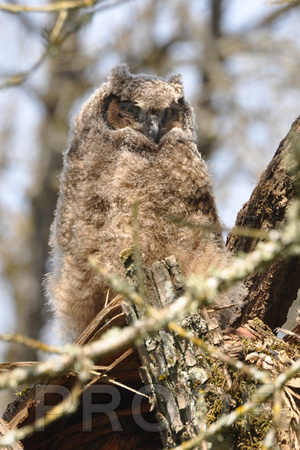
When we came across several cars pulled over and everyone out with cameras in hand, we knew there was something cool to be seen. It turned out to be the site of a great horned owl nest. One of the parents was perched across the creek in a tree, one of the chicks was hunkered down in the nest, but the second chick was right out in the open and didn't seem to have a care in the world. What a funny looking bird!

Prints of this photo available here

The final highlight of the day was one of the species we went to Ridgefield hoping to find: an American bittern (167). We saw one fly a short distance, and then heard it ca-chunck-a-chuncking after completely disappearing among the sedges. We ended the trip with 43 species on the day list, and we certainly enjoyed all the birds and all the sunshine!

Sunday, May 1, 2011

End of April: Year List Update

I'm in the middle of spending a week down in Portland, where my parents have just sold their house to move outside of the city. In addition to packing, sorting, and doing a little bit of work for my dad, I've had the chance to go on a few different birding excursions. Sorry for the lack of pictures today - the conditions just didn't quite align very often either due to distance or weather or both!

On the drive down south I stopped at Nisqually National Wildlife Refuge where unfortunately it was pouring rain. I still managed to find 18 species on the one mile Twin Barn loop trail. The highlight of the visit were the hundreds and hundreds of swallows buzzing around over the marsh near the visitor center. While the majority of them were violet-green swallows, there were also tree swallows, barn swallows, and a few cliff swallows (156) mixed in.

Yesterday my dad and I made a brief stop at Vanport Wetlands in north Portland, where a vermillion flycatcher had been spotted a couple of days before. While it remained elusive for us as it had for many other birders who tried to follow up on this report of a normally more southern species, there was still a lot of activity on the marsh. Dozens of red-winged blackbirds were singing away, with a few yellow-headed blackbirds (157) mixed in for good measure. The most plentiful bird on the water was the American coot, though there were also Canada geese, mallards, gadwall, northern shoveler, pied-billed grebes, and lesser scaup. The waterfowl highlights were several male ruddy ducks, a pair of redhead, and a pair of cinnamon teal (158). Again several swallow species were catching insects over the water, but there were also about a half dozen Vaux's swifts (159), another first for the year.

We went to check on the nearby great horned owl nest, but it appeared to be empty. On the walk over there we did have a close encounter with a surprisingly tame mourning dove, however. At Force Lake I got several close looks at a male common yellowthroat who became camera shy as soon as I pulled out my bigger lens. The only cooperative bird turned out to be this charming song sparrow:


Today we took a day off from "work" to go to Tillamook and do a COASST survey on my dad's beach. On the way out we stopped at Killin Wetlands in Forest Grove, which didn't turn up any bitterns or soras as we had hoped. The highlight of this stop for me was the chorus of about five marsh wrens singing simultaneously, with the red-winged blackbirds providing back-up. There were also some northern rough-winged swallows mixed in with the swallow crowd, and we saw a pair of Eurasian collared-doves nearby. Closer to Tillamook along the river we found a flock of about 30 greater scaup.

We didn't find any dead birds during our survey, which meant we had extra time to spend looking for live birds. At the Happy Camp beach most of the activity was near the end of the Netarts spit where we saw a few surf scoters, pigeon guillemots, and western gulls in addition to a single common loon. A group of 16 Brandt's cormorants flew by, as did a single Caspian tern (160). Everything was too far away for photos, so the only thing I took a picture of was this scene on the beach:


Next up we swung by Bay Ocean Spit as we always do, but got delayed longer than usual by the bird activity. First we came across a small flock of mallards and northern pintail, as well as a nearby group of bufflehead. Then a larger flock of ducks including northern shoveler, green-winged teal, American wigeon, and two Eurasian wigeion. Through my dad's scope we also found about 50 brant greese out in the bay, as well as our only red-breasted merganser for the day. On the mud spit were several dozen more Caspian terns, though one of the tern-like birds flying around turned out to be a lone Bonaparte's gull in breeding plumage.

The highlight of this stop for us was the shorebirds. We saw four marbled godwits, a dozen western sandpipers (161), and a group of about 45 dowitchers. My dad thinks they were long-billed, which would make them another year bird for me, but they were just too far away for me to be certain, especially with all the heat distortion looking through the scope! Still cool to see, even without knowing for sure what they were.

Our last birding stop for the day was Fenk Road, a little agricultural side road that seems to turn up more than its fair share of "good" birds. Today was no exception, as just after turning onto the road we were surprised to find a flock of about 20 least sandpipers (162) along the river bank! I don't think I've ever seen peeps along a river before. While we were watching them, a flock of about a hundred greater white-fronted geese flew in - another great find! Several ravens were also in the field nearby. The sightings didn't end there. As we pulled up to the cow barns in addition to the red-winged blackbirds, European starlings, crows, and house sparrows, I saw a single male American goldfinch (163). A little further on along the river we could see mallards, green-winged teal, gadwall, shoveler, and a couple bufflehead. Here's one of the tree swallows that was perched nearby:


The brambles between the road and the river were bustling with activity as they always seem to be, with lots of yellow-rumped warblers (both myrtle and Audubon's) as well as both white-crowned and golden-crowned sparrow. The best find of the day turned out to be the very last species we added to the day list - a single palm warbler (164). This species was reported here a couple weeks ago, and in fact this is the exact same spot I saw it for the first time in January 2010.

With the five birds added to the year list today that makes a total of 25 species added for the month of April. That's better than the 21 added during April last year, when by the end of the 30th I was sitting at 152 species on the year. I'm sure those eastern species added in January have helped boost me ahead of last year's total, but it's a good thing because during May last year is when I started my trip to Alaska! It will be tough to match the 2010 year listing efforts of May and June in Alaska during this year, but I'll be out there birding regardless! :)

Tuesday, April 26, 2011

Migrating Shorebirds and Baby Foxes

While the last few days of chilly rain felt more like fall or winter, today's wildlife sightings confirmed that we are indeed in the middle of spring. I heard there have been some good shorebird sightings at False Bay over the last couple of days so I went to check it out. The first ones I found were a flock of about 100 dunlin amid the glaucous-winged and mew gulls. A bald eagle flew over and when they flushed I realized there were even more dunlin than I thought - about 100 or so:


In with the roughly 40 green-winged teal were four short-billed dowitchers (154), a nice find. There were also about a half dozen greater yellowlegs:


The greatest find was a single marbled godwit (155), a rare species for San Juan County. Unfortunately it was too far away for photos and flew even further away after the eagle came through, but I'm sure glad I found it!

Next up I went to Fourth of July Beach where the most interesting bird was not a sea or shorebird but the oft-overlooked American robin. There were many of them feeding in the grass, and this individual in particularly caught my eye. It would catch a worm, hold it in its beak, move along, set the worm down, catch another worm, then pick up the first worm. Gathering food to take back to a hungry nestling? Here's a photo from when it had three wriggling worms in its beak at once:


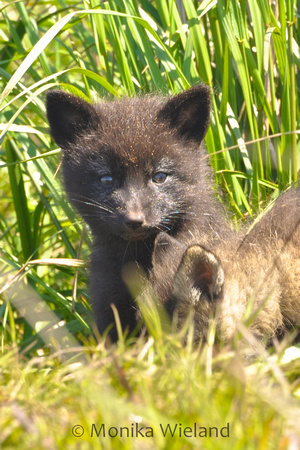
Next I stopped at South Beach, where I was distracted from birds altogether by the flowers blooming in the dunes. It looked like the hills were blushing under the force of the pink common storks-bill. The colors were impressive, especially when countered by this black fox:


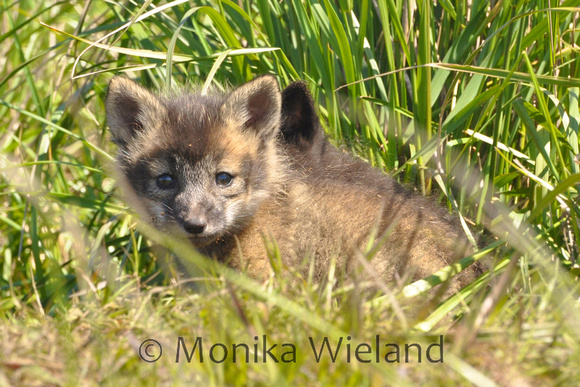
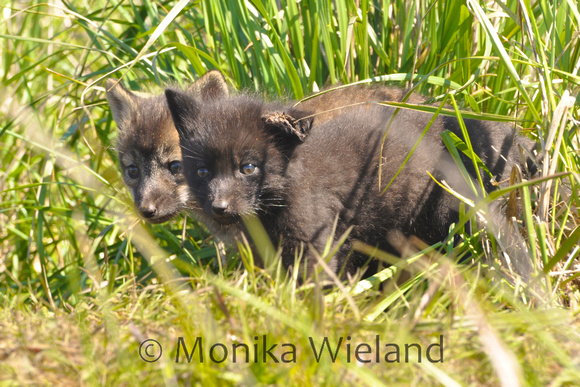
Then on my way home I was elated to find a real treasure of the spring: a fox den with four playful kits. My all-time most popular blog post that continues to get the most hits is this one, featuring photos of the baby foxes I found in late April 2009. Today they were spending more time underground than in my 2009 encounter, but when they did emerge the light was even nicer than last time since the sun was shining. Here's the most distinct of the four, with an injured left ear:


The two reddish kits mostly just peeked up over a grassy mound at me:


These are my three favorite photos of the day. These little guys are just too darn adorable:
Prints of this photo available here

Prints of this photo available here

Prints of this photo available here

Monday, April 25, 2011

Land Bank Westside Preserve Wildflowers

A friend of mine recently posted some photos of wildflowers in bloom at the Land Bank Westside Preserve, and I was inspired to get out there and take a look. (I also spent a couple hours sitting on the rocks and reading in the warm sunshine for the first time this year! A nice respite before the two solid days of rain we've had since then!) Here are some photo highlights of the flowers I saw....

Field chickweed, Cerastium arvense

Barestem teesdalia, Teesdalia nudicaulis

Common camas, Camassia quamash

Lupine, Lupinus spp.

Strawberry, Fragaria spp., with a pollinator

Big leaf maple, Acer macrophyllum

Here's a couple that I'm not sure about....is this a saxifrage of some sort?


And I have no idea what this tiny plant is. Do you?


While having your nose to the ground looking at plants up close you see more insects, too. Here's one of my favorite macro insect shots from the day:

Seven-spotted ladybug, Coccinella septempuncata

Saturday, April 23, 2011

Mt. Young Wildflowers

The other day I was writing when out of the corner of my eye I spotted a bird that looked "different". It turned out to be one of two osprey (150) that were soaring between here and Brown Island. Cool! Since then I stopped by British Camp where, while I didn't see the osprey, I saw that they are indeed working to rebuild their nest that blew down during one of our wind storms last winter.

We've finally had some gorgeous sunny spring weather and I took advantage of it the other afternoon to go up to Mt. Young and look for birds and wildflowers. It was my first outing focusing on taking flower photos with the macro lens I got for my birthday last fall. Most of the flowers are a bit late this year, but a few species are staring to peak, like these shooting stars that were everywhere:

Shooting star, Dodecatheon spp.

Fawn lilies are usually one of our earliest bloomers, but they're just starting to open up over the last week with many still in bud. They are also called Easter lilies, so I guess that's appropriate because we have a relatively late Easter this year, too.

Fawn lily, Erythronium spp.

I also found some of this plant, which confuses me every season. It's not self-heal, but purple dead nettle - a non-native:

Purple dead nettle, Lamium purpureum

On a rocky outcropping near the summit, I found a dense patch of these yellow monkey-flowers:

Monkey-flower, Mimulus spp.

Then, right towards the end of my hike, I found a few Calypso orchids (also known as fairyslippers) in the sunshine:

Calypso orchid, Calypso bulbosa

Even though my eyes were focused on the ground and I was, at times, literally crawling through the grass on my hands and knees, I still kept my ears tuned in for birds. There were lots of singing orange-crowned warblers and purple finches, and a few Townsend's warblers. One bird caught my eye and I was surprised to see it was a hermit thrush (151), a species I thought might have left for the summer already. There was another song I heard repeatedly among the treetops and I had to come home and confirm it, but as I had hoped it was the chorus of the black-throated gray warbler (152).

Next up, more wildflowers - but I'll go ahead and mention that I saw my first pair of brown-headed cowbirds (153) for the season while out looking at flowers. That keeps me dead even with Dave, who got his 153rd year bird on Wednesday. Is anyone else as amazed as we are that after four months of birding on different continents are year lists are keeping pace with each other almost tick for tick?

Wednesday, April 20, 2011

What's In A Name?

What do the San Juan Islands have in common with Wilkes Land in Antarctica? Other than being surrounded by water, you might think (like I did): not much. Actually, both were explored and charted during the US Exploring Expedition between 1838-1842. This amazing excursion, led by the controversial Charles Wilkes, is largely forgotten in American History in part because of personal and national politics that kept the results from being celebrated by the nation, and in part because the focus of American citizens was turning towards the wild and relatively unknown West rather than maritime exploring expeditions like those of Captain Vancouver and Captain Cook.

I recently read a fascinating account of the "U.S. Ex. Ex.", also known as the Wilkes Expedition.
Sea of Glory: America's Voyage of Discovery is written by Nathaniel Philbrick, an American author who has won the National Book Award for his works relating to the sea. It's a history that is full of high-seas adventure and personal drama. The make a couple of treks towards Antarctica and survey many of the islands in the Pacific, but I was especially interested in this tale because towards the end of the expedition they survey the inland waters of Washington as well as the Columbia River delta, both places with which I am familiar.

More than 300 Washington place names were designated by those surveying the region during the Wilkes Expedition, and it was interesting to read the stories behind some of the people for whom local landmarks are named. The San Juan Islands were originally explored by the Spanish, hence we have names like San Juan, Lopez, and the Strait of Juan de Fuca. When Wilkes came through, they re-named everything, and modern maps reflect a mix of both the Spanish and American names. 

Here are a few of the local geographical features that were named after members of the Wilke's Expedition:
  • Waldron Island ~ Thomas and Russell Waldron were two brothers on the expedition. One was a purser and the other a captain's clerk. Waldron was known as Isla Lemos by the Spanish and Shi-ish-uvey by the Lummi Indians.
  • Vendovi Island ~ This is an interesting one. Vendovi was a Fijian arrested by the expedition for murdering an American sailor. As the expedition went on, he got more freedom aboard the vessels and became well-liked by the crew. He was known as a colorful character. Vendovi Island was recently purchased by the San Juan Preservation Trust.
  • Stuart Island ~ Frederick Stuart was also a captain's clerk on the expedition. This island was known as Islas Moraleja by the Spanish and Qunnis (whale) by the Lummi.
  • Spieden Island ~ William Spieden was a purser on the expedition. 
  • Sinclair Island ~ George Sinclair was the sailing master aboard one of the expedition's vessels. Sinclair was known as Cottonwood and Urban Island by local pioneers, Isla de Ignacio by the Spanish, and Scut-las by the Lummi.
  • Alden Bank ~ James Alden was a member of the US Ex. Ex. who returned in later years as part of another US Coast Survey and discovered this bank.
Luckily, not all of Wilkes' place names last. He originally named our collection of islands the Navy Archipelago. I, for one, definitely prefer San Juan Islands to that.

In doing a little extra research about these local place names, I came across another great resource. The Washington Place Names Index is a very interesting resource provided by the Tacoma Public Library. You can search for specific geographic names in the state of Wahsington and read the history behind place names.

So, what does all this have to do with Antarctica? During the US Ex. Ex.'s surveys of Antarctica, they discovered and names 1500 miles of shoreline that are now known collectively as Wilkes Land. Names like Spieden and Waldron are well-known by San Juan Islanders, and those that (like me) didn't know about this portion of American history may be surprised to know that along the Antarctic coastline are places like Cape Waldron and Cape Spieden, named after the same people for whom our local landmarks are named.

I generally focus on natural history on my blog, but part of fully understanding a place is learning about the human history, as well. I really enjoyed reading about the Wilkes Expedition, particularly as it related to the San Juan Islands, and feel like it gave me a new appreciation for part of our local history.