For any use of my photos, please contact me at monika.wieland (at) gmail (dot) com

Saturday, December 17, 2011

The Trek to 157

With only a short time to go before leaving the island for the holidays (and thus the rest of the calendar year), I renewed my efforts to find a few target species I thought I could add to the county list in my quest to reach 157 species and best the existing record for species seen in a year. (I bet people have probably seen more species in a year, but 156 is the number on record with Washington Birder, so that's the number I'm trying to best.)

Thayer's gull is one species I knew I should be able to get. It's a hard one to find, not because it's not here, but because it looks so similar to several other gull species. It most often gets compared to the herring gull, but I think it looks almost exactly like our western x glaucous-winged gull hybrids that are fairly common regionally. I studied up all the details of identification and went out with the specific purpose of studying gulls. 

I found this gull in Griffin Bay and have concluded its a Thayer's gull due to the three features indicated with the arrows. The blue arrow shows the dark (almost black) primaries - darker than those of a glaucous-winged or hybrid gull, but not jet black as in other gulls. The red arrow points to the shape of the forehead - on this gull it is more rounded, whereas in western and glaucous-winged gulls the forehead is flatter. Finally, the green arrow is pointing to the bill. On Thayer's gulls, the base of the bill is a pale yellow while the tip is bright yellow, as on this gull (it's more apparent on a zoomed in version of the photo). In glaucous-winged and western gulls, the bill is almost a school bus yellow throughout. So - Thayer's gull (153 for San Juan County, year bird 202)!


I got an e-mail from an ace birder, Ryan, inquiring about the details of the San Juan snowy owl sighting from a couple weekends ago. He came up to the San Juans last weekend, and in a couple of days turned up more than 100 species including 7 or 8 that would be county birds for me. (He also heard a long-eared owl, very rare for here, and a species that would be a life bird for me! More on that later.) In the process, he also pushed his own county list for the year to 161 - better than the existing record of 156! Uh oh! Realized 162 was probably out of reach for me, I decided to take advantage of some of the great sightings Ryan reported and still push towards my original goal of 157.....

One day after work, I headed out to look for the ruddy duck he saw on Sportsman Lake. Most of the ducks were on the far side of the lake, and as is often the case when I go out looking for a specific species, I didn't find it. I did, however, finally find my northern shoveler (154) - not just one, but a flock of 15 right up close! While continuing my circuit of the lakes and ponds in the center of the island, I also found a singled cackling goose (155) in with a flock of Canada geese.

Yesterday my birding pal Phil came over to San Juan and we had a couple of hours to tour around the island and see what we could turn up. Our first stop of the day was again at Sportsman Lake, and this time the ruddy duck (156) was close enough to be identified! Some other highlights from the rest of our afternoon included an American kestrel along Bailer Hill Road, a northern shrike at Cattle Point, and six ancient murrelets in Cattle Pass. By the end of the day, we totaled nearly 50 species in the 2.5 hours birding.

This morning I decided to try for the long-eared owl that Ryan heard at American Camp in the early hours of last Sunday. This is a rare species for the region, and as far as I know, there haven't been any prior confirmed reports of healthy birds on San Juan Island. I say healthy birds because twice, once in 1987 and once in 2010, long-eared owls were found on the island but were sick or injured and had to be taken to the local wildlife rehab center. It's not often I set my alarm earlier for a Saturday than I do for a work day, but this seemed like a worthy cause.

It was still completely dark when I arrived and it was a little bit eerie walking out through the forest towards the prairie. I spend about half an hour walking up and down between the two habitats, listening carefully. Not long after I got there an owl did give me a close fly-by, startling me enough that I jumped. I'm assuming it was probably the expected short-eared owl, but who knows for sure!

As soon as it started becoming light more and more birds began chirping, peeping,  and calling. My first species of the day was actually a bald eagle!


Since I was up and out anyway, and this is a good time of day for birding, I decided to continue further to the south end of the island and see if I could find anything else interesting. As soon as I was pulling into the road to South Beach, however, my attention was diverted from birds to what turned into a pretty darn spectacular sunrise:


The sun itself came into view just as I crested the rise heading towards the Cattle Point Lighthouse:


While watching the sunrise, a flock of 15 ravens came by. Here are a few of them:


There were a pair of red-tailed hawks and a northern harrier patrolling the prairie near the lighthouse. The waters were rougher than I expected off of Cattle Pass, but I was still able to find the expected surf scoters and bufflehead as well as a Pacific loon, a red-necked grebe, several pigeon guillemots, and a half dozen red-breasted mergansers among the choppy surf.


After having been out birding for close to two hours, I decided to head home. I got in the car, started the engine, and did a U-turn to head back to town. I immediately stepped on the brakes. Kiting right above the middle of the road, about 50 feet in the air, was a rough-legged hawk (157) - an incarnation of the birding spirit and my quest for that one more species. I'm often pretty reserved, but I'll admit that I whooped in excitement at this white hawk in the sky. As I've written in previous posts, while I keep a lot of bird lists, I wouldn't saying listing is my main motivation for birding. I set goals and try to reach them, but I won't go the extremes some do to add that one more species. I would be fine if I stayed at 156 species for the county for the year, and not just because Ryan's already bested that mark all the way to 161. Still, there was something magical in just being ready to pack it in for the day, turning around, and having that one more species literally hovering right in front of me, lit up by the golden light of the sunrise. In one sense, it was just another hawk. In another, it's a bird I will never forget.

Monday, December 12, 2011

My New Book! A Guide to Birds of San Juan Island

I'm excited to announce that my new book, A Guide to Birds of San Juan Island, is now available for sale. It's a project I've been working on for the last 13 months - not only the researching and the writing, but collecting the photographs, drawing the maps, doing the layout, and starting a small business in order to self publish!


Here's the description of the book:

San Juan Island is a diverse place made up of a wide variety of habitats: shorelines, farmlands, forests, and prairies. As a result, over 300 bird species have been documented here. Whether a budding nature enthusiast, an advanced birder, or somewhere in between, A Guide to Birds of San Juan Island will give you details about all of the birds that can be seen here and where to find them. Part species guide and part site guide, Monika Wieland's book will help residents and visitors alike discover more about the bird life of San Juan Island.

It has also been endorsed by two other local naturalists and authors:

“…a thorough and thoughtful account of San Juan Island birds.  Wieland’s book is a fine resource to take into the field and a valuable reference for years to come. Nicely done! “
 - Susan Vernon, author of  Rainshadow World:  A Naturalist’s Year in the San Juan Islands

"A good local field guide ranks right up there with binoculars in the birdwatcher's toolbox.  Monika Wieland's book will be a great asset to anyone exploring San Juan Island in search of birds."
-Thor Hanson, author of Feathers: the Evolution of a Natural Miracle


In addition to being available on Amazon (see the link above), it is currently available on San Juan Island at The Whale Museum, Griffin Bay Books, and Harbor Bookstore. It makes a great gift for the holidays! I hope you enjoy it!

Thursday, December 8, 2011

The Trials and Tribulations of a Bird Lister

While I was in Portland over the Thanksgiving holiday I knew there would be the possibility of picking up a few more birds for the year list, but I didn't anticipate a brambling showing up just a few miles away from my parents' new house! This was only the 12th confirmed record of the species in Oregon, and as you can see, the morning after the report quite a few birders flocked to the scene:


I can only imagine what some of the neighbors thought of the sudden onslaught of bird-watchers to their small neighborhood trail! Unfortunately for all the patient onlookers, the bird only made one brief appearance early in the morning and then wasn't seen again. We only spent about an hour there (others camped out for the whole day!), but it turned out to be a very active bird spot, and one that I probably wouldn't have discovered if it weren't for the rare bird report. Some of the species I saw and heard there included a Virginia rail, sandhill cranes, a band-tailed pigeon, a great egret, and a white-throated sparrow. 

After looking for the brambling we headed into the city to do some errands, and while there made another stop off at Westmoreland Park where I hoped to see the eared grebe that had been hanging out there. I was disappointed not to find it. No vermilion flycatcher (see previous post), no brambling, no eared grebe. What a streak of luck! But I was even more disappointed when I heard that later the same day the eared grebe was found dead, perhaps attacked by a dog in the park! What a sad ending for that wayward bird.

Again, though, even without the grebe there was lots of bird activity at Westmoreland. There was a big flock of cackling geese on the lake along with American wigeon, mallards, bufflehead, a couple of lesser scaup, and some ring-billed and glaucous-winged gulls. Within the flock of wigeon grazing on the grass I also found a female Eurasian wigeon, which is always a fun species to find. It was thanks to my close up looks of a Eurasian wigeon at this very park about two years ago that I finally got confident enough to pick female Eurasians out of a flock, even without the presence of a male.


The weather stayed pretty nice for the rest of the weekend and I got out to see some more of St. Helens. At the marina I found a group of half a dozen Steller's jays, a species that I still need to find on Orcas Island for my San Juan County list this year:


Back at my parents' house, I was hopeful to see of the feeder visitors that my dad had reported from earlier this fall season. I struck out on the gray jays, but I did get to witness one of the brief sporadic visits of an evening grosbeak (year bird 201) flock. About 20 birds descended to the feeders and were only there about five minutes before moving on. All that effort of traveling around to look for birds, and I ended up seeing a year bird right from my parents' kitchen!


On the trip back north to San Juan Island I made another stop off at Stanwood, hoping that in the nicer weather and with better daylight I could get a better look at the snowy owls and maybe even get some photos. Unfortunately the owls weren't in sight during my half hour stop there, though again I saw lots of other good bird species including a rough-legged hawk, a ring-necked pheasant, a Wilson's snipe, and a short-eared owl. 

My year list has now reached my goal of 200 species, but I still want to add some birds to my San Juan County list. With only a month left, I've got some of my naturalist friends on alert for a few of the species I'm still keen to see. It paid off when I got a message last Sunday from Phil on Yellow Island, along with a photo of a pair of Barrow's goldeneye he had seen that morning. Being a great birding pal, he picked me up and we made a quick jaunt out to Yellow where we were able to relocate the female Barrow's goldeneye (SJ county bird 151). Not only that, but I also found a western grebe (SJ county bird 152) out in the channel! After all that trying and failing for owls in November I thought the county year list goal would remain out of reach, but the two birds in one day rekindled by hope....

Another report rekindled my hope, too: that of a snowy owl seen at South Beach! I figured with all the snowy owls showing up all over western Washington there was a decent chance of one being seen on San Juan Island this season - we've got some nice prairie habitat down around the American Camp and Cattle Point area. I've made several trips to that part of the island in recent weeks hoping for an owl sighting - on one outing I pulled over along the way to look at a bald eagle who was feeding on a deer carcass. He took flight and circled around my car before landing again, providing this photo op:


Surely a good omen for the bird-watching day? But alas, the snowy owl report was two days old, and despite my searching high and low around South Beach no owls could be found. Perhaps it just stopped over here before moving on? Too bad.

South Beach, in fact, was incredibly quiet bird-wise. Not even the regular gulls and scoters were hanging out. And it was such a good day for birding, too:


It wasn't until I scanned well offshore and found a flock of about 20 long-tailed ducks that I saw anything worth mentioning.

So, in conclusion, there have been some disappointments over the last couple of weeks in my efforts to locate some new birds for the year. There were lots of "just misses", even on the same day when the species had been seen by others. Some listers will sympathize with my frustration, while some other naturalists may question the logic of "chasing" certain species. I'm certainly not one of the most extreme when it comes to listing - I'm only willing to chase after birds that are fairly close to where I live or happen to be traveling - but upon reflection finding the new species for my county list, year list, or life list, is only half of the reason I like to head out in search of more unusual species. The other reason is that it motivates me to get out, often to new places that I haven't seen before, where I'll end up finding other cool things to look at whether or not I find the target species. Without searching for the brambling, I wouldn't have found the cool little marsh with the calling Virginia rail so close to my parents' new house. If I hadn't made efforts to find the snowy owls, I wouldn't have found the rural road in Stanwood that's home to cool species like rough-legged hawks and short-eared owls, nor would I have had the close encounter with the bald eagle on my home island. Every time I go out looking for something in particular, I see something cool, whether or not it's what I was looking for.

So, as the year winds to an end, I'm going to continue to chase down the species I don't yet have on my lists. Because who knows what I'm going to find. Stay tuned....

Saturday, December 3, 2011

Ridgefield NWR

Okay, I'm back up and running with both computer and internet, so it's time to play some catch up....

On the Friday after Thanksgiving, after a week of wind and rain, the weather finally cleared and it was a perfect day to go bird-watching at Ridgefield National Wildlife Refuge. We ended up spending more than three hours there, finding more than 30 species. Among the highlights this time of year are the water birds. All the overwintering ducks can potentially be found at Ridgefield. The most numerous on this visit were the mallards and northern shoveler, though many other species were seen in smaller numbers.

The first photo op of the day came when these three pied-billed grebes swam down a flooded ditch:


In terms of raptors, we saw northern harriers, bald eagles, and a red-shouldered hawk, but most numerous were the red-tailed hawks, including this one that stopped to look right at me:


I couldn't believe how many spider webs were everywhere. You could see them flying through the air when looking through binoculars, and they coated most all of the plants and grasses. On the drive home we noticed some of the tiny spiders had found their way inside of the car, too. It seemed like some type of tiny spider hatching explosion. You can see the webs in this first landscape shot, followed by a close up:


One of the birds I was really hoping to see while at Ridgefield was the vermilion flycatcher that has been hanging out there. I had been reading reports about it on the Washington birding listserv, hoping it would stay around long enough for me to see it. It hadn't been reported for a week or two, but had been relocated earlier in the morning on the same day we were at the refuge. I thought we were in luck, but when we reached the site it had most recently been seen we couldn't turn it up. While stopped looking for it, we did find a flock of purple finches, a red-breasted sapsucker, a brown creeper, two white-breasted nuthatches, and a Bewick's wren, so it was still a very bird-active area.

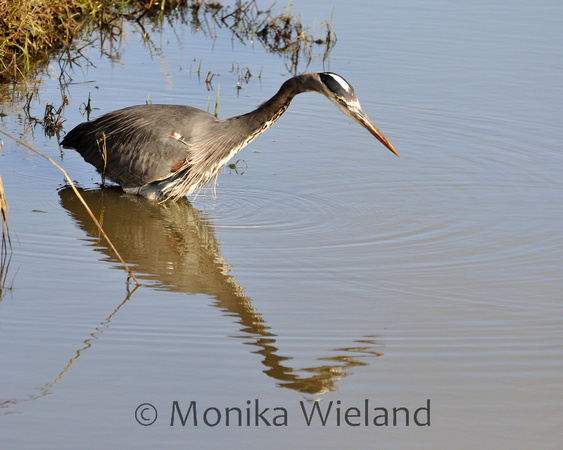
In the final stretch of the auto-tour route it was the herons that stole the show. First, we got a nice look at a great egret. Then, we paused to watch this great blue heron successfully catch several small fish:


Then, around the corner, I was amazed to see this American bittern right out in the open. These birds are often very tucked away in the grasses and hard to see, but this one was walking right along the edge of the marsh:


A couple of things really stood out while seeing this bird at close range. One was the beautiful, intricate patterning on the feathers. The other was the surprisingly large talons on the feet!

While we were watching, the bittern took a few steps back into the grass. It was amazing how, even while looking directly at it, the bird began to disappear into the grass just a few feet away.


When we got back to the start of the auto tour loop, we checked in with the park ranger who said no one else had seen the vermilion flycatcher after that one sighting early in the morning. Then, just as we were ready to leave, he came up to us on his cell phone and said he was talking to another birder who was looking right at it. Of course, being this close to not just a year bird but a life bird, I had to try again! We made another trip around the auto tour route, spending extra time in the area the flycatcher was seen, but despite having several other birders nearby looking for the same bird, we weren't able to relocate it.

There were several other year birds I was hoping to get while in Oregon, and a few other unexpected reports came in while I was there. Next up, I'll report on my successes and failures in the year bird hunt.

Wednesday, November 30, 2011

Delayed, But Lots to Come!

I have several blog posts just waiting to be written and lots of photos to share, but I've been thwarted first by a broken computer and now by a lack of internet at home. So until I'm back up and running, here's a quick preview photo of some of what's to come:

Thursday, November 24, 2011

Owl Prowling: The Elusive #200

As I looked over my year and county lists heading down the stretch, I identified owls as a group I could target to pick up some more ticks for both lists. My efforts started on San Juan Island, where I surveyed the prairie habitat at the south end of the island for a snowy owl. It's a bit of a stretch, but sightings do occur every so often on the island and there seems to be a pretty decent flight of snowy owls in western Washington right now with numerous reports around the state. I didn't find one, but I did find a short-eared owl near the Cattle Point lighthouse like I mentioned in my last post.

I got a tip from a friend about a good barn to investigate for barn owls. After talking to the owner, we headed out and climbed up into the loft of an old barn that looked like a perfect hangout for barn owls. We spooked two roosting rock doves out of the rafters, but no owls. Closer inspection turned up a couple of barn owl feathers and some rather fresh-looking owl pellets (including a rodent skull of some sort), so it seems like they're still using the site. It will be worth returning and taking another look, for sure.

Later that same night I recorded some owl vocalizations onto my phone and we headed out to do some nighttime owling. Stopping at some haphazardly chosen locations and playing great horned and western-screech owl calls didn't turn up any responses, though we did see an owl fly across the road, lit up by my headlights. It was too quick to ID, but if I had to guess, I would say it was a barn owl. It was even headed in the direction of the barn we had investigated earlier!

Giving up the county listing efforts for the holiday weekend, we departed in stormy weather on Tuesday afternoon to head south to Portland. When we pulled into Anacortes the overcast conditions and pouring rain made it seem like dusk already at 3 in the afternoon, but I drove south as fast as conditions would safely allow with a particular target in mind. Stanwood, about an hour away, is the site of some of the aforementioned snowy owl reports, and I wanted to swing through and try my luck before continuing on to Portland.

When we pulled off the freeway to head to Stanwood, the streetlights had already turned on. It was another six or seven miles to the place where, I learned from my dad via text message, two snowy owls had been seen earlier in the day along with six short-eared owls. I drove to the end of the dead end country road that had attracted numerous birders over the previous few days and pulled over to overlook the muddy field where all the owl activity had been. Nothing. I scanned with my binoculars, straining my eyes in the dimming light, figuring that if I had been able to see the trumpeter swans we had passed 15 minutes earlier stand out against the dreary background, a pure white snowy owl would be visible, as well. Way in the distance I saw a tiny white speck on a hillside; maybe it was an owl, but there was no way to tell for sure.

It was getting even darker, and the rain was still pouring down. There was another spot a few more miles away that the owls had been reported, and I weighed my options. I knew if I didn't try now, I would be kicking myself and would have to take this detour again on the way north six days later, if the owls were still present. There being no time like the present, we headed even further away from the freeway and the hours of stormy nighttime driving that awaited us. While stopped at an annoying long traffic light, I not so silently cursed myself. This was a stupid thing to be doing, right? It was already so hard to see, certainly not what I would consider bird-watching conditions, and there was a long drive ahead of us. But I was committed at this point, so we went on.

At the end of this next country road I parked and pulled on my rain jacket. The directions said you had to proceed on foot to see the owls. I was looking for the landmark specified in the directions, but after a few moments of walking saw nothing resembling the turn off recommended that would lead the owl seeker up onto the dike overlooking the field where the owls had been seen. Acting impulsively, or perhaps heeded some innate guiding sixth sense, I veered off the trail and scrambled up the muddy slope onto the dike where there was a clearing that looked like it would afford a view to the other side.

Straight in front of me, maybe 100 yards away, was a snowy owl (year bird 200). Unable to believe my eyes, I lifted my binoculars and was just able to make out the movement of the owl turning its head to look directly at me. It had been a somewhat more frustrating journey than I had anticipated to go from 199 to 200, but standing in the chilly rain on a dark November afternoon in a brief stare down with a barely-visible snowy owl also seemed somewhat appropriate. 

The rest of the drive to Portland was miserable, the conditions being no more amenable to driving than they had been for bird-watching. But every time I thought of that owl, I was still able to smile. There are many people that probably wouldn't have thought so, but the detour was well worth it.

Sunday, November 20, 2011

A Matter of Record Keeping

It's been a while since I've checked in on where I stand with the year list. I was stalled out for a while at 197, and figured my best shot at pushing over 200 would be when I do some traveling for the upcoming holidays. Then, however, I got an e-mail from Tim over at 39 Counties, who is looking to see 39 species in all 39 of Washington's counties this year (and in fact is close to getting 50 species in every county). He was looking at data on eBird and noticed that I'm within spitting distance of the San Juan County record for species seen within a year. Washington Birder has the record at 156 species, and at the time of the e-mail I had 149 in the county for the year. Of course I can't resist a challenge, so it was time to comb through the species list and renew my efforts birding on the island down the stretch.

The first thing I noticed on my San Juan County species list was the northwestern crow. Personally, I think the American crow and northwestern crow are probably one species, but currently they are considered separate species and the general consensus is that only northwestern crows inhabit the San Juan Islands. If I'm going to count this as a species on my county list, I've got to count it as a species on my year list, right? I hadn't included it as separate from the American crow just yet, so the northwestern crow now occupies the out of order position of 198 on the year list - chintzy, I know.

One species that's been reported around the county recently that I hadn't seen was the ancient murrelet, and I had been trying to see some from shore for quite some time, but without any luck. Lucky for me, my bird-watching friend Phil helped me out and we took a little trip out into San Juan Channel where he had been seeing lots of murrelets. It didn't take us long to locate a few ancient murrelets (year bird 199, county bird 150):

Ancient murrelet in San Juan Channel
It was a beautiful, calm afternoon - a nice break in some of the stormy weather we've been having - and there was lots of other bird activity out there as well. Bonaparte's gulls, mew gulls, and glaucous-winged gulls, plus common murres, rhinoceros auklets, and loons. We also saw several pairs of marbled murrelets, and I got my best-ever photo-op of this endangered species:

Marbled murrelets in San Juan Channel

I've identified 20 possible county species to look for down the stretch, and I've been out several afternoons looking for them since then. No luck just yet, but of course I've seen lots of other cool stuff. I've found two short-eared owls at different locations on the island, found a Eurasian wigeon mixed in with a flock of American wigeon, seen my first trumpeter swans on the winter, and found an impressive flock of 150+ Canada geese (especially large numbers for on the island).

Coming up this week, after scouting out a couple of potential owl locations on the island, we'll be heading to Portland for Thanksgiving. The county birding effort will be put on hold, but I expect to push the year list over 200 on the trip. Dave, my rival year lister, beat me to the 200 mark a good two weeks ago, but of course what really matters is where the count stands at the end of December 31!

So, now that all that record-keeping is out of the way (did you follow all that?), I'll be updating my bird list status more regularly down the home stretch of 2011. What will my 200th year bird be? Will I end the year ahead of Dave? Will I get the county year list record? Stay tuned to find out!!