For any use of my photos, please contact me at monika.wieland (at) gmail (dot) com
Showing posts with label rainbow. Show all posts

Tuesday, April 16, 2013

From Winter to Summer

This month - this season - is a true merge between winter and summer. Some mornings there has been a coating of frost on the ground, but some afternoons have been warm enough to walk outside with no more layers than a T-shirt. There are still bufflehead and ring-necked ducks at Westside Lake, but above them orange-crowned warblers sing and rufous hummingbirds display. Some days have been windy, rainy, and downright chilly, while others have been bright and sunny and bordering on warm. Needless to say, I've been fully enjoying those nicer days and spending more and more time outside.

Sometimes we get all kinds of weather in a single day or over the course of just a few hours. On one such afternoon, the result was a rainbow (actually a faint double rainbow!) over Brown Island seen right off our front porch:


I've been doing some bird monitoring out at False Bay Creek, and back on April 5th I heard my first common yellowthroat (130) of the season singing a single tentative song. By now, they are confidently trilling away in all the marshy areas on the island.


Last Sunday I went for a walk with four friends at Three Meadows Marsh, which is probably experiencing its most active month bird-wise right now. There were pairs of bufflehead, northern shoveler, mallards, pied-billed grebes, coot, ring-necked ducks, and wood ducks on the marsh. The most impressive sighting was FIVE swallow species, a first for me in the month of April. The tree and violet-green swallows were as expected the most common, but there were also a few more barn swallows, a single cliff swallow (132), and a pair of northern rough-winged swallows (133). There were probably a good 20 marsh wrens singing around the marsh, along with more yellowthroat. In total, two hours turned up a very impressive 40 species.

Today I took advantage of a half-day at work to spend the afternoon outside, but before leaving the work place I added orange-crowned warbler (134) to my year list. I'm surprised this one has taken so long to check off. I'm pretty sure I've glimpsed and faintly heard a few before today, but I just wasn't sure enough until now! That sighting, however, helped push our work bird list past 30 species this year, which is way more than I would have expected!

After lunch I headed out to the upland trails near the Lime Kiln Quarry. I was surprised to hear my first warbling vireo (135) of the year - a bit early for this species, but I checked the song on my bird app and it was unmistakable. A little further down the trail I heard a singing Hutton's vireo (136), another year bird!

There have been lots of mourning cloak (Nymphalis antiopa) butterflies out in the last few weeks, and today I finally got close enough to one to get a photo:


The quarry overlook was beautiful this afternoon. While taking in the view I could see or hear violet-green swallows, American robins, orange-crowned warblers, purple finches, chestnut-backed chickadees, and red-breasted nuthatches. 


I had seen a couple of rufous hummingbirds, but was surprised when a male Anna's hummingbird perched nearby. The Anna's are here year-round, but seem to fade into the background a bit during the few months after the flashy and aggressive rufous hummers arrive. 


Next up, a trip to the Oregon Coast! Hopefully the weather will cooperate, as then there will be more pictures to share and some more birds for the year list!

Sunday, January 27, 2013

The Magic Hour at American Camp

Yesterday was a very gray, drizzly day, but I felt like getting outside for a bit so close to sunset I headed down to American Camp. I wanted to look for the short-eared owls down there, who I figured might be active regardless of the weather. Amazingly, right as I pulled up to the Redoubt Road, I saw several owls flying over the prairie just as the sun was starting to break through the clouds for the first time of the day. What followed was a pretty amazing hour when it came to owls and lighting:

Short-eared owl at dusk


Double rainbow over the American Camp prairies


Before I left I drove down Pickett's Lane, and saw my closest short-eared owl of the day. It was almost getting too dark for photos, but not quite:


Short-eared owl and the end of the sunset

It ended up being a much better outing than I had hoped for: four short-eared owls, amazing light, beautiful sunset, and two rainbows! Can't ask for much more than that.

Tuesday, July 24, 2012

A Wet and Wild Whale Watch

The weather forecast Sunday evening wasn't exactly ideal for a whale watch: 25 knot winds, rain showers, and a chance of lightning isn't what you expect when you book a sunset whale watch trip in July. It's always luck of the draw when it comes to going out on a wildlife tour, but the friends and family I had in town were all game to take our chances and see what we could see. It turned out to be a pretty epic trip aboard the Natsilane with San Juan Island Whale and Wildlife Tours.

J-Pod, K-Pod, and their few L-Pod friends had been doing the "westside shuffle" all day, going from False Bay to Salmon Bank and back again. As we headed south down San Juan Channel, the waters were calm, but I knew all that could change after we pulled through Cattle Pass. Indeed, in addition to the rain starting to come down harder, we started taking on a lot of spray as we made our way around the south end of San Juan Island in steady three-foot chop.

When we first got on scene with the whales a little ways off False Bay, it was hard spotting. The whales appeared to be spread out and foraging, so we would just see one whale here, one there, and they would only surface once before diving again. Soon, however, we found a little group of whales that was spending a little more time at the surface. Within the group was K26 Lobo, and even though it wasn't quite the golden evening lighting I had imagined it might be, it was still neat to see the sun breaking through the clouds and reflecting off his tall dorsal fin:


The waves didn't seem to be affecting the whales at all - of course they often deal with much more adverse sea conditions in the winter on the outer coast - but as we bobbed in the waves, it was still apparent just how built for the sea they are.


The second group of whales we got a good look at closer to shore included mom J22 Oreo and her son J34 Doublestuf. I love this picture because it shows a key ID feature on each whale: Oreo's black beauty spots on her left eyepatch and Doublestuf's notch on his rapidly growing dorsal fin. (Click to see a larger view.)


It was amazing we got to see the whales as well as we did in those sea conditions, but as we started to head back to the harbor, our amazing sightings weren't done. The cloud formations were among the most amazing I've ever seen.


The sun fully broke through the clouds just before we got back to Friday Harbor, and with the light drizzle it created rainbows everywhere. I don't think I've ever seen so many in such a short time span before! We saw a double rainbow, which is caused by a double reflection inside the rain drops, and we also saw two overlapping rainbows going off at arcs at different angles. Apparently this might have something to do with the light bouncing off the ocean before reflecting through the raindrops. Unfortunately both the secondary rainbows were too faint to show up in my pictures.


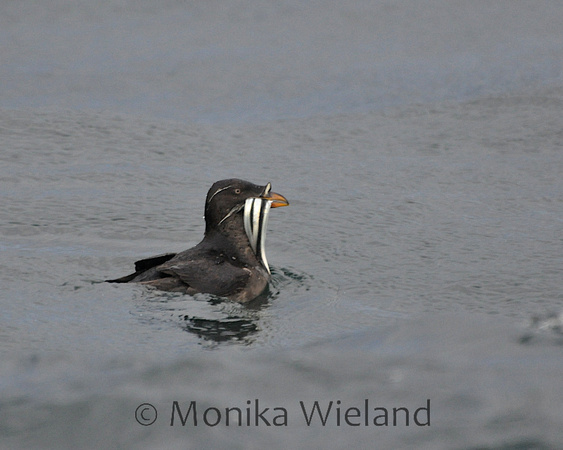
Photographers often have goals of certain shots they want to get one day, some challenge based on lighting or a certain combination of elements to help keep photographing the same subject interesting over the years. One I've always wanted to get is a rhinoceros auklet with its beak full of fish. I've gotten distant silhouetted shots of this before, but this was the type of shot I was really after. I never would have guessed it would come while at speed on a boat in choppy water, but there ya go!


Saturday, September 3, 2011

Exploring Near Campbell River, BC

After our whale-watching trip last Saturday, we had a full day to explore near Campbell River on Sunday. We spent some time on the trails near Elk Falls Provincial Park along the Campbell River. We didn't see any elk, but did see a mama deer with this fawn:


Despite being relatively close to the roadway, it was a beautiful trail through the woods:


It was an interesting site right along some industrial complexes. The bridge visible in this picture was actually built on top of a pipeline that crosses the river there. There were also lots of people actively fishing, and a few snorkeling down the river. One thing they advertise that you can do in Campbell River is go snorkeling with salmon - interesting!


We got to Elk Falls when the lighting was just right to create this little rainbow. It made for an interesting contrast in a bright waterfall lit by the sun, the dark shadows of the river valley behind, and the scintillating rainbow:


It was a warm day - warmer than most of the afternoons we've had on San Juan Island this summer - so after birding a little along the shoreline of Discovery Passage it felt great to sit on the shade of the deck at the hotel and enjoy this interesting beverage: hard cider made out of saskatoon berries. Known in the US as serviceberry (Amelanchier alnifolia), the road or trail side plant often gets overlooked by Americans. Canadians, however, enjoy the fruit in pies and jams, dried, or infused into beverages. Look at that color!


That's Quadra Island in the background of the above photo, reflected both right side up in the middle of the glass and upside down at the top of the liquid.

We also made two visits to Tyee Spit at the mouth of the Campbell River, and this was the best little birding spot we found in our explorations. On each visit we saw half a dozen bald eagles, multiple swallow species, harlequin ducks, common mergansers, Canada geese, mallards, killdeer, and several hundred Bonaparte's gull. On our second visit, however, we also found a single mute swan (year bird 191)! The mute swan, introduced to North America, is more established on the east coast, and only has a few population centers this far west. One is at the southern end of Vancouver Island, and occasionally they roam over to the San Juan Islands from there, though I have never seen one in San Juan County. I was surprised to see one this far north on Vancouver Island, but I have no idea if this is normal or not!

The park at Tyee Spit, looking inland
Overall it was a great trip to Vancouver Island! I also succeeded in proving to myself that it's really not so hard to get over there - after all, it's only a ferry ride away, just like the mainland. Next year I hope to go back, spend a little more time, and get a little further north on the island.

Sunday, January 9, 2011

Niagara Falls

As we arrived in Niagara Falls last night it was getting dark, but after a delicious dinner at The Como Restaurant we walked over to see the falls lit up. It was stunning with the skyline of Niagara Falls, Ontario in the background:


We got an early start this morning and went for a hike around Goat Island. I was eager to add some birds to the year list and I didn't have to wait long, though I was somewhat surprised to see hundreds of mallards (21) in the rapids of the Niagara River above the falls among the snow and ice.


These clearly weren't your run-of-the-mill mallards because instead of dabbling they were actually diving for something beneath the surface. Not only that, but I saw a female mallard actually go over Niagara Falls and take flight in mid-air. It was far away but I attempted to capture it via photograph. Click to see a larger version, and the blue arrows point to the female mallard:


Near the first mallards I saw were also many ring-billed gulls (22). A small flock of Canada geese (23) flew over, and then I also picked some herring gulls (24) out of the mix. There was a lot of gull activity in general all along the Niagara River, and I finally figured out what they were after when I caught this herring gull in action:


I'm assuming those little fish end up going over the falls?? The gulls were definitely feeding both at the top and bottom of the waterfalls, as well as at other points along the river.

Out at Three Sisters Island I found some common goldeneye (25), and then near Horseshoe Falls I spotted a common loon (26) far below. One thing that amazes me about these falls is not just their size, but the amount of spray that fills the air around them. Here's a look towards Horseshoe Falls from Prospect Point:


During the winter, the mist actually freezes to everything it touches, which makes for some pretty stunning winter scenes. All of the trees downwind, for instance, are coated in a thick ice as a result of the mist. I bet you can guess which side the falls are on relative to this tree:


While I was photographing the icy trees something caught my eye, and much to my surprise it turned out to be a peregrine falcon (27). Then as we continued walking I spotted a very pale gull, which I suspect was a glaucous gull, but unfortunately it disappeared too quickly and I wasn't able to relocate it despite coming back to try again later. I did, however, find a couple great black-backed gulls (28), an eastern species I was hoping to pick up.

Next up we hiked the gorge trails between Devil's Hole and Whirlpool State Parks. Interestingly enough, while this is just a short ways down the river from the falls, none of the same gull species were present. Instead, there was a huge flock of Bonaparte's gulls (29). I was also surprised to come across a lone harlequin duck (30), a rare species for this region, but an ID I was sure of since I see so many back home. Here's a view towards the big whirlpool bowl in the Niagara River canyon:


After climbing out of the gorge I saw one of the black squirrels I had heard about. It turns out these aren't a distinct species, but rather a melanistic version of the eastern gray squirrel. Melanism results in an animal having extremely dark pigmentation, and is the opposite of leucism or albinism. They can be found anywhere eastern gray squirrels occur, but in some places are more common, like they are here near Niagara Falls. This little guy wasn't too interested in being photographed so this was the best I could do:


After a quick pit stop for lunch, I headed back to goat island to try and turn up another gull species. I didn't have any luck in the gull department, but I did find a few American black ducks (31), another great eastern species to add to the list. It was cool that I could compare them directly to the nearby female mallards to make sure of the ID. On the same outing I also spotted a few American wigeon (32), canvasback (33), bufflehead (34), and several large groups of lesser scaup (35).

Here are a couple more views of Niagara Falls in the daytime. The first one includes a rainbow from this morning:


And this one is a close-up view taken from the observation platform at Prospect Point:


By this point I figure I had walked about 5-6 miles and my feet were not too happy about being stuck in snow boots all day. Although I wanted to do some more exploring I was done walking so we decided to drive north to Fort Niagara State Park near Youngstown on the shore of Lake Ontario. It was getting late in the day but we got there in time to see the sunset, and get a nice view of the Toronto skyline in the distance over the ice floes in the lake:


The timing also couldn't have been more perfect to see the Fort Niagara Lighthouse, which was silhouetted against a colorful late afternoon sky and appeared to have its light lit by the rays of the sun:


 All in all it was a great day, with 15 species added to the year list including two (the great black-backed gull and American black duck) that I have only seen once before. Now I am TIRED so it is off to bed (this will post on Pacific Time but remember I am three hours ahead of that - haha). It should be another big day tomorrow, though there are 3 inches of lake effect snow in the forecast so we'll see how much outside time I end up getting.

Monday, November 29, 2010

Thanksgiving Weekend ~ Birding on the Oregon Coast

I had a great holiday weekend with the family at the Oregon Coast. The coast is beautiful any time of year, and it seems like regardless of when you go you'll end up experiencing all four seasons. This trip was no exception. When we left, the temperatures were still below freezing in Portland and the roads were icy going over the coast range. (We saw some elk crossing the road just as we were reaching the coast that night!) While there we also got rain, sun, hail, and wind. We all had a great time playing board games, watching college football, and eating great food, and I enjoyed playing with my four year old niece and newborn nephew. My dad and I also had some time to get some good birding in.

On the morning of Thanksgiving we went from Cannon Beach, where we were staying, over to Seaside to check out an area that's known as "the cove". Great birds are often reported there and I've seen some there myself on previous visits. This time there were lots of gulls (western, glaucous-winged, and ring-billed), and also a big flock of black turnstones and surfbirds (year bird 224). 


They weren't at all skittish, and most remained resting while we approached to take some pictures. They looked a bit comical standing on one leg, trying to stay warm in the morning chill. The turnstones are the black ones, and surfbirds are gray:


Here is one of the western gulls. I'm still learning about gull identification as I go along, but my understanding is the mantle on western gulls is much lighter further to the north. Down in California they would appear more like in the field guides with a darker back.
 Someone saw that we were interested in birds and came over and told us about a female painted bunting that had been hanging out nearby. He hadn't seen it in a few days, but we decided to go over and take a look anyway since we were so close. There was no sign of the bunting, but there was a lot of bird activity at the site, where we saw dark-eyed juncos, golden-crowned sparrows, and a Bewick's wren, northern flicker, downy woodpecker, and spotted towhee:


It's amazing to me that Anna's hummingbirds overwinter in the Pacific Northwest. I'm not quite sure how they manage to find enough food and survive the freezing temperatures, even though I did hear about a few considerate birdwatchers that rigged up electrical wire to keep their hummingbird feeders from freezing during this last cold spell. This female Anna's found some winter blossoms right outside the windows of the cabin we were staying in:


When there were breaks in the weather we could take some walks on the beach near Haystack Rock. I was amazed on our first walk to see about twenty dead sea birds within a stretch of a few hundred yards. I was equally amazed to come back out the next day and see only two of them remained - the rest had been swept out to sea by the last tide. It left me wondering just what we would find on the COASST survey of my dad's beach near Netarts the next day. Last year, November was the record high survey when we found 11 birds.

Sunset near "The Needles", the two rocks near Haystack Rock.

The next day it was raining on our hour long drive down to Netarts, and it stopped just as we arrived. It took us a little over two hours to survey the beach, even though the tide was fairly high so the beach was narrower than during some of our other surveys. In total we ended up finding a record (for us) thirteen birds, including six northern fulmars, two rhinoceros auklets, two common murres, two gulls, and one unknown (just a wing remained). It's always interesting to me since I have yet to find any birds on my survey beach on San Juan Island, since far more birds wash up on the outer coast than in inland waters. Here is one of the dark morph northern fulmars we found:


We saw the next storm cell moving in as we were measuring our last couple of birds, and sure enough the first rain drops hit the windshield *just* as we were stepping back into the car. It was another major downpour, but it was short-lived, and by the time we were passing Tillamook Bay after a stop for a beverage and a snack the sun was shining again and a bright rainbow could be seen over the bay:


It was already getting late in the afternoon and with limited daylight we had to just head back to the cabin without doing too much birding. There were still several possible year birds to be found on the coast, though, so we decided to drive home yesterday the longer way by going through Tillamook again and taking some time to bird in hopes of finding a Brandt's cormorant, Thayer's gull, or ruddy turnstone for the year list. We saw double-crested and pelagic cormorants, common goldeneye, bald eagles, ruddy ducks, and scaup, but no year birds as we approached Tillamook. We decided to go for one more birding stop on the Tillamook Spit before heading inland and it turned out to be a great decision. As we were driving out the Spit we were very surprised when my mom spotted a pair of red phalaropes (225) feeding right along the shoreline!


It was unexpected to see this mostly pelagic species right along Tillamook Bay, and interestingly enough the only other time I've seen this bird was during Thanksgiving weekend last year when one stopped over for a few days at Westmoreland Park in Portland.

Further out on the spit we stopped to scan a large flock of American wigeon and found a single male Eurasian wigeon in with them. There was also a great egret nearby. On the start of our drive home along the bay we also saw several belted kingfishers and surprisingly a single Bonaparte's gull as well.

It turned out to be a great weekend, and bird-wise I ended up seeing 49 species in all. Next up, it's time to head back to San Juan Island, which thankfully has thawed out from the early winter snow they experienced while we were gone!

Tuesday, September 1, 2009

September's First Sunset

It was chilly and drizzly today, making it feel like the change from August to September brought the change from summer to fall overnight. Still, by early evening, it turned into a beautiful, if not still frigid, end to the first day of September. Here are some photo highlights:

From the road while walking home from work


The view from "my rock" at Lime Kiln Lighthouse....not a bad view while I was waiting for the whales!


J-Pod led the way as the whales started passing a little before sunset


The rest of the whales were pretty far offshore, but the sunset itself was worth sticking around for. Due to color-balancing issues all these photos appear on the web much less orange than the originals, but it still gives you the idea.

The sky lit up over Vancouver Island after the sun went down


A purse seiner heads home in the fading light after a day of fishing.