For any use of my photos, please contact me at monika.wieland (at) gmail (dot) com
Showing posts with label butterfly. Show all posts

Tuesday, October 6, 2020

A Getaway to Okanogan County

With 2020 in no way shaping up as planned, with two cancelled vacations we found ourselves ready for a little getaway after more than 6 months without leaving San Juan Island. Only interested in visiting unpopulated areas, wanting to see some new birds, but also to stay in the state of Washington, we decided to head due east from home, east of the Cascades into Okanogan County. While we had explored the Winthrop/Twisp area before, this time we decided to go further east, renting a home-base cabin 30 minutes east of Tonasket out in the woods. 
 
It didn't take long to start seeing new bird species to add to our photo year list; the most exciting one on the way to our cabin was a flock of mountain bluebirds.
 
 
While the goal of the trip was birding, the all-around change of scenery is much appreciated, including the vegetation. It's amazing how different the plant life can be just a few hours drive from home. I could spend all day looking at the trees and shrubs and trying to identify them - in fact we did spend an hour on one quarter-mile trail just looking at the plants! We've timed it well for the fall colors, too, which as been an added bonus.


Our plan has been a series of loop drives from our home base cabin, exploring all kinds of back roads in search of wildlife. The weather has been better than expected - in fact, hotter than expected, and we did not pack accordingly! But no complaints about the all-day sunshine and the amazing photographic opportunities that has helped provide.

Black-billed magpie in perfect light

One of the biggest surprises of the trip was finding a black bear! While we had visited suitable bear habitat, where we saw it was not at all where I would picture a bear - in the middle of farm country. I'm glad I got a photo before it disappeared over the hill, or I might not have believed I really saw it!


The mammal diversity has been better than expected as well. The black bear was the largest, and my second favorite is probably the smallest, the yellow-pine chipmunk.
 

 Another unexpected find was the ghost town of Molson near the Canadian border. Not only was the town, complete with original pioneer buildings you are free to explore, amazing in its own right, but it also neighbors a series of lakes where we found species I never would have anticipated on this trip, including blue-winged teal and Barrow's goldeneye.

The ghost town of Molson, WA

Molson Lakes, hosting an incredible diversity of waterfowl species

The trip turned up two hoped-for life birds, in addition to more than 15 species for the photo year list.

Life bird #1: White-headed woodpecker, a serendipitous find of a species I've longingly look at in the field guide for many years!

Life bird #2: The well-camouflaged gray partridge

The so-called game birds were among the target species for the trip. I figured California quail would be the most common, but I wasn't prepared for just how many flocks we would see! 

The ubiquitous California quail, ranging in flock size from half a dozen to more than 30

My goal was to see at least one other species which we did with the gray partridge, but we lucked out again by finding a group of chukar, too, a bird I've only seen twice and a lifer for Jason.

A brief look at a chukar

I've always been fascinated by the fact that birding seems to come in "spurts". You can go through extremely quiet stretches and then seemingly hit the jackpot, finding unrelated species all in the same place. Such it was on the chukar day, after seeing nothing much more than magpies and robins for 2/3 of the day, a flurry of excitement in one unplanned roadside stop turned up not only the chukar, but a flock of over 100 sandhill cranes migrating overhead, and our first golden eagle of the trip.

Sandhill cranes riding the thermals well overhead

Golden eagle! Another hoped-for species of the trip

I keep saying this trip was primarily about bird-watching, but really, it was about immersing in nature, enjoying all creatures great and small, and getting a much needed break from at all, at least as much as is possible in 2020.

Orange sulphur butterfly

Douglas squirrel

It was rejuvenating to get away for a bit, and also a great reminder that you don't have to go far to go exploring. I will definitely be reliving these warm, sunny days and all the cool critters we saw through whatever it is fall and winter has in store for us in the coming months.

Tuesday, February 13, 2018

Birding Around the Phoenix Area

Once we woke up and started birding in Arizona, it was very apparent we were in a different climate with a whole new host of birds! While we had started seeing new things along the way, here it felt like every species we saw was different from back home. 

Time to look even more closely everywhere! No longer just yellow-rumped warblers flitting around in the trees, but verdins as well

Our first stop of the day was to Zanjero Park in Gilbert where there is a burrowing owl nesting habitat. I knew this was a city park and had seen from people's photos they got quite close to the owls, but I wasn't prepared for anything like this! The owls were using the pipes just off the sidewalk as burrows, visible here as the little lumps on the left with poles marking and numbering each one (click to see a larger view) - maybe 30 feet off the path at most? It's amazing to me that they just sit there and watch while people, bikes, and dogs go right on by!


People have reported as many as 14 owls there before, but we were thrilled to see 2.


Next stop was the Riparian Preserve at the Gilbert Water Ranch, which has a series of ponds you can walk around. It's not surprising that this oasis attracts a lot of wildlife, including not just waterfowl but all kinds of birds! For starters, it was a great place to get photos in the sunshine of many species we've only seen in the gray weather this year back home.


But it didn't take much looking to start seeing species we don't get back at home, like one of my personal favorites, the black-necked stilt.


And for some reason these two species often seem to go hand in hand, as another pond also had the American avocet. So fun playing with reflections in sunny blue water!


There were many places to sit near the water partially obscured by vegetation where, if you were patient enough, even the more skittish species would start to approach.

Long-billed dowitcher
I wouldn't expect to have added in the neoptropic cormorant as a life bird in the middle of the desert, but there they were!


And while watching these guys, a juvenile black-crowned night-heron flushed from the bush above them!


To the careful observer it was more than just birds enjoying the water ranch, too; occasionally darting across the paths were these desert cottontail.


After a break for lunch we headed to the Desert Botanical Gardens, where even this time of year the heat of the afternoon was enough to make the birds more scarce. We thought it was hot, though it was probably cool to the locals - maybe close to 80? It was bizarre for us to see butterflies pollinating flowers in February!


We did end up finding a few avian species, but it would have been worth the trip just to see one of my desert favorites - the cactus wren.


It had been more than 10 years since my last trip to Arizona, but it used to be at least an annual trek when my grandparents on my dad's side were alive. While originally from Germany, they ended up spending much of their lives in Scottsdale, which is also where my dad graduated from high school and, later on, my parents would meet and live for the first few years of their marriage. So, somewhat unexpectedly, there are some Wieland roots in Arizona, and was a bit nostalgic to be back. It felt fitting to make a visit to my grandparents' memorial which I hadn't seen in person before.


When I made a similar trip for my grandparents on my mom's side a few years ago, I got a life bird, and I was surprised when the same thing happened again here - after visiting the memorial a vermilion flycatcher flew into a nearby tree.

Thank you for the life bird, Omi and Opa!
Perhaps it was due to the cooler late afternoon, but the birding was actually better here at the memorial gardens than it had been at the desert botanical gardens! A couple of mute swans have apparently made their home here for many years; the light and everything else was perfect for this photo - except the feather on its beak!


When you get a roll birding, whether it's seeing lots of new things or trying to reach a target number of species for the day, it's easy to get a bit trigger-happy. A memorable moment my dad and I often recall is when we were doing a Big Day and light was fading and we were just short of our target and we thought we saw a western screech-owl that turned out to be a robin. I was guilty of the same thing when the last bird we saw of the day flew from a tree and I called out, "Zone-tailed hawk?!" No - the photos would prove later it was "just" a dark morph red-tailed hawk. That's part of what makes birding so fun, though, is the never knowing what you'll see. In a new area you're likely to see all kinds of new things, but it was a good reminder that some of the regulars are still around, too.

Thursday, May 2, 2013

April Flowers and May Moths

The weather last weekend didn't end up being conducive to much more picture taking, but I did get out to a COASST survey at Fourth of July Beach, and as per usual the live birds were the most interesting find as there were no stranded birds. I was surprised to see a trio of killdeer there, and hanging out with them was a small flock of least sandpipers (149) and a single western sandpiper (150). 
This week, however, has seen some more beautiful, warm spring weather. On Tuesday afternoon I took a walk at American Camp where more wildflowers are blooming every day. 

Small-flowered lupine (Lupinus polycarpus)

Meadow death-camas (Zygadenus veneosus)

Common camas (Camassia quamash)

One of my favorite wildflowers is also one of the smallest. It's very easily overlooked - the small-flowered forget-me-not:

Small-flowered forget-me-not (Myosotis laxa)
Here's another shot with my thumb in it to show just how small they are. The flowers are only 2-5mm wide.


I'm not sure what this plant is, but it also had very small white flowers:


I was surprised to see a mosquito (or a close relative) feeding on some English daisies. As annoying as they can be, only the females are blood suckers and only during parts of their life cycle, so it makes sense that the rest of the time they're another useful species of insect pollinator.


I also came across this very cooperative butterfly:

Common checkered skipper (Pyrgus communis)
It stayed completely still as I slowly made my approach and took a few pictures. When I glanced down at my camera to check a setting, it made a quick getaway, as when I looked back up it was no where in sight. My field guide says this is probably the most common American skipper species, but I haven't noticed it here before.

These interesting insect sightings were trumped by a surprising find today on the sidewalk in front of the office at work. I couldn't believe my eyes when I saw this ceanothus silk moth:

Ceanothus silk moth (Hyalophora euryalus)

These are the kind of moths you see pictures of in books and magazines, but I've never seen one in real life. They're mostly nocturnal, which explains why I haven't seen one before, but WOW! Also known as the Nike moth (for the swooshes on its wings), the larva feed on plants of the Ceanothus genus which explains their other common name. I was surprised to see Douglas fir and madrone are also on their list of host plants/food - I guess this is good habitat for them here!

The giant silk moth family, so named for the large silk cocoons they spin, contains some of the most stunning moth species in the world. I believe this one is a male due to the large size of the feathery antennae. The adults only live for 2-3 days, but males may fly up to 20 miles in that time as they track down females by scent.

Yet another example of how you just never know what you're going to see - or where you're going to see it!

Tuesday, April 16, 2013

From Winter to Summer

This month - this season - is a true merge between winter and summer. Some mornings there has been a coating of frost on the ground, but some afternoons have been warm enough to walk outside with no more layers than a T-shirt. There are still bufflehead and ring-necked ducks at Westside Lake, but above them orange-crowned warblers sing and rufous hummingbirds display. Some days have been windy, rainy, and downright chilly, while others have been bright and sunny and bordering on warm. Needless to say, I've been fully enjoying those nicer days and spending more and more time outside.

Sometimes we get all kinds of weather in a single day or over the course of just a few hours. On one such afternoon, the result was a rainbow (actually a faint double rainbow!) over Brown Island seen right off our front porch:


I've been doing some bird monitoring out at False Bay Creek, and back on April 5th I heard my first common yellowthroat (130) of the season singing a single tentative song. By now, they are confidently trilling away in all the marshy areas on the island.


Last Sunday I went for a walk with four friends at Three Meadows Marsh, which is probably experiencing its most active month bird-wise right now. There were pairs of bufflehead, northern shoveler, mallards, pied-billed grebes, coot, ring-necked ducks, and wood ducks on the marsh. The most impressive sighting was FIVE swallow species, a first for me in the month of April. The tree and violet-green swallows were as expected the most common, but there were also a few more barn swallows, a single cliff swallow (132), and a pair of northern rough-winged swallows (133). There were probably a good 20 marsh wrens singing around the marsh, along with more yellowthroat. In total, two hours turned up a very impressive 40 species.

Today I took advantage of a half-day at work to spend the afternoon outside, but before leaving the work place I added orange-crowned warbler (134) to my year list. I'm surprised this one has taken so long to check off. I'm pretty sure I've glimpsed and faintly heard a few before today, but I just wasn't sure enough until now! That sighting, however, helped push our work bird list past 30 species this year, which is way more than I would have expected!

After lunch I headed out to the upland trails near the Lime Kiln Quarry. I was surprised to hear my first warbling vireo (135) of the year - a bit early for this species, but I checked the song on my bird app and it was unmistakable. A little further down the trail I heard a singing Hutton's vireo (136), another year bird!

There have been lots of mourning cloak (Nymphalis antiopa) butterflies out in the last few weeks, and today I finally got close enough to one to get a photo:


The quarry overlook was beautiful this afternoon. While taking in the view I could see or hear violet-green swallows, American robins, orange-crowned warblers, purple finches, chestnut-backed chickadees, and red-breasted nuthatches. 


I had seen a couple of rufous hummingbirds, but was surprised when a male Anna's hummingbird perched nearby. The Anna's are here year-round, but seem to fade into the background a bit during the few months after the flashy and aggressive rufous hummers arrive. 


Next up, a trip to the Oregon Coast! Hopefully the weather will cooperate, as then there will be more pictures to share and some more birds for the year list!

Monday, May 14, 2012

Lots of Spring Walks, Lots of Spring Sightings

Last week Wednesday I got to check on the owlets again with my friend Katie (check out her blog for some awesome owl pics!). It's amazing how much they grew in just one week!


We watched them from a distance for about 10 minutes, and the cutest moment was when this little guy stretched, looking more like a slinky toy than a baby owl:


On Friday, a walk at the Friday Harbor Labs turned up my first singing olive-sided flycatcher (174) and also a western tanager (175) and another barred owl. A non-avian highlight was this very cooperative butterfly:


On Saturday, we spent the afternoon at another friend's house. I enjoyed exploring around her yard, where in an hour I saw/heard about 20 bird species. Here's the view from her back porch:


One bird highlight were the pine siskins. They were loooovvvviiinng the thistle seed feeders:


But my favorite birds to watch were by far the two pairs of rufous hummingbirds, that showed no fear of me sitting right below the feeders. That allowed for some great photographic opportunities. Here's a male, just landing and holding onto the perch:


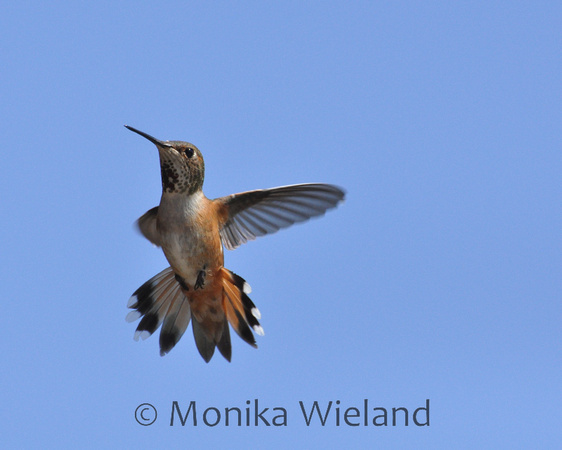
And here's a female hovering near the feeder, my favorite photo of the week:


While watching her feeders, I also saw my first black-headed grosbeak (176) of the year. We then went for a walk, and along her driveway was some striped coralroot (Corallorhiza striata), the first time I've seen this particular species of flowering plant that gets its nutrients not through photosynthesis but off fungi in the soil:


Nearby was the spotted coralroot (Corallorhiza maculata), the species I see more often:


On the walk, I heard several Wilson's warblers (177), as well as more olive-sided and Pacific-slope flycatchers, a mourning dove, and a band-tailed pigeon,  the latter two being more uncommon species here.

Sunday a hike near Roche Harbor gave me a chance to stop by the marina and see the purple martins (178) that are taking advantage of the nest boxes there. Finally, during a walk after work today, I heard my first Swainson's thrush (179) of the year. Meanwhile, Dave's been ticking away over in the UK, and despite my productive California trip in February sits only 7 species back in our year list competition!