For any use of my photos, please contact me at monika.wieland (at) gmail (dot) com
Showing posts with label doves. Show all posts

Saturday, February 24, 2018

To San Diego in Pursuit of More Birds

After four nights in Mexico it was time to head back to the US, and we decided to make a day of driving out of it and head east to San Diego. Even on our "travel" days, however, we always looked out for a stop or two to break up the day and hopefully provide some new birds. Jason did some research and found a gem in Yuma West Wetlands, a park right on the California-Arizona border. While we didn't see any burrowing owls in their designated habitat similar to the one we saw at Zanjero Park in Gilbert, AZ, we did see more than 20 species including several we hadn't see anywhere else.

The small common ground-dove, a species I had only ever seen once before on a different trip to Mexico
Our first confirmed Costa's hummingbird - we had likely seen some before but had had trouble confirming due to difficult lighting. I love how they can look so cute and so angry at the same time!
It's so much fun visiting these local parks that are oases for both people and birds alike. Many of the species there are probably very common to local birders, but so exciting for us out-of-towners to see. 


Northern mockingbirds are as common as robins in much of the southern US, but they're a rare treat for us to see from the Pacific Northwest

This park featured a fishing hole for both its human and avian visitors. This great egret was hoping for an easy bite, but after the fisherman wasn't getting any bites the egret moved along and had better success on his own.


When we got to San Diego that evening, Jason returned to eBird to research what we might have a chance of seeing the next day. Two of our most hoped-for species on the trip to Mexico had been the blue-footed and brown boobies that are regularly seen there. We searched hard for them, but didn't have any luck. With the relatively low numbers of terns and pelicans also around, my guess is there wasn't enough fish for them in the northern most reaches of the Sea of Cortez. (I remember seeing similar things in San Ignacio Lagoon - some years the fish-eating birds were abundant, and others scarce, depending on the fish.) That's the way it is with wildlife of course; there are never any guarantees. But when Jason found the rare bird alert for the pair of Nazca boobies that have been in San Diego Bay since mid-December, well, we simply had to give it a shot!

I had never heard of a Nazca booby before, and that's because they are a recent split from the masked booby. Their primary breeding colonies are in the Galapagos Islands but they are also seen in other parts of the eastern tropical Pacific in southern Mexico and northern South America. They are considered a "mega-rarity" to the United States.

From reports from other birders, we knew the views from land were usually distant. The boobies tend to sit on the Number 34 buoy in the bay, near a Naval base, where the only viewing is from the far side of the bay. When they're flying around foraging, some have been lucky enough to get closer looks from land, but these sounded rare. The best views and photos were coming from those who got on a boat to go see them closer. We decided to start on land and make sure the birds were even present before deciding what to do next. From the shore-based lookout, we could barely make out a white speck on the buoy across the water - if it hadn't been for so many reports from others, I wouldn't have even been confident there was a bird on the buoy, let alone that it was a booby.

Do you see the Nazca booby? Do you even see the buoy it's on?
We did, however, see the white speck, and another birder with a scope said it was the booby. With having missed the boobies in Mexico, having this one so close, and being on vacation, we decided, "What the heck. Let's splurge and rent a boat and go see it." So we did just that! Loew's Action Sport Rentals was just down the road (and the booby has apparently been good for business!)

If the booby won't come to us, let's go to the booby!
We headed out for the Number 34 buoy and found....nothing.


Just our luck! The bird that had been sitting there had apparently taken off to forage, meaning it could be anywhere in the bay. We had less than an hour and counting to try and find it.

Finding a booby in a bay aka finding a needle in a haystack
We started cruising around at higher speed, stopping for any black and white bird soaring around.

Nope, not a Nazca booby - but a royal tern, that's cool too!
Then something caught my eye that was most definitely a different shape. We found one!!!

Plunge-diving Nazca booby
At first it was flying around at high speed and we only got distant looks. It would dive, and briefly sit on the water, but every time we got closer it would take off and resume foraging. 


But then it turned and flew right over us!

Wow! Success!
On our way back to the harbor we swung by the Number 34 buoy again, and this time we got lucky - the second bird had returned and let us get a great look.


We had definitely been concerned we were going to be skunked once we got out there, but it turned out to be well worth it! As we slowly motored back to port, I felt like we were being watched - and it turns out that we were, by this osprey:


On a roll, we decided to check out  the near by San Diego River estuary for some other great bird sightings that had been reported there in recent days. We found one of them - a little blue heron, a bird far more likely to be seen in the southeastern US than in the southwest.

Little blue heron - another great find!
By this point, however, us island dwellers had had enough of downtown, so we headed north out of the city and made a stop at one of my all-time favorite birding spots: Batiquitos Lagoon. I used to go here regularly when my grandpa lived in Oceanside and is one of the places that gets credit for getting young me excited about birding. I can't go through the San Diego area without making at least one short stop here. It's still basically in the city but regardless of time of year is home to an astounding amount of bird life.

Yay! Batiquitos Lagoon!
It didn't take long to start adding more year birds.

California towhee
While looking up for a possible great horned owl near a nest in the middle of the park, I spotted a merlin feeding on a vole or other small rodent. Their color is so much lighter here than the darker morphs back home that it took me a moment to recognize what it was!


I stopped at a pipe outlet where the water creates a dark puddle in the bushes. On a visit here with my dad probably about 20 years ago we had stopped here and seen a sora emerge from the reeds, still the only time I have ever seen that species. As I was telling Jason this story I couldn't believe my eyes when another elusive bird emerged from the grasses: a Virginia rail! I was trying so hard all of last year to get a chance to photograph this species and now I got a golden opportunity, right where I had seen a sora. Birding is so fascinating this way - how often you can go to the same little place and see the same type of thing even decades apart.

My first time photographing a Virginia rail!
Our trip was already winding down, but we still had a couple days in California, and we had plans to both soak up as much sunshine as possible and see as many birds as we could before heading back north! I'll wrap up our road trip story in the next blog post.

Friday, March 8, 2013

Anticipating Spring

As the calendar turned to March, and the days get noticeably longer, I find I'm more than ready for some of the things I associate with spring on San Juan Island: a little more sunshine, wildflowers, and spring migrants. I was all ready to go on the first Saturday in March, but unfortunately woke up to drizzly weather that stayed all day. Not to be entirely deterred, I went out and walked around Three Meadows Marsh and did some birding in the rain.


When taking a first glance at the marsh, there weren't many (or any) bird in sight. Closer scanning with the binoculars and a walk all the way round turned up a respectable 10 species of waterfowl. The highlight of the walk, however, was hearing two or three different Virginia rails. Also heard were both marsh and Pacific wrens and a lot of red crossbills. The species total for the one hour walk was 24.

Sunday was much more what I hoped for weather-wise: sunshine! It was windy and chilly, but that didn't matter as much. I could just feel myself beginning to recover from the winter-long vitamin D deficiency as I walked along the bluffs at Cattle Point. If I just looked at the scene in front of me and ignored my partially frozen ears and fingers, I could imagine this being a tropical beach below me:


That daydream only kept me warm for a few minutes, though, so I headed to the other side of the dunes to get more out of the wind. On the windy side the only notable sighting was five bald eagles (one adult, four immature) playing in the wind. Two of the immature eagles were chasing each other around at top speed, which was awesome to watch. There were a wider variety of birds to be seen on out of the wind, however. In the trees I found a pair of mourning doves - still an uncommon species on San Juan Island, though I seem to be finding them more regularly here:


In the same clump of trees I found a small flock of bushtits (year bird 117) and hear a pair of Bewick's wrens (118) singing. A few minutes later, while scanning the channel, I got my first definitive look at a Brandt's cormorant (119) this year. I'm sure I've seen them during my other visits to Cattle Point, but they're usually too far out in the channel to see any field marks, instead ending up on my day list as "cormorant species". The species total for this outing was again 24.

During the week I didn't have a chance to get out much, but one day this very pale, scraggly looking great blue heron came for a visit right off the front porch:


It was kind of a gray week, but today, Friday, the sun came back out so this afternoon after work I went for another walk at English Camp. I was particularly hopeful to add at least one spring migrant to my year list, but alas there were no osprey building a nest, warblers singing in the treetops, or swallows cartwheeling over the bay. Patience, patience - they'll be here soon! It was a beautiful walk regardless.


 There's enough different on my new camera that I still feel like I've got a lot to learn, so I played around with a few different things while aiming my lens at some of the more common species that I admittedly sometimes take for granted and don't photograph at all.


While standing at Bell Point watching five black oystercatchers in flight over the bay, I realized the Douglas fir I was standing under seemed to be crackling. Right over and around me was a small flock of red crossbills feeding on seeds out of the cones, seemingly unbothered by my near presence. Despite being so close to them, I couldn't get a very clear look at them. This is about the most of any bird that I saw - see the crossbill?


Crossbills seem to be really abundant on the island right now. They're often hard to get a good look at, but if you are familiar with their call, you can hear them everywhere. They were just one of the 26 species I saw at English Camp this afternoon.

The red-flowering currants were in bud, which means the rufous hummingbirds should be here any time now. This shot in particular reminded me that even though I'm ready for it to be here NOW, spring is indeed on the way:


Sunday, March 25, 2012

Early Spring Birding

It's strange weather in US this spring: the eastern two-thirds of the country are experiencing unseasonably warm temperatures and, as a result, very early spring migrations. Not so here on the west coast, where winter is hanging on with lots of wind, rain, and even a few sea level snow flurries. The weather over the last few weeks hasn't been too great for getting out a lot.

Last weekend I did go out for a walk at the Lime Kiln quarry, where the highlight was seeing my first Hutton's vireo (158) of the year. It was in with a very winter-like mixed flock of chestnut-backed chikadees, ruby- and golden-crowned kinglets, and dark-eyed juncos.


There were a couple awesome sightings right off our front porch recently, too. We've seen a river otter a couple of times, and one afternoon it was actively fishing between the two docks. While I was watching, it hopped right up on the dock at the base of our stairs to eat a fish, and didn't seem to mind me being there with the camera at all!


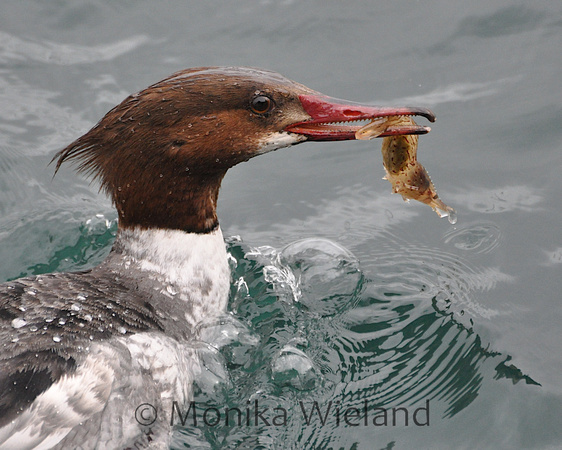
The fishing must be good right here, because we've continued to see all three (common, red-breasted, and hooded) merganser species too. This female common merganser caught a dock shrimp right off the houseboat on this rainy afternoon. I love how you can see the serrated teeth:


This weekend the weather has finally started to feel spring-like, so I got out for a few hours of birding both days. On Saturday, the highlight was my first San Juan swallows of the year; there were about a dozen tree swallows over Sportsman Lake. I also heard my first county marsh wren of the year there, but I saw both those species in California back in February, so they weren't year birds.

While there aren't a lot in the way of spring migrants here just yet, the winter birds are noticeably starting to decline in abundance. The flocks of ducks are much smaller, and I saw only two trumpeter swans yesterday.

Saturday I spent most of the time inland because it was pretty windy out, but with a calmer day today I headed to the south end of the island. It was a beautiful, sunny afternoon down at Cattle Point.


For the first 10 minutes or so the only bird species I saw were a couple of glaucous-winged gulls and a flock of house finches, but after a little over an hour there I had upped that total to more than 25 species. There were still a few surf scoters and horned grebes in Cattle Pass, and I was thrilled to also see my first-ever eared grebe in San Juan County. I also saw a small flock of harlequin ducks and 8 black oystercatchers.

An eagle flew over Goose Island, stirring up all the gulls, and then went and perched in this tree. Here it is calling to its mate who was circling high overhead:


Another good find was this mourning dove, an uncommon species on San Juan Island. Usually I just see and hear Eurasian collared-doves at this location.


As I was walking back towards my car, I heard the unmistakable sound of a rufous hummingbird (year bird 159) doing an aerial display. I hung out long enough to watch it do several big parabolic dives. I only saw a male, but presumably there was a female nearby watching too! Then, while I was looking up immature scoter plummages in my field guide while sitting in the car, a single violet-green swallow (160) flew over! Not bad!

I also went for a walk over by South Beach, where it wasn't very birdy, but I did see about five western meadowlarks. It's a weird transitional time right now. There aren't very many birds around numbers-wise, but you can see small numbers of both winter and spring species. Hopefully this nicer weather will continue and some of our other migrants will start showing up soon!

Finally, I had to pull over to photograph this very nice looking red fox, still sporting his/her plush winter coat:


Tuesday, February 15, 2011

A few recent sightings

On Sunday there were reports of part of J-Pod heading in (east) from the Strait of Juan de Fuca. Hopeful to maybe catch them on the west side of San Juan Island, I went out to the Land Bank Westside Preserve in the afternoon. There weren't any whales, so I walked around the property and did a little birding. In the south cove were four harlequin ducks, and the bald eagle was in his usual snag to the south as well. A few glaucous-winged gulls hung out around the shoreline, but otherwise the water was pretty quiet. To the north I could see a pair of black oystercatchers on the rocks, and they eventually took flight with their characteristic whistling calls. On the trail that winds through the blackberry brambles I came across a flock of nine golden-crowned sparrows:


I went down to South Beach hoping to find another year bird, but the water was pretty quiet down there as well, and there were no shorebirds on the beach. I did find a few surf scoters, a couple of horned grebes, and a trio of red-breasted mergansers.

At this point I got an update from a friend that the whales were still heading in, so I decided to stop by Land Bank one more time. Right when I pulled up and lifted my binoculars I saw two blows and the distinct dorsal fins of a male and female orca. These weren't the incoming J-Pod whales, however, but two transient whales! (Maybe T20 and T21 who have been around?) They were miles away heading south from Beaumont Shoal and soon disappeared into the late afternoon gloom. I waited another 20 minutes or so, but the residents never made it in, nor did they later judging by the lack of vocalizations on the hydrophones that night.

Yesterday was a wild windy day, with heavy rain last night, and then more wind this morning. It hasn't been weather conducive for going out birding, but when I was driving home through town just a little bit ago I saw a Eurasian collared-dove (124) in somebody's front yard! It looks like these guys are spreading around the island in a hurry, as this is my first sighting in town, though I haven't seen any in their regular perches near False Bay or Cattle Point yet this year.

Thursday, January 6, 2011

A Couple More Birds and Conclusion of the WJC

With daily hockey games the birding has continued to be limited, and even on my few walks sightings have pretty much been limited to a pair of mourning doves or a small flock of crows.

Mourning dove

 The only birds added to the year list this week are a red-tailed hawk (13) seen from the car and the American goldfinches (14) that have started coming to the feeders.

Pair of American goldfinches with a black-capped chickadee

Pretty much all of the eastern bird species that I had hoped to photograph while here have eluded me since New Year's Day, so I hope they start coming to the feeders again in the next couple of days. The only eastern species I have photographed isn't a bird but a mammal - the eastern gray squirrel:

Eastern gray squirrel

The lack of birding has clearly been getting to me as last night I had a dream about bird-watching (granted it was in the warmth by the thawed out lake, not in the 20s in the snow like it is here!). There were all sorts of bizarre birds in the dream that I hadn't seen before, and the only one I was able to locate in my dream field guide was the emperor-faced sora. It looked like a coot and was swimming in the lake but had bright orange cheeks, a yellow bill, and a strange blue knob on top of it's head. My dad suggested I start a 2011 dream bird list, and right now that one would probably exceed my waking bird list for the year!

That said, the World Junior Championship has been a phenomenal experience for a hockey fan like myself. I've attended 10 games in 8 days, and some of the more exciting match-ups have come since my last post. After Sweden beat Canada in the round robin play to win their grouping, Canada faced off against Team USA in the semi-finals, ending any hope for a repeat of last year's gold medal match-up where USA upset Canada in overtime. The crowd for the USA vs. Canada game was unbelievable:

Crowd at the USA vs. Canada semi-final game

Canadian fans, who far outnumbered US fans even though we're in New York and not Ontario, celebrated the 4-1 win and sent USA to the bronze medal game vs. Sweden.

Waving the red, white, and blue at the bronze medal game

Yesterday afternoon in the bronze medal game, USA came out with a strong third period performance to top Team Sweden 4-2 and win the bronze. While somewhat of a disappointment after last year's gold, it's the first time USA has won a medal while hosting the tournament and the first time in the 35 years of the tournament's existence that they have won medals in back-to-back years.

Team USA shakes hands with Team Sweden after being awarded their bronze medals

Yesterday evening was the gold medal match-up of Canada vs. Russia. Canadians were out in full force hoping to see their team recapture the gold medal they had won for five straight years before last year. Tickets were being resold for about $200 a piece and there was not an empty seat in the noisy building when the game started.

Team Canada during warm-ups at the gold medal game

Things were looking to go in the Canucks' favor after Canada was up 3-0 after two periods of play, but Russia came out strong with a pair of goals 13 seconds apart early in the third, and Canada failed to respond as Russia put up three more to score five unanswered goals in the third period to snatch the gold medal.

Russia celebrates winning the 2011 World Junior Championship

While about half the fans poured out of the building with time still on the clock after Canada was trailing 5-3, those that stayed were surprisingly classy and cheered Russia's win. I did hear one woman telling her husband that she didn't regret one penny they spent on the tickets, though he didn't seem to feel the same way. I went into the game cheering for Canada since Portland Winterhawk Ryan Johansen is on the team, but I couldn't help but root for the heavy underdogs and admire Russia's upset win.

Now that I'm overdosed on hockey for a while it's time to get cracking on that year list!

Monday, July 26, 2010

San Juan Island Eurasian Collared Doves

On June 28th I saw my first ever San Juan County Eurasian collared-dove along Bailer Hill Road. Since then, I've seen anywhere from 1-3 there regularly, and today I finally stopped to take a photo. The lighting wasn't the best, but it was good enough to show the field marks.


I reported this sighting, and while it wasn't the first San Juan County record it was one of only a handful and I was learned that they have really just started colonizing the island this year. In addition to where I'm seeing them in the center of the island, there have been reports of more down near Cattle Point at the south end of the island.

Wikipedia describes this species as one of the great colonizers of the bird world in the last 100 years, dispersing from an original range of subtropical Asia to now being found all over Europe, throughout Russia, and into Northern Africa. After being introduced to the Bahamas, in 1974 it has colonized Florida and rapidly expanded its range across all of North America. The first sighting in Washington State was in 2000, and sightings have increased dramatically since 2005, with confirmed sightings in all of Washington's counties.

Originally many birders feared this would be the next great invasive bird species, a la the European starling. Of particular worry was that it would displace the similar native mourning doves. I heard one birder say that it seems Eurasian collared-doves may be inhabiting more urban settings while mourning doves prefer suburban areas. I have also heard speculation that perhaps the Eurasian collared-dove is filling the niche left empty by the extinct passenger pigeon - an interesting notion!!