For any use of my photos, please contact me at monika.wieland (at) gmail (dot) com
Showing posts with label dogs. Show all posts

Wednesday, January 18, 2012

Winter Storm Watch

We've had several days of varying amounts of snow, hail, and wind, but the worst of the most recent winter storm watch undoubtedly hit today. First thing this morning I put some fresh seeds on top of the snow and it didn't take me long to have some birds on the porch even before it really got light out. I can only imagining spending a night like last night outside, let alone when you're that small! By the way, that's not fog in the background, but mostly blowing snow:


Here are a few other wintery scenes from around the marina, later in the afternoon after it got light out and some more snow had fallen:


Snow pattern on a roof

After failing to get all the way home from work in my low-rider, two wheel drive car (I walked the last quarter-mile), I was amazing at all the bird activity. Juncos, chickadees, song sparrows, nuthatches. I saw my first Anna's hummingbird (93) of the year - though somewhat surprisingly not at the feeder I hung out this morning and refilled a couple of times throughout the day as it turned to slush. I imagine it must be hard to find food out there as a hummingbird on a day like this, though our overwintering Anna's eat sap and insects in addition to flower nectar.

I was glad I stocked up on suet before the storm hit, and so was this nuthatch. Look at that tongue visible in his beak!


There was activity in the water, too. A river otter came by. This pied-billed grebe was here this morning and back in the afternoon - I only ever see them in our marina when their preferred freshwater habitat freezes over.


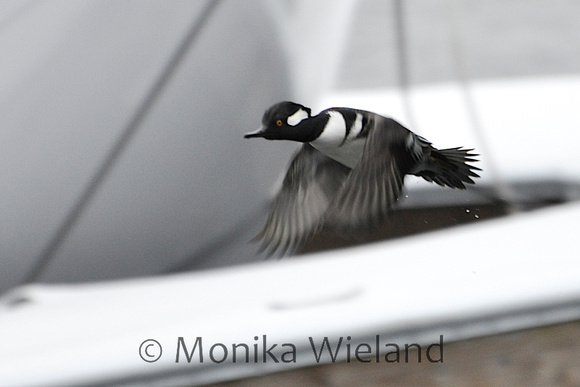
A group of four hooded mergansers (2 males and 2 females) were fishing in the same area as the grebe. When they took flight I had the camera ready, resulting in this photo that I like a lot:


The belted kingfisher was around, too, though instead of taking one of her usual more prominent perches she found a place to sit that was a little more out of the wind:


We walked to town to get a few groceries, and because of the snow I took my camera, too. I was happy I did when I saw this dog patiently waiting outside the store:


It will be interesting to see what the next few days are like! I don't mind a little bit of this winter weather, with the exception of having to worry about getting to work and back each day!

Monday, June 27, 2011

A Day At Lime Kiln Point State Park

June 2003

I had just graduated high school and was a couple weeks into my new research internship at The Whale Museum. I was settling into my regular routine of heading to Lime Kiln Point State Park every morning, where another intern and I would spend mornings in what was informally known as the "acoustics shed". We would plug headphones into a pair of dusty old computers and analyze recordings made on the park's hydrophones, assessing both sound quality and identifying specific vocalizations made by the Southern Resident killer whales. It was these many hours spend in the acoustics shed where I learned how to identify all the discrete calls. Occasionally one or the other of us would pull off the headphones and we would discuss the nuances of a particular call type. Is this an S7, or an S12? Why?

At midday a researcher from another project would come in to get weather data off our computers, and this was cue that it was time for lunch. We would all congregate at a picnic table to eat sandwiches, chips, and fruit. There were five or six of us spending our summers at the lighthouse, and we were periodically joined by a rotating cast of other characters: visiting friends and family, whale aficionados from elsewhere on the island, or visitors who came to the park hoping to see the whales. Some of these visitors, we learned, made annual pilgrimage to Lime Kiln from Seattle, or California, or Texas, or Holland. We became an informal whale community, swapping stories of past whale encounters and looking over photo ID guides, discussing how to identify certain whales that had more generic saddle patches.

The warm afternoon sunshine made it too pleasant to go back into the acoustics shed. Instead, we'd start a game of chess, while others played cards (if it wasn't too windy), or found a place to rest on the rocks and read a book or nap. Eventually, someone would get up to scan the horizon, and when the telltale sign of red and yellow zodiacs was seen, we would drop everything else and spring into action. Some of the other researchers would grab clipboards, data sheets, and ID guides. I would go into the lighthouse to start the hydrophone recording, make a few quick notes about the date, time, and direction of travel, then grab my camera and head down to my favorite rock: low to the water and right in front of the lighthouse. Soon we would see spouts, then dorsal fins, and I would start snapping photos - photography was new to me; in years past, I had shot only video. When the whales passed in front of us we would call back and forth to each other on the rocks, trying to ID each family group as they swam by....

Whale-watching from Lime Kiln in 2003 - that's me on "my rock", closest to the water, in the blue shirt with the camera

June 2011

I walk down the familiar trail to the lighthouse with my camera, backpack, and lunch. The morning calm hasn't yet left the water and when I see one of the researchers he tells me that half of J-Pod went north a few hours earlier. That's okay: I hope to see the whales, but mostly I wan to come and spend a whole day sitting at the lighthouse. It's something I haven't done much of in recent years.
The summer of 2003 was my first of five years interning for The Whale Museum. The call types I learned helped me write my undergraduate thesis on killer whale vocal communication. I continued with photography, and published a book of orca photographs in 2007. These last few years, working full time as a naturalist on a whale watch tour boat, were fulfilling in some ways, but also left something lacking. I've stepped away from working as a naturalist this season, and I'm re-evaluating my direction in life. I didn't go on to get a Masters degree in bioacoustics as I foresaw as a new high school graduate. I don't work on the boats anymore, despite so many people telling me that was the perfect job for me. But I'm still here, at Lime Kiln, waiting for whales. Some things haven't changed.

Pigeon guillemots taking off

Eight Canada geese in Haro Strait

I don't have to sit on the rocks long this morning before a couple of people I know walk up. We sit and look at the birds fishing in the ebb tide. A seal pops up in the kelp with a salmon and we pull out our cameras. My friends move on, and I find another place to lay on the rocks and start a new book. As the sun warms up I pull out my lunch and eat it while watching dragonflies and swallowtail butterflies, listening to nothing but the sound of the gentle waves.


Just when I'm starting to think about heading home to the chores that await me there, someone calls out, "Monika, we've got whales!" Out of nowhere, the other half of J-Pod is upon us, in a rare mid-day June moment of being unaccompanied by the commercial whale watch fleet. I immediately recognize J34 Doublestuf and pull out my camera as strangers gather on the rocks above me.

J34 Doublestuf

The whales quickly pass by, with a few tailslaps and distant breaches, and most of the tourists are gone. I walk around to the other side of the lighthouse and am surprised to see that I know almost all the people sitting there, and have known them for five or even ten years. Bob, the researcher. Billy, the park ranger. Wendy and Megan, the mother and daughter who make annual visits here. Diane, who used to intern for Bob, and now lives on the island. Mary, the volunteer naturalist.

Like the whales that just passed by, there have been some changes in our whale community over the last eight years. J11 Blossom has passed away. I haven't spoken to my fellow acoustic intern from 2003 since that last late summer evening. J28 Polaris has a new knick in her dorsal fin and a small calf in tow. Diane is now married with a brand new puppy. J22 Oreo is a familiar presence, the same as ever. So is Bob, the summer resident researcher collecting data on the boats and whales as they pass the lighthouse.

Diane's new English cream golden retriever puppy - Maddy

There's something grounding to me about spending a full day at Lime Kiln. I spent more than seven hours there yesterday, something I haven't done in years. I got sunburned. I read half a book. I ate a picnic lunch. I talked with old friends. I just sat and looked - there's never nothing to look it.

A pair of oystercatchers that flew by while I sat on the rocks at Lime Kiln
It was awesome.

Monday, August 30, 2010

Frogs and Dragonflies

This afternoon I was over at Katie's and we again took our cameras out into the amazing garden. The little Pacific tree frogs (also known as Pacific chorus frogs) were again abundant. I'm pretty sure we were mostly seeing juveniles, because adults tend to be 1-2 inches long and these little guys were more on the order of half an inch long:


I noticed a lot of variation in color, with some individuals being all green and others being almost completely brown or copper, with lots of intermediate color forms. I thought maybe you could tell individuals apart by these markings, but I read that some individuals actually seasonally change their color morph over the course of days or weeks based on the background brightness of their habitat. They think there are three common morphs: green, brown, and changers.


Above is a green Pacific tree frog. It's perched on a cattail leaf to give you an idea of how small it is! Below is a more copper-colored individual:


There were also all sorts of insects enjoying the garden, and today I had some luck photographing dragonflies. This first one is a striped meadowhawk (Sympetrum pallipes). Not much is known about the biology of this western species, but I was able to differentiate it from other meadowhawks by its black legs and pale diagonal stripes on the thorax:


There is one common dragonfly I have been seeing a lot of, including at Westside Lake, but I had never successfully photographed it until today. It's a darner of some sort (Aeshna spp.), but there are too many different kinds and I didn't get a good enough look at the necessary field marks to be able to figure out which one it is.


It's a little bit hard to tell here, but the one in the above photograph is a shimmery bluish. The one below was much greener, and as such probably a female:


The dogs were kept out of the garden today so they didn't disturb the wildlife, but they proved just as photogenic back in the yard. Here's the black lab, Ola:


Monday, August 16, 2010

Critters in the Garden

This afternoon I went to visit my friend Katie, who lives in the center of the island on a property with a pond and a huge garden. Despite the heat (we've had three or four days now with temperatures well above 80), there was quite a bit of activity on the wildlife front, and we were both ready, cameras in hand.

In addition to lots of cabbage white butterflies that are abundant right now all over the island, I also spotted a Lorquin's admiral (Limentis lorquini). This is a species I see every year but have yet to successfully photograph. Today I was so close to getting that perfect picture! Alas, I couldn't quite maneuver my way through the plants and this image is blurred by the stem of a plant in front of the rather tattered looking admiral. I'll have to keep trying, but this will do for now!


Near the edge of the pond we spotted several Pacific tree frogs (Pseudacris regilla) - amazingly enough the first frogs I've ever seen on the island! These were some of the smallest tree frogs I've ever seen: Katie described them accurately as being about the size of a thumb nail. They weren't very camera shy, either....


The bees were enjoying the wide variety of flowers in bloom in the garden, and I've tentatively identified the bumblebee species that we saw as Bombus mixtus:


The two dogs on the property kept us company and didn't really seem to disturb much of the wildlife, other than maybe the wood ducks on the pond which quickly made themselves scarce. With a face like this I couldn't resist pointing the camera at the domestic wildlife, too:


In terms of bird life, I saw a family of about ten California quail on my drive up. Overheard we had a pair of turkey vultures and a band-tailed pigeon (216) - I had to double check my year list and was surprised I hadn't picked up this species yet this year! In the trees in the yard and at the feeders we saw and heard cedar waxwings, chestnut-backed chickadees, red-breasted nuthatches, and purple finches. Here's a male purple finch in the tree where the feeder was hanging:


One other species of butterfly also caught our attention. It was enjoying several different flower species including these daisies. I'm pretty sure it's a woodland skipper (Ochlodes sylvanoides), reported to be common in the region, especially in early August:


It turned out to be a beautiful afternoon the garden, though it was nice to retreat to the coolness of the shade after a while!

Wednesday, June 9, 2010

Urban Wildlife in Anchorage

Location: Anchorage, Alaska
Population: 279,243

Before leaving the Denali area yesterday we got to take a tour of the sled dog kennels at the place where were staying. The owner of the lodge is a dog musher who has been on some pretty extraordinary expeditions and now guides back country dog sled trips in the winter. (Another side note of interest: we were staying on Stampede Road, the site where Christopher McCandless headed into the wilderness and eventually died of starvation while living in an abandoned bus 20 miles from the nearest road. You're probably familiar with his story - it has been documented in the book and movie Into the Wild.)

I have always found dog sledding intriguing but have never learned that much about it, so it was awesome to be able to learn a bit from someone so passionate about it. He raises his own dogs and currently has 22. They aren't Siberian huskies or malamutes, but northern sled dogs - a breed he says you cannot really call purebred or mixed, but rather "neither". They are direct descendants of the dogs brought over by people on the Bering land bridge. There is a lot of variation within them, and overall they tend to be much healthier than the ultra purebred dog speices.


He had a little of puppies in the yard which were almost five months old. I was immediately attracted to the playful female pictured below, and he said he has keyed in on her as a potential future lead dog. As any dog owner knows, dogs have varying personalities and that was very clear in the half hour we spent in the yard. He explained that the qualities he looks for in a lead dog are the same as the qualities you'd look for in a human leader, and that those qualities are just a rare. Most dogs are content to be followers, but some are willing to be out in front, make decisions, and take responsibility for the team. If I ever make it to Alaska in the winter I will have to try dog sledding for sure - I don't think I'd like the darkness of the northern winter, but the lure of dog sledding and seeing the aurora borealis might just be enough to lure me back.


Yesterday and today we've spent in Anchorage, the largest city in Alaska and home to nearly half the state's population. The setting for this city is a pleasant one as it is right at the end of Cook Inlet and surrounded by mountains. Even though it is a fairly metropolitan area, the wildlife of Alaska still make a home here. We went to Potter Marsh, part of the Anchorage Coastal Wildlife Refuge and just yards from a highway, to see some of the urban wildlife for ourselves.

Right away we saw this tree swallow that was amazingly accommodating and gave us the closest views you are ever likely to get of a wild bird:


While the marsh is an important stopover for many migrating species, some breed there as well. There were many mew gulls sitting on nests all over the wetlands, and several families of Canada geese as well:


Multiple fish species spawn in the marsh or transit through to higher streams, and off the boardwalks we did see some fish. I don't know a lot about fish, but after looking up some photos these don't look to me like the salmon, char, grayling, trout, stickleback, or scuplin listed as being native to the marsh. Unfortunately they look most like the northern pike, a species that was illegally introduced 10 years ago. Does anyone know for sure if that's what this is?


All the fish provide food for many of the birds, including the Arctic terns that dive-bomb the water from above. This tern caught (by the tip of the tail!) what looks to me like a stickleback:


Speaking of dive-bombing some tree swallows that must have had a nest in the area harassed this black-billed magpie until it took off looking for a quieter place to perch:


Some other birds seen and heard while strolling the boardwalks include the alder flycatcher and Lincoln's sparrow (two species that were life birds for me this trip), black-capped chickadees, orange-crowned warblers, northern shoveler, northern pintail, green-winged teal, and savannah sparrows.

Being Alaska, big animals make a home in this urban area as well. I read that an estimated 30 brown bears and 60 black bears make their home within the city limits, living in the greenbelts and taking advantage of the numerous lakes and streams. At Potter Marsh we saw a moose grazing in the wetlands:


There were dragonflies and damselflies making their home in the marsh as well, and this dragonfly settled down long enough for some photos that allowed me to tentatively identify it as a black meadowhawk (Sympetrum danae). This species is found in Europe and Asia as well, and in Britain it is known as the black darter. Are any of my British friends able to confirm this ID? You guys know more about dragonflies than I do!


After leaving Potter Marsh we headed a little further south of the city to Beluga Point which overlooks Turnagain Arm of Cook Inlet. As the name suggests this is a good spot to look for the Cook Inlet beluga whales, probably our shot of seeing them this trip. Unfortunately this population has declined dramatically and was recently listed as an endangered population, a fact that is very controversial locally even though the population has plummeted from several thousand to several hundred in a relatively short period of time. The reason for the decline is heavily debated as well, with reasons spanning over-hunting by local natives to pollution, disease, prey decline, over-predation by orcas, noise disturbance, etc., etc. With all the political attention surrounding these whales it was surprising to me how hard it was to find information about where and when to see them. We spent a couple of hours at Beluga Point on the incoming tide when they apparently follow the fish into the inlet, but no luck today. There were some Dall's sheep up on the cliffs above the overlook, another large mammal making a home within a fairly large city.

The incoming tide is a sight to see in itself, however, as this is the site of one of the world's 60 or so bore tides. A bore tide occurs when a huge tidal exchange is funneled into a relatively narrow inlet or bay, resulting in the leading edge of the incoming tide forming a standing wave. We didn't get to see the bore tide today, but with up to a 30 foot (!!) tidal exchange in six hours watching the tide come in is impressive. In a matter of minutes we watched the mudflats get covered in water as the rise rose several feet in front of our eyes. Pretty cool.