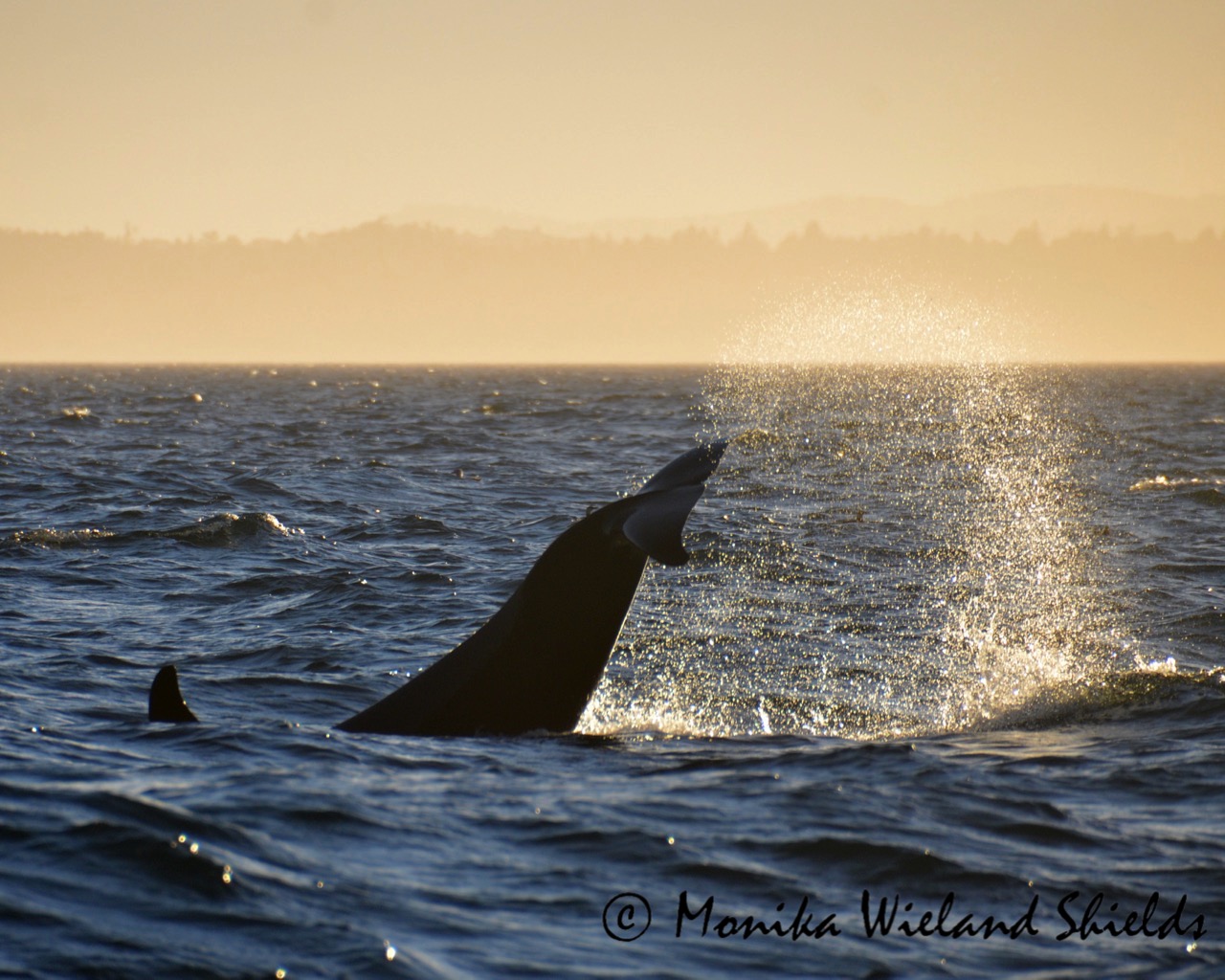
Today is Dia de Los Muertos (Day of the Dead), where every year I take a moment to remember the Southern Resident killer whales we've lost over the previous year. You can find all my previous Day of the Dead tributes
here; it's hard to believe I've been doing this for a decade! I think it's so important to both remember the stories of the whales we've lost and to honor them; so many of them, both in life and in death, fuel our fight for a brighter future for this unique population of whales.
J17 Princess Angeline
J17 was one of the iconic whales of J-Pod from the very first day I met them, and it's still hard to picture J-Pod being without her, even after a season with her absent. With distinct saddle patches on both sides (one with a possible healed gunshot wound) and a distinct slope to her fin, she was one of the first whales I learned to identify. Her namesake was Chief Seattle's daughter.
 |
| Close pass from J17 at Lime Kiln in 2005 |
For the first 10 years of my knowing her, her family group was made up of herself and her two daughters, J35 Tahlequah and J28 Polaris. I always thought of them as a curious and playful threesome with whom I had many memorable encounters over the years.
 |
| J17 as I knew her for a long time: flanked by her two daughters J28 Polaris and J35 Tahlequah, shown here in 2007. |
 |
| J17 was always good for a cartwheel - this one in 2016 |
It was such an exciting few months at the end of 2009 and beginning of 2010 when their family group doubled in size, with all three females having calves. First J17 gave birth to J44 Moby, followed by J28 giving birth to J46 Star and J35 giving birth to J47 Notch. I have one of those orca mobiles I bought at The Whale Museum many years ago, that has three females, each with a calf. Ever since this spate of births in their family group I have always thought of the mobile representing the J17s and their three little ones at the beginning of 2010. For J17, this was her first living calf in over a decade.
 |
| J17 with her son J44 Moby in 2010 |
Five years later J17 became a mother again during the "baby boom" year, giving birth to another daughter, J53 Kiki. (Kiki's name also comes from Chief Seattle's daughter Princess Angeline, who was also known as Kikisoblu.) With J28 also having given birth again, for a brief time this family group was at its largest size with 7 whales: Princess Angeline as the matriarch, her three daughters (J28, J35, J53) and a son (J44), and two grand-offspring (J46 and J54).
 |
| J17 Princess Angeline and J53 Kiki - a photo I always felt was a symbol of hope for this population. Apparently others have felt the same, as the photo has since been used by Greenpeace, Oceana, and shared on social media by Leonardo DiCaprio. |
Sadly, before the end of 2016 the J17s were struck by tragedy, and it has followed them in the years since. First was the loss of both J28 and her son J54. Then last year was the infamous 17 day-vigil by J35 carrying her deceased calf, which undoubtedly took some type of toll on Princess Angeline herself, who was still a nursing mother at the time. Her body condition declined after giving birth to Kiki, and never recovered. By the end of 2018 she had "peanut head", and by summer of 2019, she did not return to inland waters with J-Pod.
 |
| My last photo of J17, taken in March 2019 |
She's one of the most prolific Southern Resident mothers I have known, and the population is extra lucky that her family line seems to be able to produce a lot of healthy females, as there has been a male-bias sex-ratio into the population in the last couple decades. Because of these two facts, her legacy will hopefully be a long one. Despite the matriline having been fractured by recent deaths, her lineage could play a big role in the future and potential recovery of the Southern Residents in the future reproductive successes of J35 Tahlequah, J46 Star, and J53 Kiki. These three seem to be taking care of each other, too, as there was especial concern over Kiki, just 4 years old at the time of her mom's death. But in 2019 she has looked very robust, and has been spending a lot of time with both Tahlequah and Star, with Star having been observed sharing fish with her on several occasions.
Princess Angeline was 42 at the time of her death. While she was likely at the end of her reproductive life, the loss of her as a grandmother will undoubtedly be felt. We've already seen her family group become less cohesive after her death, but we hope her descendants carry on her strong maternal skills and that the J17s again become a matriline of seven whales or more.
K25 Scoter
Scoter was the eldest son of K13 Skagit and a true mama's boy, never far from her side. He's one of the first young males I got to watch grow up, but was notorious for his broad but relatively short dorsal fin.
 |
| K25 Scoter in 2005 at the age of 14. He was a real "late bloomer", with a shorter dorsal fin than most males his age. |
 |
| K25 Scoter (with a much taller dorsal fin 10 years later in 2015) following close behind his mom K13 Skagit |
Scoter seemed to enjoy the years L87 Onyx spent with K-Pod, as Onyx was particularly associated with the K7 matriline. While Onyx associated a lot with K7 Lummi, Scoter's grandmother K11 Georgia, and K13 Skagit, the two young males were also regularly seen together.
 |
| K25 with L87 in 2008 |
One of my most memorable encounters with Scoter happened in 2010 when I was aboard the Western Prince. We were parked and watching foraging whales when suddenly he appeared out of the depths right off our port side, carrying a salmon in his mouth. This sequence of photos remains the best I've ever taken of a Southern Resident with a salmon, and this photo was used in the book
Salish Sea: Jewel of the Pacific Northwest.
Scoter was satellite tagged by NOAA at the end of 2012, and his tag transmitted for an impressive 97 days, supplying the first detailed insight into the winter movements of K-Pod. While we knew Ks and Ls spent a lot of time on the outer coast in the winter, occasionally making trips to California, for the first time we had daily or near-daily updates on where exactly the whales were and how they were using the outer coastal habitat. The data from Scoter's tag was key in finally getting the critical habitat for Southern Residents extended to include the outer coast, and I believe will also be key in demonstrating the continued importance of the Columbia-Snake River Basin to K and L Pods, as it showed how much time they spend near the mouth of the river. Unfortunately, part of the tag remained embedded in Scoter's dorsal fin, leading to an extensive tag re-design by NOAA, but leaving Scoter with a permanent scar for the rest of his life.
 |
| K25 with satellite tag in December 2012 - Photo by NOAA |
When his mom died in 2017, we knew K25 was an "at risk" whale. Adult males often perish shortly after their mothers, and with his strongest female associates being his two sisters who already had offspring of their own, Scoter was a perfect example of the social context playing such a key role in an individual Southern Resident's prospects for survival. Like J17, Scoter was observed with "peanut head" by the end of 2018, and failed to return with his family group when Js and Ks finally returned to inland waters in July 2019.
 |
| My last photo of Scoter, taken September 2018 |
Scoter was 28 at the time of his death. He leaves behind a brother (K34), two sisters (K20 and K27), and two nephews (K38 and K44). The K13s spent so much time in inland waters over the years that I feel like I've gotten to know them as well as I know J-Pod. His one-of-a-kind dorsal fin will be missed, as there is truly no other whale quite like Scoter.
L84 Nyssa
Nyssa was part of the so-called "back page whales", the portion of L-Pod who traditionally appeared on the last page of the Center for Whale Research ID guides and also spent the least amount of time in inland waters of any of the Southern Residents. Despite rarely visiting the Salish Sea, he was one of the easiest of all Southern Residents to identify with a single large notch, a bold check-marked shape saddle on the left, and finger marking on his right side saddle patch. He was often the first whale from this elusive group of whales I would ID, leading me to exclaim, "The back page Ls are here!"
 |
| L84 off San Juan County Park in 2016 |
When I first met Nyssa in 2000, he had just lost his mother L51 Nootka the year before. Her body washed ashore near Victoria in September 1999 and she had a prolapsed uterus, having recently given birth to L97 Tweak. Being a neonate, Tweak had virtually no prospects for survival, but his/her big brother Nyssa along with L74 Saanich were seen trying to take care of and feed the little calf in the days after Nootka's death. They were not successful, but Nyssa maintained a close relationship with his closing living relatives in his uncle Saanich and great uncle L73 Flash over the next decade.
 |
| L84 Nyssa (right) with L73 Flash in 2007 |
The 2000s have not been kind to the "back page" Ls. Since 2012, Nyssa has been the last living member of the L9 matriline, one doomed to extinction after his mother died leaving no females capable of reproduction. He beat the odds and continued to survive by finding a surrogate mother figure in the living matriarch of the other "back page" matriline, L54 Ino, who took in both Nyssa and another orphaned male L88 Wavewalker. Despite the fact these whales have such strong matrilineal ties, these whales collectively taught me that they will "create" their own families if need be, making a matriline of their own when their direct relations have died out.
 |
| L84 Nyssa with Dave Ellifrit of the Center for Whale Research in 2015 |
My most memorable encounter with Nyssa happened in November 2014. My friend Julie and I had just bought our first boat Serenity a couple weeks prior. We weren't confident enough to take it far off the dock and thought for sure we would have to wait until spring to have our boat "christened" by an encounter with orcas. When word came in of members of all three pods milling off Kellett Bluffs, however, it was too great of a chance to passed up, and despite the choppy sea conditions we braved heading out as far as we had yet gone to see whales.
The whales were very spread doing long dives with unpredictable surfacings, and it was very fitting that the first whale to come close enough for us to identify was J2 Granny. We tell the story that Granny christened our boat (and our fledgling research efforts at the Orca Behavior Institute), but the part of the story that doesn't often get told is that on that day Granny was traveling with L84 Nyssa. Truly, he was part of the christening as well, which is also fitting, since his story gives us so many different glimpses into the social complexity of the Southern Residents that fuels all of our research questions at OBI.
 |
| Nyssa on the day he and Granny christened out boat Serenity in 2014, with Lime Kiln lighthouse in the background |
While both J17 and K25 had look malnourished in the months preceding their deaths, Nyssa's loss came as more of a surprise, as he had appeared to be in good health in recent encounters. A unique whale til the end, even the announcement of his death was unusual in that the Center for Whale Research declared him missing before they had ever encountered L-Pod in 2019, basing their announcement off photos provided by others on the outer coast. Sadly, it would true to be accurate, as Nyssa failed to return to inland waters with the L54s and L88 when they did finally make a rare visit to the Salish Sea in September. Nyssa was 29 at the time of his death. As the last living member of the L9 matriline, he leaves behind no living relatives and with his death leads to one of the several impending matriline extinctions within L-Pod.
New Additions
Since it's a bittersweet process to remember the whales we have lost (one from each pod this year), I traditionally end these posts with a nod of welcome to the newest members of the Southern Resident Community as well. In 2017 and 2018 there were sadly no whales to welcome, but thankfully this year we have had two new little ones born to help spark some hope among the continued losses.
One of them is L124 Whistle, the third offspring of L77 Matia. In a likely first, this little whale was first identified by helicopter, when a local news time broadcast footage of the Southern Residents in Puget Sound back in January. There had been no calves born since 2016, so it was clear this was a "new" whale, too tiny to be any of the others! Incredibly, Whistle's natal group (the L12s) has not been confirmed in inland waters since the end of February, so I have yet to meet this little whale! The L12s used to spend so much time here, and I hope in 2020 they do again so I can meet this little guy before he gets too big!
The other new addition is even sweeter, being a female calf born to J31 Tsuchi in May. Tsuchi has always loved spending time with calves, but her first in 2016 was stillborn. Fortunately, this pregnancy was successful, and it has sure seemed like we humans aren't the only ones excited to welcome J56 Tofino, as J31 and her rambunctious baby have spent time with whales from many other matrilines, and it truly seems as though all of J-Pod is enamored with this little calf. Thankfully both mom and baby appear robust and energetic, and we hope this is just the beginning of a long life of successful motherhood for Tsuchi.
 |
| One of my all-time favorite whale photos (and that's saying something!): J31 Tsuchi with J56 Tofino in the foreground and J47 Notch behind, taken in August 2019. |