For any use of my photos, please contact me at monika.wieland (at) gmail (dot) com

Wednesday, April 18, 2012

San Juan Channel: Bird Survey and Branded Sea Lion

Yesterday afternoon we participated in a marine bird survey transect down San Juan Channel. In the fall, a class at the University of Washington Friday Harbor Labs has been conducting surveys down this transect for birds and marine mammals over the last several years, and my friend Phil is interested in establishing a year-round data set following the same transect. Seven volunteers gathered to do the first one yesterday on a drizzly but calm afternoon.

While on the water I saw 13 bird species, the vast majority of them rhinoceros auklets. We did one survey going north to south, and one going south to north, and both times the other side of the boat saw WAY more birds than my side in terms of numbers. Still, we counted several hundred rhino auklets in each direction. Some other highlights included almost a hundred common murres, about 20 red-breasted mergansers, and a single long-tailed duck, the latest in the season I've seen one.

In terms of marine mammals, we had only one harbor porpoise and one harbor seal within our survey zone, but there were other marine mammals out there. Lots of Steller sea lions were hauled out on Whale Rocks, and this California sea lion was hauled out on the Reid Rock buoy just outside of Friday Harbor:


You can't tell in the above photo, but this sea lion is branded with the number 670, and this is the fourth spring in a row he's been hauling out on this same buoy! He was branded in Puget Sound in 2000 as a two or three year old, weighing 235 pounds. He has been seen multiple times on San Miguel Island, California (where he was a territorial male in 2008), as well as at Cascade Head, Oregon, and in the Strait of Georgia, British Columbia. That's a known range of over 1200 miles! Pretty amazing. As a 15 year old (or so) now, he probably weighs 800+ pounds. According to Wikipedia, the average lifespan is about 17 years in the wild. It will be interesting to see how many more years he keeps returning!

Monday, April 16, 2012

April San Juan Sightings

It's been a busy month at work, but on weekends and on nice springtime afternoons I've still made sure to get out and enjoy spring here on San Juan Island. Here are a few photos and sightings from the last two weeks.....

Last spring my friend Katie and I found a barred owl roosting in a tree near her house. We thought it might be a nesting site and checked it out earlier in the year this year. No luck, but by early April an owl was again spending its days in the same tree hole. Like last year, only part of its face was visible, but it was still cool to see:


Spring migrants have seemingly been slower to arrive here in the rest of the state, but one afternoon out turned up both my first savannah sparrow (161) of the year, and my first sighting of western bluebirds (162). The western bluebird reintroduction project has completed its five years of relocations, but they are still monitoring the local bluebird population. When I saw this male and female, 8 pairs had been known to have returned to the island.


There have been some clear nights with impressive stars this month, and one evening I got home just in time to see this impressive moonrise across the bay.


The local farmer's market has started up for the summer again, and on the first Saturday it was open I came home with a fresh baked chocolate croissant which I enjoyed while sitting on the front porch in the sun. While I was eating it, I heard a noise nearby, and saw I wasn't the only one eating a late morning snack. This mink was busily foraging, and came up with an eel-like fish. It dropped it, and was here scoping me out before going to retrieve it:


Sevearl birding excursions around the island have turned up first-of-the-year sightings for me in San Juan County, though they're birds I added to the year list early with the trip to California. Orange-crowned warblers, osprey, turkey vultures, wood ducks, and common yellowthroat are some of the species that have arrived. As a result, my county year list has surpassed 100 species this month.

With my parents up visiting this weekend, I did lots of birding with my dad, and added a few outright year birds as well. The brown-headed cowbirds (163) have arrived, which is not an exciting sighting since they negatively impact so many other bird species. While doing a COASST survey at Fourth of July Beach, I saw my first three northern rough-winged swallows (164) of the season. Then, while stopping to see the alpacas at the alpaca farm, I was surprised to see a chipping sparrow (165) sitting on a fence wire.

Also at Fourth of July Beach there was a small flock of shorebirds made up of about 10 black-bellied plovers and 20 dunlin, both of which are always a pleasure to see. Both of them are also starting the transition to summer breeding plumage, and probably won't be around much longer. Here's part of the flock:


Across the way looking over the Strait of Juan de Fuca were some impressive clouds, which as I know from my black and white landscape photography week (see last post) can make for some impressive shots. Here's one:


Finally, a hike at British Camp turned up lots of singing orange-crowned warblers, a few remaining surf scoters, and this very wet dark-eyed junco that had seemingly just taken a bath:


Next up, hopefully some more time outside, and some more regular blog posts again!

Sunday, April 8, 2012

San Juan Island In Black and White

My dad and I have been continuing our respective 365 Projects for the year, where we're taking a picture every day. Some weeks we come up with themes, which are great not only to come up with subject matter but are proving to be an inspiration to approach photography in whole new ways. Some of our themes, like "leading lines" and "forgotten" have kept me finding new photographic opportunities long after the week has passed. This week, the theme is "black and white landscapes". I've never really done much black and white photography before, but I've enjoyed trying something new. It's amazing how different a scene has to be to look good in black and white, compared to what looks good for a color landscape. Here are my results of this week thus far (one more day still to go!):


Sunday, March 25, 2012

Early Spring Birding

It's strange weather in US this spring: the eastern two-thirds of the country are experiencing unseasonably warm temperatures and, as a result, very early spring migrations. Not so here on the west coast, where winter is hanging on with lots of wind, rain, and even a few sea level snow flurries. The weather over the last few weeks hasn't been too great for getting out a lot.

Last weekend I did go out for a walk at the Lime Kiln quarry, where the highlight was seeing my first Hutton's vireo (158) of the year. It was in with a very winter-like mixed flock of chestnut-backed chikadees, ruby- and golden-crowned kinglets, and dark-eyed juncos.


There were a couple awesome sightings right off our front porch recently, too. We've seen a river otter a couple of times, and one afternoon it was actively fishing between the two docks. While I was watching, it hopped right up on the dock at the base of our stairs to eat a fish, and didn't seem to mind me being there with the camera at all!


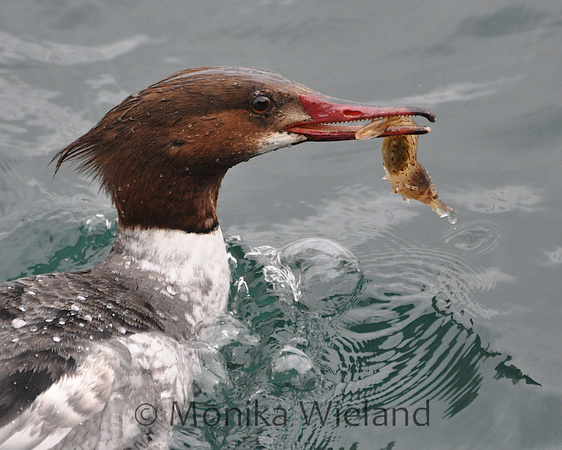
The fishing must be good right here, because we've continued to see all three (common, red-breasted, and hooded) merganser species too. This female common merganser caught a dock shrimp right off the houseboat on this rainy afternoon. I love how you can see the serrated teeth:


This weekend the weather has finally started to feel spring-like, so I got out for a few hours of birding both days. On Saturday, the highlight was my first San Juan swallows of the year; there were about a dozen tree swallows over Sportsman Lake. I also heard my first county marsh wren of the year there, but I saw both those species in California back in February, so they weren't year birds.

While there aren't a lot in the way of spring migrants here just yet, the winter birds are noticeably starting to decline in abundance. The flocks of ducks are much smaller, and I saw only two trumpeter swans yesterday.

Saturday I spent most of the time inland because it was pretty windy out, but with a calmer day today I headed to the south end of the island. It was a beautiful, sunny afternoon down at Cattle Point.


For the first 10 minutes or so the only bird species I saw were a couple of glaucous-winged gulls and a flock of house finches, but after a little over an hour there I had upped that total to more than 25 species. There were still a few surf scoters and horned grebes in Cattle Pass, and I was thrilled to also see my first-ever eared grebe in San Juan County. I also saw a small flock of harlequin ducks and 8 black oystercatchers.

An eagle flew over Goose Island, stirring up all the gulls, and then went and perched in this tree. Here it is calling to its mate who was circling high overhead:


Another good find was this mourning dove, an uncommon species on San Juan Island. Usually I just see and hear Eurasian collared-doves at this location.


As I was walking back towards my car, I heard the unmistakable sound of a rufous hummingbird (year bird 159) doing an aerial display. I hung out long enough to watch it do several big parabolic dives. I only saw a male, but presumably there was a female nearby watching too! Then, while I was looking up immature scoter plummages in my field guide while sitting in the car, a single violet-green swallow (160) flew over! Not bad!

I also went for a walk over by South Beach, where it wasn't very birdy, but I did see about five western meadowlarks. It's a weird transitional time right now. There aren't very many birds around numbers-wise, but you can see small numbers of both winter and spring species. Hopefully this nicer weather will continue and some of our other migrants will start showing up soon!

Finally, I had to pull over to photograph this very nice looking red fox, still sporting his/her plush winter coat:


Saturday, March 17, 2012

The Plot Thickens Surrounding the Death of L112

Christopher Dunagan of the Kitsap Sun interviewed Ken Balcomb after his comment in the San Juan Journal, "Clearly the animal was blown up," referring to the three-year old member of L-Pod, L112. Ken elaborated on his comments, stating he believes she may have died due to a bomb dropped from an aircraft. This is starting to look like a more likely theory than after effects of the sonar exercises, in part because Joe Gaydos of the SeaDoc Society, who conducted the cranial necropsy, said L112 did not swim far after receiving blunt force trauma to the head before she died.

Read the full article here.

Wednesday, March 14, 2012

The Sonar Issue Intensifies

Last month I posted a blog about L112 Sooke, a young Southern Resident killer whale that washed up on a beach on the Washington coast. Initial findings led many to wonder if maybe she was killed by Navy sonar activity in the Strait of Juan de Fuca. Since, then the Navy sonar issue has intensified and is getting more and more media attention.

An MRI was done on the head of L112, and while results from that test have not been revealed, a cranial necropsy was also conducted at the Friday Harbor Labs. (If you are interested in that kind of thing - it's not for the squeamish - video clips from the cranial necropsy can be seen here.) The scientists involved in the necropsy found trauma in the tissues of the head and evidence of hemorrhaging, though no official cause of death will be released until all tests are completed. Ken Balcomb, director of the Center for Whale Research, had some strong words about the issue in this San Juan Journal article. "It didn't die of disease or starvation. Clearly the the animal was blown up," said Balcomb, who was present for a beaked whale stranding that was also related to military activities.

As it is sounding more and more likely Sooke died of trauma related to sonar use, the question is looming: how many of her other family members have met similar fates? While it is not uncommon for members of K and L Pods, who were in the area during the sonar incident, to spend long lengths of time out of the Salish Sea this time of year, none of them have been seen again since Sooke was found. Until they are seen again, we won't know if Sooke was the only casualty. Candace Whiting ponders the same question in this Seattle PI blog.

Meanwhile, the Everett Naval Station has been conducting sonar exercises from their dock in Puget Sound, which has also been creating a stir. On multiple occasions the sound has been heard in the air or reverberating through the hulls of ships. While the Navy claims this is a standard procedure, it is being heavily criticized for coinciding with the arrival of the gray whales and occurring right in some of their prime feeding grounds in Puget Sound.

With all of these issues in the news, it's somewhat appropriate that there also happens to be a public comment period as the Navy seeks to reauthorize their training ranges in Oregon, Washington, and California. The draft Northwest Training and Testing Environmental Impact Statement can be read here. The proposed actions they hope to undertake are summarized here.

For some additional information on how sonar kills whales, as well as some suggested comments, check out the succinct summary posted by Candace Whiting on her blog.

I really hope many of you will take some time to learn a little more about this issue and submit your comments before the April 27th deadline. You can submit your comments online here. As is beginning to come to light with Sooke, this is a very real issue that could have some very serious impacts on our local marine mammals, including the endangered Southern Resident killer whales. Military exercises are a necessary event, but they can be done in areas and at time where their impact on cetaceans is limited. They don't need to happen in the Salish Sea, a habitat for so many marine mammal species. Please take a moment to make your voice heard!

Saturday, March 3, 2012

Coast Starlight: Northbound

Time always flies when you're having fun, and our California trip was no exception. On the morning of Friday, February 24th it was already time to check out of our hotel, but before we left we took another walk along the bluffs and the beach. There were lots of surfers out, and lots of birds too! I saw a northern mockingbird (151), which I thought might be a "big miss" on the trip. On the rocky part of the beach was a single northern tattler (152), and perched on a wire near a residential neighborhood was a Say's phoebe (153).

Right after our walk, the fog moved in really quickly, and the temperature dropped accordingly. Goodbye, warm California weather! It felt like it was happening to make it easier to leave. Because of the chill, we decided not to walk on the beach near the butterfly grove again, instead exploring part of the town of Pismo Beach which we hadn't done yet. The highlight was walking out the Pismo Beach Pier. In addition to getting a different perspective by looking almost straight down on the surfers, there was a lot of wildlife activity just beyond them. Bird-wise, there were brown pelicans, common murres, lots of gulls, and a couple of loons - one of which was close enough to differentiate as a red-throated loon (154). There were also some great mammals to be seen - sea otters, a pair of sea lions, and best of all - a small pod of dolphins!! I first spotted their dorsal fins just beyond the surfers, and they seemed to be surfing themselves. Then two of them jumped in synchrony, completely clearing the water! It was awesome. The volunteer in the information booth on the pier said he'd seen gray whales and porpoises from the pier before but not dolphins. I'm guessing they were probably bottlenose dolphins, but it was hard to tell through the fog.

After lunch, we headed inland to drop off the rental car and wait at the train station for our ride back north. Away from the coast, the sun was still shining, and it was warm enough to sit outside on a bench in a T-shirt and read for an hour before the train came. You can be sure I soaked up every ounce of California sunshine I could! Here was the view from my bench:


In that hour I also saw/heard an impressive 15 species of birds. Most entertaining were the three kestrels - one female and two males seemingly competing for her. One of them definitely had the upper hand - I actually saw him mating with her twice, but the other male was making quite a racket trying to get in there, too. There was also a very vocal pair of red-shouldered hawks that flew by twice. Spring was most definitely in the air!

Our train came, and I enjoyed the last couple of hours of daylight as we started our trek north. As the sun was setting over the hills to our west, this was the scene from the train just before it got dark:


That was the last we'd see of the warmth on our trip! When we awoke, it was near Klamath Falls, Oregon, where the temperatures were below freezing, the breeze was blowing, and we saw occasional snow showers. It was still pretty, though.


After pulling out of the Klamath Falls train station we passed right along Upper Klamath Lake, where there were eagles, ravens, and lots of scaup, bufflehead, and common mergansers.


I also saw a couple of black-billed magpies (155), which I figured would be my last species for the trip. We then headed up into the Siskiyou Mountains where more snowy scenes awaited us.


We descended back into the Willamette Valley and just before pulling into Portland, I added one more year bird - a wood duck (156) near Gladstone! We spent the night at my parents' house, and before heading back north to Washington the next day, I also got to see the evening grosbeaks (157) that had returned to their feeders while we were on the trip. Amazingly, from when we left Friday Harbor until we returned, I added an impressive 49 year birds to my total for 2012, including 3 life birds. That was way beyond my expectations!

While driving north through Washington we experienced every type of weather - sun, rain, snow, hail, and back again - and when we got on the ferry the sun came out again to welcome us home, even though the temperature was now about 45 degrees colder than in California!